Sediment Transport in Antidune Flow
The key to understanding antidunes, their behavior, and the sedimentary structures that they produce requires insight into how sediment is transported in antidune flows. It is remarkable that after nearly 90 years of study, there are no published studies detailing sediment transport in antidune flow.
The following discussion provides an overview of sediment transport in antidune flow. A detailed discussion gets into some hairy equations that I haven't looked for over 10 years, so we will avoid that for now. But the general discussion will show how the distribution of flow velocity and depth along the bed sets up the distribution of bed shear stress. The bed shear stress distribution, in turn, controls the sediment flux and determines the zones of deposition and erosion on the bed.
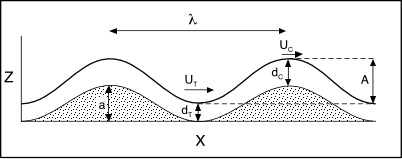
Starting with a simple configuration of antidunes with an amplitude (a) and wavelenth (lamda l). Flow over the trough and crest is supercritical, meaning that at both the trough and crest the ratio of flow velocity (U) to the square root of flow depth (d) times gravitational acceleration is greater than one.
Supercritical flows respond to changes in bed elevation differently than subcritical flows. If a supercritical flow encounters positive feature on the bed (like a mound sticking up in the flow), it responds by slowing down and increasing in depth (Middleton and Southard, 1984). Similarly, for a negative feature, the flow becomes faster and shallower.
With antidunes, the crest is a positive feature on the bed, while the trough is a negative feature. The flow responds so that the flow velocity in the trough (UT) is greater than the flow velocity at the crest (UC), while the flow depth in the trough (dT) is less than the flow depth at the crest (dC).
6:40:59 PM 
|


