Patterns of Erosion and Deposition in Antidune Flow
The distribution of shear stress along the bed drives sediment transport (Middleton and Southard, 1984), with the sediment discharge in the flow being a function of the bed shear stress. Sediment discharge is greater where bed shear stress is greater, because the higher bed shear stresses can remove more sediment from the bed.
McLean and Smith (1986) indicate that changes in bed elevation with time (whether the sediment is being eroded from or deposited to the bed) is a function of sediment discharge along the bed in a two-dimensional flow. Which in turn is directly related to the bed shear stress. If you move along the bed from a zone of high sediment discharge to low sediment discharge, sediment will accumulate with time. Conversely if you move from a zone of low sediment discharge to high sediment discharge, sediment will be removed from the bed with time.
Because sediment discharge is directly related to bed shear stress, the points of maximum and minimum bed shear stress on the bed define boundary points between zones of increasing and decreasing sediment discharge. Erosion (removal of sediment from the bed over time) occurs where bed shear stress is increasing along the bed. Deposition (addition of sediment to the bed over time) occurs where bed shear is decreasing along the bed.
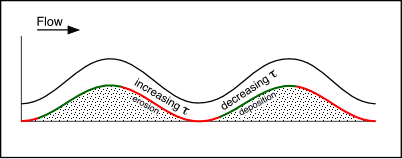
Now if you look at the patterns of bed shear stress along the bed and the resulting zones of deposition and erosion, you can see why antidunes migrate upstream and why they typically build in amplitude.
Starting the crest of the upstream antidune, there is a shear stress minimum just downstream of the crest. From this minimum, bed shear stress increases along the downstream side of the bedform to a maximum just downstream of the trough. Erosion occurs along this interval.
Moving on from this bed shear stress maximum, bed shear stress drops along the upstream side of the bedform, as the flow slows down and gets deeper, to the bed shear stress minimum just downstream from the crest. Depostion occurs in this interval of decreasing bed shear stress.
The result is that sediment is added to the upstream side of the bedform and removed from the downstream side. As this happens, the bedform moves upstream. Similarly, since the trough is in a zone of erosion and the crest is in zone of deposition. The bedform will build in amplitude over time.
3:40:12 PM 
|


