| |
 |
Wednesday, June 26, 2002 |
The June 28 Chronicle of Higher Education has a de .... The June 28 Chronicle of Higher Education has a debate on the question whether university presses are endangered. Malcolm Litchfield argues that they threatened by (1) their own drift toward commercial publishing and (2) library experiments with digital publishing. Niko Pfund argues that they are not threatened, and in fact are assured survival precisely because they straddle the academic and commercial worlds.
In his piece, Litchfield also proposes a kind of institutional eprints archive to replace much of the function of a university press, though he needlessly complicates it by suggesting that faculty transfer to their institution non-exclusive electronic rights to publish their academic writings. He also suggests that retroactive peer review could replace and improve upon the current system of prospective peer review. (I've often argued in FOSN that retroactive peer review can reduce the cost and shorten the delay of scholarly publication.) [FOS News]
I'm intrigued by the practice of "retroactive peer review". Must learn more. Is this like putting the article out there and seeing what happens, building a system/practice that will let the stuff that gets good peer review to rise to the top (so to speak).
2:11:44 PM 
|
|
XML in Mozilla 1.0. We all know of Mozilla's prowess when it comes to supporting standards such as HTML and CSS. But what does it have to offer XML enthusiasts? Michael Classen reports. 0625 [WebReference News]
Great article -- gotta download Mozilla 1.0 to play with its XML features...
2:04:13 PM
|
|
Gillmor on corporate criminals. 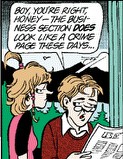 Dan Gillmor blasts the corporate crooks whose transgressions fill today's newscasts, greedy bastards who milked billions from their companies, betraying their shareholders. Dan thinks they're aberrant, and that their worst sin is making investors believe that there's no way for the little guy to win. I wonder how aberrant they are -- these are fly-by-night operators; the perps in these billion-dollar, economy-destroying felony crimes are seasoned CEOs and CFOs, people who come from the ranks of Big Five consulting firms and out of world-renowned B-schools. These crooks are the kinds of talking hairpieces that VCs like to parachute into startups to get them ready for IPO; they're the kinds of back-slapping cap-toothed glad-handers who know how to talk to the investment bankers. Some days, I believe that the only way to get to the top of a venture-funded or public company is to check your morals at the door. Dan Gillmor blasts the corporate crooks whose transgressions fill today's newscasts, greedy bastards who milked billions from their companies, betraying their shareholders. Dan thinks they're aberrant, and that their worst sin is making investors believe that there's no way for the little guy to win. I wonder how aberrant they are -- these are fly-by-night operators; the perps in these billion-dollar, economy-destroying felony crimes are seasoned CEOs and CFOs, people who come from the ranks of Big Five consulting firms and out of world-renowned B-schools. These crooks are the kinds of talking hairpieces that VCs like to parachute into startups to get them ready for IPO; they're the kinds of back-slapping cap-toothed glad-handers who know how to talk to the investment bankers. Some days, I believe that the only way to get to the top of a venture-funded or public company is to check your morals at the door.
Rational people are starting to assume something that isn't necessarily true. They're becoming convinced that the system is hopelessly, irrevocably rigged against everyday investors by a corrupt cadre of insiders in boardrooms and on Wall Street, willfully assisted by regulators and elected officials who are either corrupt themselves or simply blind.
None of this excuses the greed that turned many of those currently rational people into greedmongers themselves. Every financial bubble brings out the sharks, and the smaller fish tend to swim en masse into the killing zone. Link Discuss [Boing Boing Blog]
2:02:02 PM
|
|
Darwin: The Semantic Argument Web. David Weinberger. I fear that the Semantic Web will go the way of SGML and for basically the same reason: normalization of metadata works real well in confined applications where the payoff is high, control is centralized and discipline can be enforced. In other words: not the Web. [Tomalak's Realm]
Just read the article. I have to agree with it for the most part. I think in terms, however, of promoting at least small amount of metadata, see how people do with them (that is, what software arises to take advantage of the metadata, how users use them, etc) and to add more. We need to build an infrastructure that lets us incrementally add more metadata without undoing previous work. Weinberger's last paragraph makes this type of point. We also have a bit of a chicken-and-egg problem. Why put much effort into metadata if there are no tools for them? Why build tools if there aren't metadata to enter? We can start slow and easy and see what happens.
1:40:16 PM
|
|
How MIT's OpenCourseWare Will Change E-Learning. MIT's OpenCourseWare project will make virtually all of the school's course content available free on the Internet--and will transform the e-learning industry. In this new e-learning space, companies can add value by increasing interaction; tailoring, assembling, and re-purposing content; becoming certification authorities; innovating with technology; and innovating with pedagogy. [elearningpost]
The author should take a look at slides from a talk that Hal Abelson gave at UC Berkeley last fall. Here is an argument for how OCW actually is aligned with MIT's mission:
- Digitial distribution increasingly commoditizes content, which helps sharpen our focus on substantive values of residential education: personal attention from faculty and participation in learning and research communities.
- "Giving it away" helps defuse complex intellectual property issues of ownership and control that can otherwise distract the university from its mission to disseminate knowledge.
Good quotes from other parts of his set of slides:
I'd like to publicize the phrase 'commons of the mind,' which is due to Jamie Boyle, who is a theorist of intellectual property at Duke. The 'commons of the mind' is a kind of mental ecology that certain of us live in that has to do with free-flowing and free-exchanging ideas. It is important to use economic jargon that this ecology, like a real environment, is largely non-rivalrous and non-exclusionary. Like the real environment, the 'commons of the mind' is being threatened by various kinds of pollution these days. That pollution largely consists of people asserting intellectual property rights. What a university does, by and large, is to try to feed on this natural resource, and it's important that it does so.... But I worry that the pressures that we're talking about, the investment pressures that Michael Goldstein brought up, of having to recover your investment and thinking about capitalization, will start to undermine this 'commons of the mind' for universities, and will make our lives much more difficult.
But, in any case, in cold business terms, forget about altruism; if you're producing an entire thing and there's a value chain, and you find your unique differentiator, it is to your advantage to commoditize the rest of the value chain. This is why IBM is putting so much money into Linux and open source. It's really wonderful that people see tremendous benefits to the world from what M.I.T. is doing, but I do not view this as altruistic. I view it as a way to help preserve university values in the face of the threat of commercialization of this thing called "courseware."
6:36:20 AM
|
|
© Copyright 2002 Raymond Yee.

|
|
|
|
| June 2002 |
| Sun |
Mon |
Tue |
Wed |
Thu |
Fri |
Sat |
| |
|
|
|
|
|
1 |
| 2 |
3 |
4 |
5 |
6 |
7 |
8 |
| 9 |
10 |
11 |
12 |
13 |
14 |
15 |
| 16 |
17 |
18 |
19 |
20 |
21 |
22 |
| 23 |
24 |
25 |
26 |
27 |
28 |
29 |
| 30 |
|
|
|
|
|
|
| May Jul |

|
|


