The Rosetta Stone has long been believed to be black basalt.
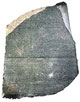
However, according to Cpl John M Shewfelt:
The black colour is the result of printer's ink applied in 1799. After the discovery of the stone during Napoleon's campaign in Egypt, the ink was applied so that copies of the inscriptions could be sent back to Europe.
Over the years, other substances were applied to or accumulated on the stone, including carnauba wax and handling grease. Of course, two centuries of being pawed over by the oily mitts of researchers contributed as well!
The false color is a technological by-product of attempts to copy the Stone so it could be transcribed, interpreted and disseminated.
The stone itself turned out to be a dark grey granite-like stone with a pinkish hue and a pink vein at the top, says Shewfelt.


