Updated: 9/7/02; 3:37:59 PM.
Information Management
Items dealing with various ways to use information.
        

Sunday, August 04, 2002

Personal KM - PEP.

Radio Free Blogistan - PEP (Personal Expression Project). This sounds like what I would like to have. I would like to be able to access control what goes in my blog. Some stuff for family, some for friends, some for work, some for the public etc. Still digging!For several years now I've been slowly spec'ing out an ideal personal publishing platform for posting a peck of pickled peppers.... Uh, sorry. No, actually I mean a system with a well designed content database at the core and a great deal of flexibility both in how to submit content (client, web, email, handheld, wireless?) and an equal degree of flexibility about how to stream or syndicate the content out. [Roland Tanglao's Weblog]

Until I can get one of these, my Radio weblog will have to do (and it's doing OK).

[McGee's Musings]
6:50:57 PM    comment []

KM at scale.

More content categorizers..

Information overload.

We cope but it isn't getting much better.

And sometimes finding what we're looking for is like a needle in a field of haystacks. Or a leaf in forest of trees.

Search alone is rarely enough to find what you need in very large data spaces. For example, Google search results and Monster candidate listings often return thousands of close hits. Matching engines efficiently apply criteria to a two-sided search (both employer and worker have demands to be met and supply ways to meet the others' demands).

Taxonomies are another approach. Yahoo! and Open Directory show the value of navigating through clumps and clusters of related sites. But you have your own data to mine. And creating a taxonomy by hand is expensive and slow. 

Enter taxonomy helpers. They do several things:

  • Analyze source files: Suck metadata from your diverse resources (documents, web pages, emails, news feeds, etc.) into a common and comparable format
  • Define clusters: Help define your topics and how the topics are related. This is compute and storage intense, so it is often done bit by bit. Starting with broad categories and refining and splitting them as they fill up.
  • Categorize: Assign each resource into one or more categories in the taxonomy, typically using metadata.
  • Serve: Manage a user experience for surfing or flying through the taxonomy.

Here's a roundup on some shipping categorizers.

First, I noted Quiver, a tool that recommends topics for human review and approval.

Back in April, eContent Magazine wrote a piece on Taxonomy's Role in Content Management.

Taxonomy technology greatly assists the sharing of enterprise knowledge. But don't expect to sit back and watch it go. Experts agree that those searching for an out-of-the-box solution shouldn't hold their breath. Count on adding a little elbow grease, but the results will be worth it.

They mentioned taxonomy vendors:

Autonomy creates and maintains outlines using pattern and cluster analysis. Separate components analyze documents for their content and categorize them to taxonomy branches and leaves.

Inxight Software's Categorizer filters, classifies and delivers content to users and corporate knowledge bases. It scales to millions of documents and thousands of topics in multiple languages. A sister product, MetaText Server elicits structured data from unstructured sources.   

Lotus Discovery Server extracts, analyzes, and categorizes structured and unstructured content to reveal the relationships between the information as well as the people, topics, and user activity in an organization.

Microsoft's SharePoint Portal Server has manual content categorization features.

Semio's SemioTagger autocategorizes content.

Sopheon autocategorizes content from multiple sources, including sources external to the enterprise.

They also pointed out taxonomy visualization sites.

Antarcti.ca uses cartography to map clusters of information spatially.

Inxight VizServer's Star Tree (shown here) and Table Lens help you to meaningfully surf large dataspaces.

TheBrain Technologies
www.thebrain.com

Now eWeek reviews three more products in this space:

eWeek's overview of the comparison findings is worth reading as is their eVal Scorecard: Content Categorization. Note they used very small record sets, the low thousands. Even a small company will organize hundreds of thousands of records, if not millions.

One last note. Standards in this area are few and rarely implemented. These few are RDF (Resource Description Framework), DAML (DARPA Agent Markup Language), and DAML+ OIL (Ontology Inference Layer).

Now where should I categorize this post?

[a klog apart]

An excellent overview and summary. These are critical issues to managing KM problems at scale.

[McGee's Musings]
6:49:58 PM    comment []

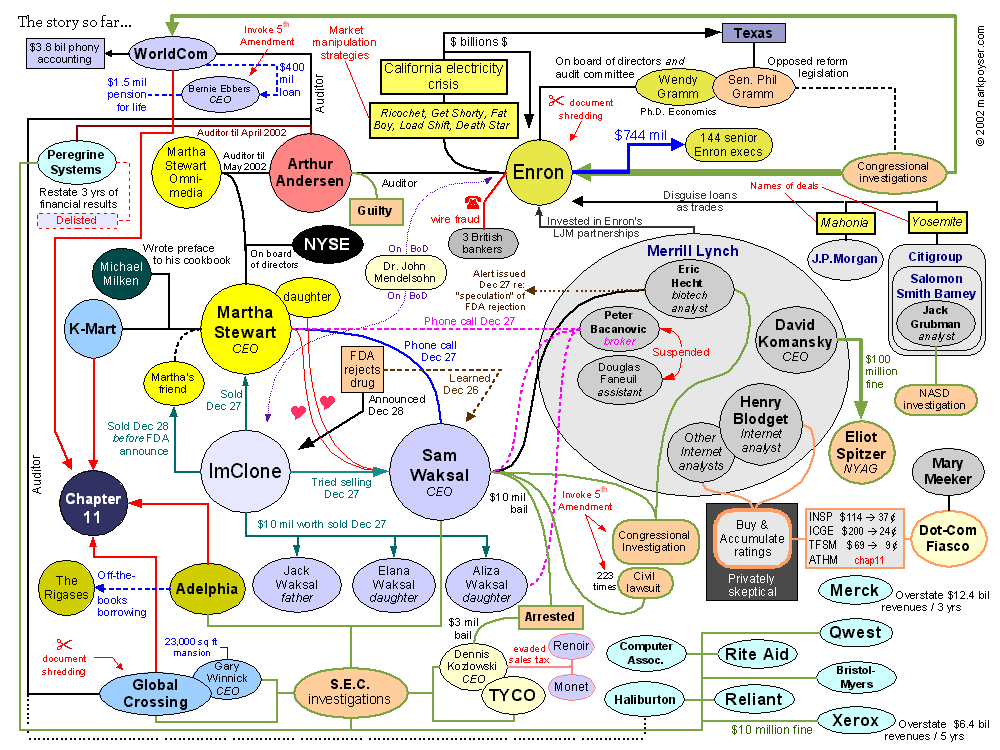
Many Scandals Loosely Joined.

Forwarded via Tim Hiltabiddle via an unknown source, apparently initiating somewhere in Juniper Networks, here's a map of the unfolding scandals. (Click on the snippet below to see the entire illustration.)

[JOHO the Blog]
6:44:37 PM    comment []

Tivo-WAN.

Network-enabled Tivo

"I recently got networkworking on my Tivo. This allows me to do a lot of things I couldn't do before. For example, I can control the Tivo from any computer that's connected to the Internet. I can add season passes remotely, control what's currently playing, delete shows, etc. There are a lot of possibilities.

One thing Tivo people like to do is compare and contrast the things their Tivos record for them. So I figured I'd make it easy for people by putting all that information up on the web. On my new Tivo page, you can see what's currently playing (even if nobody is currently watching it). You can also see the full list of shows now showing, all of my season passes and the todo list. Maybe someday I'll even get a screen capture of what's currently playing." [lukwarm.com, via life - listed chronologically]

I am strangely fascinated by these lists on Lukas' site. I want this for my ReplayTV!! We need neighborhoods, aggregators, and rankings for sharing these types of lists.

I actually probably would share my ReplayTV lists because I wanted to, but not if the entertainment industry demanded it. Too bad they don't understand how to work with their customers instead of repeatedly antagonizing them.

[The Shifted Librarian]
5:34:21 PM    comment []

myOnlineLife.

Wow - while I was on vacation, I missed the release of myRadio.

"This Tool extends the Radio Userland aggregator from rss to any networked data (xml, html, soap, personalized services, etc), and any layout. It is exceedingly simple for developers to add functionality to the framework. The GUI (screenshot) is reminiscent of My Yahoo! and other server based personalization tools.

The goal of this project is to very quickly bring all the functionality of server based personalization to the client, then use the client based architecture to develop way beyond!"

That's one giant leap....

If you've installed this tool, can you please let me know how it's working for you? My mind is exploding with the idea of how to set up this type of digital dashboard for each member of our staff at SLS. Of course, masukomi is correct that we need authentication built into aggregators for the next logical steps in this process.

Imagine if database vendors RSS-ified their databases so that you could offer authenticated monitoring to your patrons. For example, what if my library subscribes to NewsIllinois (a database available to millions of Illinois residents, thanks to subsidized funding from the Illinois State Library) and I want to monitor it for items about libraries. If I could enter my library card number into my aggregator and the database sent out RSS notifications, summaries of new items could appear in my aggregator automatically. I could click on the link to view the full text because the link would already have the authentication embedded in it.

Just think what this type of functionality could provide for lawyers, doctors, journalists, and other specialists. All flowing through the library's resources!

[The Shifted Librarian]
5:33:19 PM    comment []


© Copyright 2002 Mark Oeltjenbruns.
 
August 2002
Sun Mon Tue Wed Thu Fri Sat
        1 2 3
4 5 6 7 8 9 10
11 12 13 14 15 16 17
18 19 20 21 22 23 24
25 26 27 28 29 30 31
Jul   Sep


Click here to visit the Radio UserLand website.

Subscribe to "Information Management" in Radio UserLand.

Click to see the XML version of this web page.

Click here to send an email to the editor of this weblog.