Geo-contextual interface - on a smaller scale.
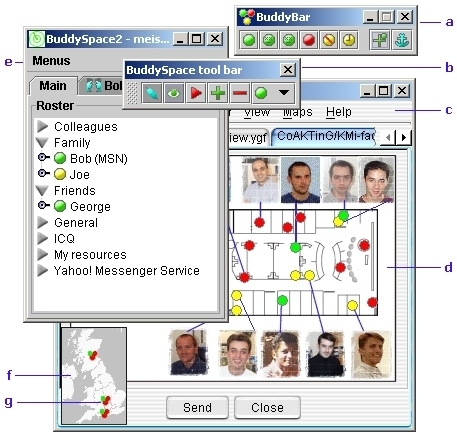
BuddySpace.  Now that the notion of presence is beginning to infuse our electronic communication, an inevitable next question is: presence where? Marc Eisenstadt, chief scientist at the Knowledge Media Institute of the Open University in the UK, wrote to show me a Jabber-based system called BuddySpace that locates presence indicators on maps. In the map shown here, Marc (top row, third photo from right) is present in the office, but idle. Martin Dzbor (bottom row, far right), KMI's "chief presence architect," is present and active. And that little dot on the US map, in New England, is me, present and active. ... [Jon's Radio]
The first time I heard of those 'radio' badges that broadcast where you are - was in the context of Xerox PARC. Apparently behavior patterns changes - when people know that others know where they are. There was only one 'safe spot' that the badges didn't work from - the toilet.
Then I heard that - when you visit Bill Gates' mansion - they hand you a badge - that not only keeps track of where you are, but also enables the 'dynamic' paintings to change to suit your preferences and tastes. Kewl!
Now we have 'enhanced presence management' from these Brits! Totally Kewl! It's built with Jabber and cleanly integrates into the existing IM world.
This is clearly a major piece of the 'digital lfiestyle'. Of course - the only trick is to us this sort of technology for GOOD rather than some Big Brother nightmare.
There are so many great applications for this - from managing and running a meatspace event - where it's imperative that you keep track of where everyone is - and making sure they're doing their job or tasks.
Or for kids - at school. We'd be able to let them run around more freely if we could just track their movements.
But one things for sure - it would sure fit into the concept of multimedia conversations!
Here's some of what Marc [Eisenstadt] says about BuddySpace:
The nice thing with BuddySpace is the 'feelgood' factor: like returning to the office late at night and seeing a few key lights on, knowing that certain people are in... more compelling with an office layout rather than a list...even better is your perceptual ability to spot the ABSENCE (or 'busy state', etc) of someone at a glance on a map you know, rather than having to scan a list...even a well-organised hierarchy is hard to scan rapidly.
[back to Jon Udell]
Cool! It's going to get even more interesting when location becomes dynamic. We had that for a while, with phones, when caller ID meant not only "who" but also "where." Then, with cellphones, the "where" went away. We'll get that information back soon, and when we project it onto maps, collaboration in virtual teams will seem a little less abstract.
[Marc's Voice]
I can't even react to this. Hurts my head. [


