Seb does it again. Towards Structured Blogging.

Lately I've been thinking about how we could evolve blogging tools to allow people to author more structured (dare I say semantic?) content, so that other people could find their stuff that they find of interest more easily.
Right now what we have, globally speaking, is pretty much a huge pool of blog posts, each implicitly tied to a particular weblog author and with a date slapped on. Now, say I've written a review of the latest Radiohead album into my blog. I'd like others who are interested in Radiohead, or in music reviews in general, and who may not know me, to be able to pick out my review from the common pool in a simple way. Interesting people may come my way because of this.
What we're talking about is getting people to put more metadata on their content. Now allowing it is one thing, and fostering it is another. And I'd say the latter is the bigger challenge.
The importance of feedback
I believe a critical element to get a sustainable system is for people to get reasonably quick feedback in return for the extra effort expended in creating metadata. The Internet Topic Exchange, in which Phillip Pearson implemented the ridiculously easy group-forming design, seems to work because it has a short feedback loop, and might provide a template for where we'd like to go. Here's an illustration of how the Internet Topic Exchange works:

People (on the left) associate select posts with particular topics by specifying a Ping URL; TrackBack carries information about their posts into the Exchange (the fat square), and from there they make it into open topic-specific blogs (on the right). (I don't need to talk about the per-topic Wiki pages here.) Creating a new topic is as easy as inventing a name - anyone is allowed (and encouraged) to do it.
Now, people interested in particular topics will watch them, and this is where the fun comes from. Look at the figure above. Say John (the yellow guy) doesn't know Elaine (the purple girl). But he watches Topic 1 dutifully. Now Elaine happens to come across the channel for Topic 1 and posts to it because she's also interested in Topic 1. Soon John gets her post in his aggregator, checks out her blog, and voilà, he's found a like mind.
In this case the metadata that we have managed to get John, Elaine and others interested in consists of a simple topic identification. This simple scheme has helped such groups as spanish bloggers, emergent democrats, and Austin bloggers coalesce.
Beyond topics
How might we work our way from this model to a different form of metadata, say a music review? Here's a possibility. We retain the basic architecture of the Exchange, but add a new type of blog post called "music review". A drop-down box might enable me to select between "plain-vanilla blog post" and "Music Review". The interface for entering a "Music Review" post might look like this:

(Here I'm assuming there is some sort of standard for music reviews composed of a title, an identification code for the piece of work being reviewed, a rating, and some text. If you know of a similar existing standard please let me know.)
In an ideal world, the "Find" button would pop up an assistant that lets you dig into a music metadatabase (say, MusicBrainz) and quickly home in on an unambiguous ID code for whatever it is you're reviewing (possibly asking you to contribute to the metadatabase if it doesn't know about this piece of work), and puts it in the box.
You fill in the other boxes, click "Post", and your part is pretty much done. Next the system does three things. First, it stores the review in a non-lossy format somewhere on your site. Second, it converts your input into a regular blog post to put in your blog and RSS feed. Third, it notifies one (or more) central indexing service(s), analogous to the Topic Exchange, that knows about music reviews, of the availability of your new review and of its location. This central service also serves a variety of RSS feeds. There could be song-based feeds, album-based feeds, artist-based feeds, genre-based feeds, etc. that you can subscribe to. You could subscribe to the "Radiohead songs and albums" feed and get all reviews of Radiohead songs and albums as soon as they come out. Or maybe you just want to be notified whenever someone reviews a certain song you especially like.
As in the case of the Topic Exchange, these RSS feeds are where the feedback (and the addictive quality) comes from and how new interpersonal links form and people cluster.
Putting it all together
Now to generalize. I talked about music reviews, but the scheme should also work with other kinds of content. Music video reviews, movie reviews (using IMDB?), ad reviews, TV show reviews, game reviews, radio station reviews, weblog reviews, restaurant reviews (perhaps using GPS data), scholarly article reviews... other kinds of content that are not reviews also, such as song lyrics, TV show transcripts, quotes, self-identification data.
Each of these would have (one or more) standard format(s). The basic idea is to let the blogging system support "alternate post type" plug-ins. Anyone should be able to develop such a plug-in (and a corresponding indexing service) for a new kind of post that they want.
If something like this were to become successful it would compete with a host of commercially led user-contributed databases such as Amazon's review database. One advantage would be to put control more firmly in the hands of contributors.
Will people care enough about having their writings under their own control and collected in one place to move away from such databases? I think they might. I know I do.
Other people are thinking along similar lines: Danny Ayers, Alf Eaton, Marc Canter, Sam Ruby, Ben Trott, Karl Dubost, to name a few. It would be nice to make something like this happen in 2003.
[Seb's Open Research]
Seb is so right on. First he does the Personal Knowledge Publishing rap, then he wrote about the collective mind "web-enabled group minds at work" - and he's been tracking the TopicExchange for a while. he's also been the ONLY person so far, besides me - who has contributed to the Topic Exchange channel I created - 'theMatrix'. [Marc's Voice]
6:24:24 AM 
|


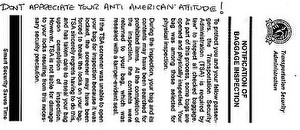 A traveller flying to San Diego from Seattle found his luggage had been opened by the Federal Transport Security Authority, who had left behind a note telling him so, on which was scrawled "DONT APPRECIATE YOUR ANTI-AMERICAN ATTITUDE" -- a reference to the "No Iraq War" signs he'd picked up in a shop in Seattle.


