|
 |
Tuesday, February 04, 2003 |
pr0nt1n65: hyper-pixelated porn images --> art. Snipped from Mt. Molelog:
 pr0nt1n65: Very low-res oil paintings that, from a distance, appear to be pornographic. Up close, they're just squares of color, though. So where's the smut -- on the canvas, or in our heads? If the answer is the latter, then where's the smut on a computer or TV screen, which is just the same thing, but with better resolution? There are now prints available (hallelujah!). Mind you, these are "giclee prints", which seems to be art-world speak for "ink-jet printout" -- so, these are high-resolution automated digitally pixellated versions of low-resolution manually analog pixellated versions of porn scenes. pr0nt1n65: Very low-res oil paintings that, from a distance, appear to be pornographic. Up close, they're just squares of color, though. So where's the smut -- on the canvas, or in our heads? If the answer is the latter, then where's the smut on a computer or TV screen, which is just the same thing, but with better resolution? There are now prints available (hallelujah!). Mind you, these are "giclee prints", which seems to be art-world speak for "ink-jet printout" -- so, these are high-resolution automated digitally pixellated versions of low-resolution manually analog pixellated versions of porn scenes.
"When I was 8 or 9 years old, I acquired a split beaver magazine. You can imagine my disappointment when, upon examination of the photos with a microscope, I found that all I could see was dots."
Link to images (they're explicit, but work-safe 'cause they're all chunky-pixelated!) Discuss (Via Reverse Cowgirl's Blog) [Boing Boing Blog]
This just strikes me as a cool idea. I wonder what other type of pixelated images will be next. Maybe a Mosaic picture made up of a bunch of these types of pictures.
7:42:58 PM 
|
|
Tiny Whiskers Make Huge Memory Storage.
When we hear about ever-increasing disk storage capacity, we usually read about new engraving technologies. Not here. Charles Choi has the story.
New, tiny magnetic sensors could help break a technical barrier to ushering in the next generation of computer disk storage capacity, researchers reported Friday.
The sensors, filaments of nickel thinner than a wavelength of visible light, are capable of detecting extremely weak magnetic fields.
Although it is already possible to increase hard drive storage capacity many times, the process has lagged because technology has not existed to read the data signals, researcher Harsh Chopra, a materials scientist at the State University of New York in Buffalo, told United Press International.
Here comes the fascinating part of the article.
In findings to be published in next July's issue of the journal Physical Review B, Chopra and physicist Susan Hua described sensors they have developed that are both small and sensitive to improve the density of hard drives.
The sensors are actually microscopic whiskers of nickel only a few atoms wide. Each of the filaments can read infinitesimal magnetic fields and at room temperature can detect a 100,000 percent change in voltage.
For comparison, he explained, imagine normal magnetic sensors can read a signal that begins with a strength of 1 and swings between an "off" reading at 0.8 and "on" at 1.2. The new sensors can read a range that swings between minus 1000 and plus 1000. That degree of sensitivity means terabits of data -- or trillions of bits -- could be crammed into a square inch of disk space.
Don't expect to see these devices anytime soon: "The normal cycle for [such technologies] from discovery to implementation is about six to eight years," Chopra said.
Source: Charles Choi, United Press International, February 3, 2003 [Roland Piquepaille's Technology Trends]
7:29:36 PM
|
|
Transparent clothes. Tokyo researchers have developed "transparent" clothing which crudely paints the clothing on one side of you with the scenery on the other side of you.
The team has said that the system is still less than perfect. Unless an observer is looking in roughly the same direction as the video camera, the clothes will not be a perfect match with the background.
The claimed uses are for things like surgery, allowing a surgeon to effectively see through their hands. Link Discuss [Boing Boing Blog]
7:24:55 PM
|
|
BuddySpace.
Geo-contextual interface - on a smaller scale.
BuddySpace.  Now that the notion of presence is beginning to infuse our electronic communication, an inevitable next question is: presence where? Marc Eisenstadt, chief scientist at the Knowledge Media Institute of the Open University in the UK, wrote to show me a Jabber-based system called BuddySpace that locates presence indicators on maps. In the map shown here, Marc (top row, third photo from right) is present in the office, but idle. Martin Dzbor (bottom row, far right), KMI's "chief presence architect," is present and active. And that little dot on the US map, in New England, is me, present and active. ... [Jon's Radio] Now that the notion of presence is beginning to infuse our electronic communication, an inevitable next question is: presence where? Marc Eisenstadt, chief scientist at the Knowledge Media Institute of the Open University in the UK, wrote to show me a Jabber-based system called BuddySpace that locates presence indicators on maps. In the map shown here, Marc (top row, third photo from right) is present in the office, but idle. Martin Dzbor (bottom row, far right), KMI's "chief presence architect," is present and active. And that little dot on the US map, in New England, is me, present and active. ... [Jon's Radio]
The first time I heard of those 'radio' badges that broadcast where you are - was in the context of Xerox PARC. Apparently behavior patterns changes - when people know that others know where they are. There was only one 'safe spot' that the badges didn't work from - the toilet. 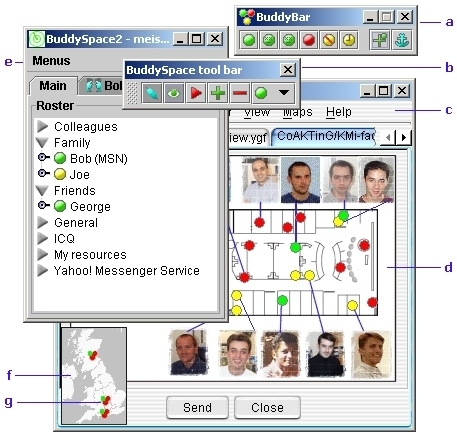
Then I heard that - when you visit Bill Gates' mansion - they hand you a badge - that not only keeps track of where you are, but also enables the 'dynamic' paintings to change to suit your preferences and tastes. Kewl!
Now we have 'enhanced presence management' from these Brits! Totally Kewl! It's built with Jabber and cleanly integrates into the existing IM world.
This is clearly a major piece of the 'digital lfiestyle'. Of course - the only trick is to us this sort of technology for GOOD rather than some Big Brother nightmare.
There are so many great applications for this - from managing and running a meatspace event - where it's imperative that you keep track of where everyone is - and making sure they're doing their job or tasks.
Or for kids - at school. We'd be able to let them run around more freely if we could just track their movements.
But one things for sure - it would sure fit into the concept of multimedia conversations!
Here's some of what Marc [Eisenstadt] says about BuddySpace:
The nice thing with BuddySpace is the 'feelgood' factor: like returning to the office late at night and seeing a few key lights on, knowing that certain people are in... more compelling with an office layout rather than a list...even better is your perceptual ability to spot the ABSENCE (or 'busy state', etc) of someone at a glance on a map you know, rather than having to scan a list...even a well-organised hierarchy is hard to scan rapidly.
[back to Jon Udell]
Cool! It's going to get even more interesting when location becomes dynamic. We had that for a while, with phones, when caller ID meant not only "who" but also "where." Then, with cellphones, the "where" went away. We'll get that information back soon, and when we project it onto maps, collaboration in virtual teams will seem a little less abstract. [Marc's Voice] I can't even react to this. Hurts my head. [The Universal Church Of Cosmic Uncertainty]
7:22:40 PM
|
|
© Copyright 2003 Mark Oeltjenbruns.
|
|
|


