NewsStream Pick of the litter from my aggregated feeds -- Summarized
| April 2005 | ||||||
| Sun | Mon | Tue | Wed | Thu | Fri | Sat |
| 1 | 2 | |||||
| 3 | 4 | 5 | 6 | 7 | 8 | 9 |
| 10 | 11 | 12 | 13 | 14 | 15 | 16 |
| 17 | 18 | 19 | 20 | 21 | 22 | 23 |
| 24 | 25 | 26 | 27 | 28 | 29 | 30 |
| Mar May | ||||||
SOA: Refactoring Mainframe Applications into Dynamic Web Applications (Part 1). [DevX: Latest Web Development Content 3/17/2005; 12:53:06 AM] By refactoring your mainframe applications into Web services you separate presentation from logic, and gain the ability to reuse mainframe data in Web applications. This two-part article describes the complete process.
4/2/2005 8:43:54 PM 
Web Services Come Into Balance. [eWEEK Developer 3/15/2005; 3:52:25 PM] Maturing service scene requires more robust application design. Developers who had built applications that consume the PayMaxx services must now confront the need for a fallback strategy. It's always been part of the Web services proposition that an application had to deal with dependence on resources that were not under the application owner's control. That theoretical concern is now demonstrably real. Using tools such as UDDI to identify and engage alternative service providers, with or without an intermediate layer of value-added services support, looks like the next step in the process of Web services adoption. See also:
- Web Services Come Into Balance: Maturing service scene requires more robust application design.
- A href="http://www.eweek.com/article2/0,1759,1745776,00.asp">Systems Must Be Designed to Doubt: Sensors, business rules and cultivated paranoia yield customer-facing apps that can cope with unfortunate events. 4/2/2005 8:35:29 PM
Reason Magazine: "It's Mainly Just for Fun" [NASA Watch 4/2/2005; 6:53:18 PM] Interview with space entrepreneur Burt Rutan on how private space flight policy should emphasize innovation, safety—and having a helluva good time.
 "When people think of the Wright brothers they think of 1903. I think a more important thing to look at when you make the point you're making is 1908 to 1911, early 1912. We're talking about only a three and a half year time period that started when only 10 people had flown, and ended three and a half years later when thousands of pilots flew hundreds of airplanes in 39 countries."
"If you think about it, until we had the Internet, we didn't know what computers were really for. Now it's our communication, it's our commerce, it's our—everything. I like to think that's what suborbital space tourism is; it's going to be a big industry. Just like personal computers. But it's mainly just for fun. You've got to have thousands, tens of thousands, of people enjoying it in order to figure out what to do with it. We never would have invented the use of the Internet, the communication, and the commerce, and everything if you had just a few dozen people with computers. 4/2/2005 7:16:32 PM
 NASA on your iPod. [Science @ NASA 3/21/2005; 2:52:21 PM] Using an iPod or any portable MP3 player, you can now explore the universe while driving, jogging, waiting in line ... just about anywhere. It's easy: tune in to the Science @ NASA podcast. Podcasting is a new technology that lets you search for audio broadcasts on the Internet - so-called "podcasts" - and download them onto portable MP3 players. You can take a podcast with you and listen to it whenever and wherever the mood strikes. ScienceANASA has been providing audio recordings of science news stories for years. Last December, the site began podcasting those stories. By February, Science @ NASA was the #1 most popular podcast among users of the Podcasting News website.
4/2/2005 6:43:15 PM
NASA on your iPod. [Science @ NASA 3/21/2005; 2:52:21 PM] Using an iPod or any portable MP3 player, you can now explore the universe while driving, jogging, waiting in line ... just about anywhere. It's easy: tune in to the Science @ NASA podcast. Podcasting is a new technology that lets you search for audio broadcasts on the Internet - so-called "podcasts" - and download them onto portable MP3 players. You can take a podcast with you and listen to it whenever and wherever the mood strikes. ScienceANASA has been providing audio recordings of science news stories for years. Last December, the site began podcasting those stories. By February, Science @ NASA was the #1 most popular podcast among users of the Podcasting News website.
4/2/2005 6:43:15 PM
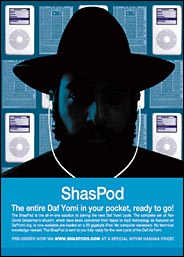 2,000 Talmud tapes, or one loaded iPod. [Michael Gartenberg 3/21/2005; 11:53:21 AM] Or you could just buy yourself an iPod or any MP3 player and download the files yourself here for free.
The Daf Yomi is a seven-and-a-half-year cycle of Talmud learning. Participants study a page a day of this compendium of Jewish oral law, culminating in a celebration, known as the Siyum HaShas. But how do you study a 2,711-page book when you have to commute? With the ShasPad. For $399, Yehuda Shmidman sends his customers a 20-gigabyte iPod loaded with Talmud lectures. That is $100 above the price of an iPod alone. “We created this because of two glaring trends,” the entrepreneur said. “One is the iPod, and the other is the Siyum HaShas, which is something so incredible that when it happens you obviously want to join the next cycle.” The New York Times. 4/2/2005 6:32:12 PM
ZDNet UK: No Regrets for Newham. [Linux Today 4/1/2005; 5:54:52 PM] Newham Council thinks 'more than ever' that its decision to go for Microsoft-based systems over Linux-based alternatives was the right call. The council was at the centre of a major row between Linux advocates and Microsoft last year, following an evaluation of the benefits of Linux' and Microsoft's technologies — which concluded that Microsoft offered the best value. "In areas such as BizTalk Microsoft has products that have a real lead," said Newham’s head of ICT Richard Steell. The council is also working on a number of other projects including employee self-service and e-forms, as well as electronic monitoring systems in the home. But while it has a "Microsoft-centric" strategy, it still finds some room for open source: "We do use Linux in some areas such as for Web servers and have no immediate plans to discontinue." 4/2/2005 5:03:05 PM
The intrinsic appeal of telework [Globe And Mail 4/2/2005; 4:53:06 AM] The Canadian Telework Association estimates that more than 1.5 million Canadians work outside of regular offices, at least part of the time, connected electronically to their managers, employees or clients. At IBM Canada, 5,000 of the 20,000 employees are classified as "mobile workers." They work from home or from their cars if they travel a lot. They can book space in one of the "mobility centres" at 13 IBM locations across the country if they need to be at the office for a day or two. "Some of the feedback we've had from employees over the years is that they are a lot more productive and they don't have the interruptions [that often occur in an office setting]. Especially when they are doing work that requires a lot of concentration, they find it beneficial to work this way." 4/2/2005 3:51:01 PM
Best Buy to Eliminate Rebates [Slashdot: 4/2/2005; 1:53:29 AM] According to the Minneapolis Star Tribune 'In response to customer complaints, Best Buy, the world's largest electronics retailer, promised today to eliminate mail-in rebates within two years.' Can it be that we're finally nearing the end of one of the most hated marketing ploys of all? "Our customers are telling us they just hate the process," said Ron Boire, executive vice president and general merchandise manager at Best Buy. Further commentary available at BusinessWeek. 4/2/2005 3:47:04 PM
eTrust EZ Antivirus - 1yr FREE [RedFlagDeals.com 4/1/2005; 8:52:07 PM] Looking to protect your computer? Then head to My-ETrust.com. They’re giving away a free one-year trial of their EZ Antivirus Software. 4/2/2005 3:43:21 PM
What's missing in the digital hubs of today. [Michael Gartenberg 4/1/2005; 11:53:44 AM] Ian Fogg talks about some of his PC/TV issues here. He's totally correct. The PC, as it stands now is just too complex to serve this role for the average person. I've been using a Media Center PC as one of the hubs in the house and it works well for the most part. ... Except when it doesn't work. ... In short, the very flexibility of the PC is the Achilles heel for this device in the home. On the other hand, my TiVo is rock solid. It just works but is very limited in terms of overall flexibility of content and features. I want flexibility of content, the ability to add new features and rock solid reliability. I can't seem to get those things today which is what's leading to an ad-hoc series of solutions. Perhaps there's no good solution, for as soon as you open a platform for adding new features, you add inherent complexity and that tends to make things less reliable. So I'd be willing to live with a closed box for adding features but I insist on the flexibility of content portability that the PC offers me. For now, there's nothing like that on the market so I'll stick with using MCE but only in a very clean state. 4/2/2005 3:39:09 PM
BBC: Man implanted with chip that reads his mind. Only thing it does is turn TV on and off. [Fark 3/31/2005; 2:53:58 PM] A paralysed man in the US has become the first person to benefit from a brain chip that reads his mind. The device, called BrainGate, consists of nearly 100 hair-thin electrodes implanted a millimetre deep into part of the motor cortex of his brain that controls movement. Wires feed the information from the electrodes into a computer which analyses the brain signals. He can think his TV on and off, change channels and alter the volume thanks to the technology and software linked to devices in his home. 4/2/2005 3:31:58 PM
 Ultraviolet View of Mimas. [Universe Today 3/31/2005; 1:52:43 PM] NASA's Cassini spacecraft took this picture of Mimas, Saturn's "Death Star" moon on February 18, 2005 at a distance of 938,000 km (583,000 miles). The image was taken using Cassini's ultraviolet filter, which helps to reveal better contrast of the moon's craters than would be possible in visible light. Mimas' large crater Herschel dominates the upper right of the picture.
4/2/2005 3:25:49 PM
Ultraviolet View of Mimas. [Universe Today 3/31/2005; 1:52:43 PM] NASA's Cassini spacecraft took this picture of Mimas, Saturn's "Death Star" moon on February 18, 2005 at a distance of 938,000 km (583,000 miles). The image was taken using Cassini's ultraviolet filter, which helps to reveal better contrast of the moon's craters than would be possible in visible light. Mimas' large crater Herschel dominates the upper right of the picture.
4/2/2005 3:25:49 PM
HTML 4.01 Element Reference. [WebReference News 3/31/2005; 11:52:05 AM] HTML is the most basic and common language on the world wide web and is relatively easy to learn. If you've been looking for an excellent resource, this article contains the HTML 4.01 element (tag) list as recommended by the W3C. 4/2/2005 3:15:49 PM
The Register: Deutsche Bahn Dumps Intel, Pumps SUSE onto IBM Mainframe. [via Linux Today 3/31/2005; 9:52:12 AM] Deutsche Bahn, Europe's biggest railway, is junking 300 Intel servers in favour of an IBM mainframe. But its OS of choice, SUSE LINUX Enterprise Server, has profited from the cull and will run business-critical apps such as Lotus Notes on the new IBM eServer zSeries 990 mainframe. DB Systems, the captive IT service arm of Deutsche Bahn, anticipates "significant cost savings, more vendor independence and integration advantages throughout the roll-out period and beyond". ... 4/2/2005 3:13:21 PM
Do it yourself spyware? Maybe there's a less sinister use, too...
TypeRecorder v2.0.1 $15.99. "TypeRecorder records everything that you type on your computer. Every keystroke is saved to a daily file on your computer, available for immediate retrieval. This is especially useful if you want to have some degree of insurance in the case of system crashes, power outages, or any problem that would cause you to lose data. Any data that you enter with a keyboard will be discretely saved. TypeRecorder is also helpful in monitoring unauthorized use of your computer, as it can log the time and application being used when any key is pressed." via [Lockergnome's Windows Fanatics 4/1/2005; 1:53:01 AM] 4/2/2005 2:44:53 PM
Schiavo parents to sell donor data to direct-marketing firm. [Boing Boing 3/31/2005; 7:52:44 PM. (Thanks, Steve)] Xeni Jardin: The parents of rececently-deceased Terri Schiavo will sell their list of supporting donors to a direct-mailing firm. The company, "Response Unlimited" pays about $150 a month for 6,000 names and $500 a month for 6,000 e-mail addresses. A spokesperson for the Schindlers confirmed that they had agreed to sell the information, but won't say for how much. 4/2/2005 2:38:41 PM
NY Times: It's Not Just a Phone, It's an Adventure. [Tomalak's Realm 3/31/2005; 6:53:02 PM] Practically every new iteration of cellphone promises more: digital music, streaming video, 3-D video games, location-based navigation and full Internet browsing, not to mention a camera. With more features often come more buttons, complications and costs, and thicker operating manuals. 4/2/2005 2:18:02 PM
Web Services Come Into Balance. [eWEEK Developer 3/15/2005; 3:52:25 PM] Maturing service scene requires more robust application design. Developers who had built applications that consume the PayMaxx services must now confront the need for a fallback strategy. It's always been part of the Web services proposition that an application had to deal with dependence on resources that were not under the application owner's control. That theoretical concern is now demonstrably real. Using tools such as UDDI to identify and engage alternative service providers, with or without an intermediate layer of value-added services support, looks like the next step in the process of Web services adoption. See also:
- Web Services Come Into Balance: Maturing service scene requires more robust application design.
- A href="http://www.eweek.com/article2/0,1759,1745776,00.asp">Systems Must Be Designed to Doubt: Sensors, business rules and cultivated paranoia yield customer-facing apps that can cope with unfortunate events. 4/2/2005 8:35:29 PM
Reason Magazine: "It's Mainly Just for Fun" [NASA Watch 4/2/2005; 6:53:18 PM] Interview with space entrepreneur Burt Rutan on how private space flight policy should emphasize innovation, safety—and having a helluva good time.
"When people think of the Wright brothers they think of 1903. I think a more important thing to look at when you make the point you're making is 1908 to 1911, early 1912. We're talking about only a three and a half year time period that started when only 10 people had flown, and ended three and a half years later when thousands of pilots flew hundreds of airplanes in 39 countries.""If you think about it, until we had the Internet, we didn't know what computers were really for. Now it's our communication, it's our commerce, it's our—everything. I like to think that's what suborbital space tourism is; it's going to be a big industry. Just like personal computers. But it's mainly just for fun. You've got to have thousands, tens of thousands, of people enjoying it in order to figure out what to do with it. We never would have invented the use of the Internet, the communication, and the commerce, and everything if you had just a few dozen people with computers. 4/2/2005 7:16:32 PM
NASA on your iPod. [Science @ NASA 3/21/2005; 2:52:21 PM] Using an iPod or any portable MP3 player, you can now explore the universe while driving, jogging, waiting in line ... just about anywhere. It's easy: tune in to the Science @ NASA podcast. Podcasting is a new technology that lets you search for audio broadcasts on the Internet - so-called "podcasts" - and download them onto portable MP3 players. You can take a podcast with you and listen to it whenever and wherever the mood strikes. ScienceANASA has been providing audio recordings of science news stories for years. Last December, the site began podcasting those stories. By February, Science @ NASA was the #1 most popular podcast among users of the Podcasting News website.
4/2/2005 6:43:15 PM
2,000 Talmud tapes, or one loaded iPod. [Michael Gartenberg 3/21/2005; 11:53:21 AM] Or you could just buy yourself an iPod or any MP3 player and download the files yourself here for free. The Daf Yomi is a seven-and-a-half-year cycle of Talmud learning. Participants study a page a day of this compendium of Jewish oral law, culminating in a celebration, known as the Siyum HaShas. But how do you study a 2,711-page book when you have to commute? With the ShasPad. For $399, Yehuda Shmidman sends his customers a 20-gigabyte iPod loaded with Talmud lectures. That is $100 above the price of an iPod alone. “We created this because of two glaring trends,” the entrepreneur said. “One is the iPod, and the other is the Siyum HaShas, which is something so incredible that when it happens you obviously want to join the next cycle.” The New York Times. 4/2/2005 6:32:12 PM
ZDNet UK: No Regrets for Newham. [Linux Today 4/1/2005; 5:54:52 PM] Newham Council thinks 'more than ever' that its decision to go for Microsoft-based systems over Linux-based alternatives was the right call. The council was at the centre of a major row between Linux advocates and Microsoft last year, following an evaluation of the benefits of Linux' and Microsoft's technologies — which concluded that Microsoft offered the best value. "In areas such as BizTalk Microsoft has products that have a real lead," said Newham’s head of ICT Richard Steell. The council is also working on a number of other projects including employee self-service and e-forms, as well as electronic monitoring systems in the home. But while it has a "Microsoft-centric" strategy, it still finds some room for open source: "We do use Linux in some areas such as for Web servers and have no immediate plans to discontinue." 4/2/2005 5:03:05 PM
The intrinsic appeal of telework [Globe And Mail 4/2/2005; 4:53:06 AM] The Canadian Telework Association estimates that more than 1.5 million Canadians work outside of regular offices, at least part of the time, connected electronically to their managers, employees or clients. At IBM Canada, 5,000 of the 20,000 employees are classified as "mobile workers." They work from home or from their cars if they travel a lot. They can book space in one of the "mobility centres" at 13 IBM locations across the country if they need to be at the office for a day or two. "Some of the feedback we've had from employees over the years is that they are a lot more productive and they don't have the interruptions [that often occur in an office setting]. Especially when they are doing work that requires a lot of concentration, they find it beneficial to work this way." 4/2/2005 3:51:01 PM
Best Buy to Eliminate Rebates [Slashdot: 4/2/2005; 1:53:29 AM] According to the Minneapolis Star Tribune 'In response to customer complaints, Best Buy, the world's largest electronics retailer, promised today to eliminate mail-in rebates within two years.' Can it be that we're finally nearing the end of one of the most hated marketing ploys of all? "Our customers are telling us they just hate the process," said Ron Boire, executive vice president and general merchandise manager at Best Buy. Further commentary available at BusinessWeek. 4/2/2005 3:47:04 PM
eTrust EZ Antivirus - 1yr FREE [RedFlagDeals.com 4/1/2005; 8:52:07 PM] Looking to protect your computer? Then head to My-ETrust.com. They’re giving away a free one-year trial of their EZ Antivirus Software. 4/2/2005 3:43:21 PM
What's missing in the digital hubs of today. [Michael Gartenberg 4/1/2005; 11:53:44 AM] Ian Fogg talks about some of his PC/TV issues here. He's totally correct. The PC, as it stands now is just too complex to serve this role for the average person. I've been using a Media Center PC as one of the hubs in the house and it works well for the most part. ... Except when it doesn't work. ... In short, the very flexibility of the PC is the Achilles heel for this device in the home. On the other hand, my TiVo is rock solid. It just works but is very limited in terms of overall flexibility of content and features. I want flexibility of content, the ability to add new features and rock solid reliability. I can't seem to get those things today which is what's leading to an ad-hoc series of solutions. Perhaps there's no good solution, for as soon as you open a platform for adding new features, you add inherent complexity and that tends to make things less reliable. So I'd be willing to live with a closed box for adding features but I insist on the flexibility of content portability that the PC offers me. For now, there's nothing like that on the market so I'll stick with using MCE but only in a very clean state. 4/2/2005 3:39:09 PM
BBC: Man implanted with chip that reads his mind. Only thing it does is turn TV on and off. [Fark 3/31/2005; 2:53:58 PM] A paralysed man in the US has become the first person to benefit from a brain chip that reads his mind. The device, called BrainGate, consists of nearly 100 hair-thin electrodes implanted a millimetre deep into part of the motor cortex of his brain that controls movement. Wires feed the information from the electrodes into a computer which analyses the brain signals. He can think his TV on and off, change channels and alter the volume thanks to the technology and software linked to devices in his home. 4/2/2005 3:31:58 PM
Ultraviolet View of Mimas. [Universe Today 3/31/2005; 1:52:43 PM] NASA's Cassini spacecraft took this picture of Mimas, Saturn's "Death Star" moon on February 18, 2005 at a distance of 938,000 km (583,000 miles). The image was taken using Cassini's ultraviolet filter, which helps to reveal better contrast of the moon's craters than would be possible in visible light. Mimas' large crater Herschel dominates the upper right of the picture.
4/2/2005 3:25:49 PM
HTML 4.01 Element Reference. [WebReference News 3/31/2005; 11:52:05 AM] HTML is the most basic and common language on the world wide web and is relatively easy to learn. If you've been looking for an excellent resource, this article contains the HTML 4.01 element (tag) list as recommended by the W3C. 4/2/2005 3:15:49 PM
The Register: Deutsche Bahn Dumps Intel, Pumps SUSE onto IBM Mainframe. [via Linux Today 3/31/2005; 9:52:12 AM] Deutsche Bahn, Europe's biggest railway, is junking 300 Intel servers in favour of an IBM mainframe. But its OS of choice, SUSE LINUX Enterprise Server, has profited from the cull and will run business-critical apps such as Lotus Notes on the new IBM eServer zSeries 990 mainframe. DB Systems, the captive IT service arm of Deutsche Bahn, anticipates "significant cost savings, more vendor independence and integration advantages throughout the roll-out period and beyond". ... 4/2/2005 3:13:21 PM
Do it yourself spyware? Maybe there's a less sinister use, too...
TypeRecorder v2.0.1 $15.99. "TypeRecorder records everything that you type on your computer. Every keystroke is saved to a daily file on your computer, available for immediate retrieval. This is especially useful if you want to have some degree of insurance in the case of system crashes, power outages, or any problem that would cause you to lose data. Any data that you enter with a keyboard will be discretely saved. TypeRecorder is also helpful in monitoring unauthorized use of your computer, as it can log the time and application being used when any key is pressed." via [Lockergnome's Windows Fanatics 4/1/2005; 1:53:01 AM] 4/2/2005 2:44:53 PM
Schiavo parents to sell donor data to direct-marketing firm. [Boing Boing 3/31/2005; 7:52:44 PM. (Thanks, Steve)] Xeni Jardin: The parents of rececently-deceased Terri Schiavo will sell their list of supporting donors to a direct-mailing firm. The company, "Response Unlimited" pays about $150 a month for 6,000 names and $500 a month for 6,000 e-mail addresses. A spokesperson for the Schindlers confirmed that they had agreed to sell the information, but won't say for how much. 4/2/2005 2:38:41 PM
NY Times: It's Not Just a Phone, It's an Adventure. [Tomalak's Realm 3/31/2005; 6:53:02 PM] Practically every new iteration of cellphone promises more: digital music, streaming video, 3-D video games, location-based navigation and full Internet browsing, not to mention a camera. With more features often come more buttons, complications and costs, and thicker operating manuals. 4/2/2005 2:18:02 PM
This Page was last updated: 5/1/2005; 9:53:44 AM
Copyright 2005 Eric Hartwell
Theme Design by Bryan Bell


