
|
Tuesday, October 15, 2002 |
|
Does That Mean We Can Call This The Digital Cold War?. Alan Graham is still on a roll about the current music industry and their proposed laws versus consumers and their fair uses, as well as a few other things. Exhibits A and B:
Paging Howard Rheingold on this last one.... Speaking of Mr. Graham, you'll recall that he first proposed sending a book that is glued shut to our legislators to illustrate the point of public domain and fair use. My pointer to his proposal generated some interesting suggestions in my comments section, so feel free to add your own nomination (although the YACCS commenting service does seem to be down temporarily). Although he didn't leave it in the comments, Richard Allan Baruz suggests Uncle Tom's Cabin. Maybe we need an official vote on this topic? Sounds like a premis for a bad bad sci-fi novel. 11:43:45 PM 
|
|
Warcarving. I'm going to have to do this, just to see how many of my neighbors ask me what the hell it means. 11:33:52 PM
|
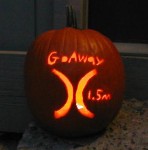 This Hallowe'en, why not warcarve your pumpkin and let your neighbors know about your open wireless network?
 |
Russian cyberpunk: news or fiction?. The Moscow Times is running a strange little cyberpunk techno-thriller vignette -- it's not clear to me whether this is news, a serialized novel, or a columnist with heavy sleepdep, but the prose is great: Chrome was telling us how some bug hacker got into the helmet frequency one day and flooded their gourds with Donny Osmond songs. Four hours of it. What could you do? You couldn't take the helmet off or you'd over-geiger like the morons. Nearly drove them crazy. "And they call it puppy love." Chrome was crooning, laughing, riding high. He'd just bagged Laila, the one who used to be on TV here -- half a week's pay, but they said get her now because some wheel at CentComm was about to privatize her. Then he stepped outside with Dietrich and was gone. Link Discuss (Thanks, Pat!) [Boing Boing Blog] Interesting, but what is it? Is there more? 11:32:06 PM
|
|
Because tiny devices need tiny batteries.. 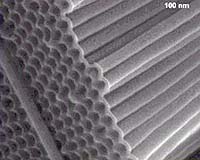 A University of Florida research team is developing nano-batteries that could enable smaller, smarter, feature-packed mobile devices, as well as truly tiny power sources for "microelectromechanical" devices (aka MEMS): A University of Florida research team is developing nano-batteries that could enable smaller, smarter, feature-packed mobile devices, as well as truly tiny power sources for "microelectromechanical" devices (aka MEMS):
"In the first year of a five-year collaborative effort with three other institutions funded by a $5 million grant from the U.S. Office of Naval Research, the research is showing progress toward its goal of creating a three- dimensional, millimeter-sized battery – considerably smaller than the centimeter-sized hearing aid batteries that are the smallest batteries on the market today. Image: synthetic membranes containing a parallel collection of nanotubes, with inside diameters of molecular dimension greater than 1 nanometer. Photo (c) Department of Chemistry, U of FL. Link Discuss [Boing Boing Blog] More power, less mass. My dream of the credit-card PC may yet be upon us. 6:52:57 PM
|
Last update: 11/2/2002; 3:18:15 PM .


