Monday, January 24, 2005
|
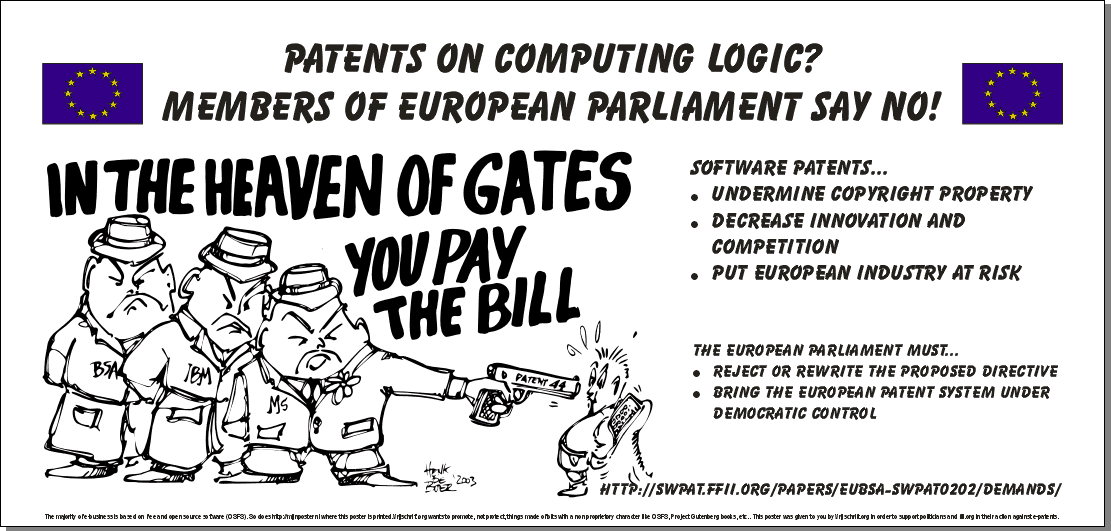
is copyleft strengthening copyright? ....from an email ping-pong between me and G.B. who's been working on a policy-related project, whose conclusions will be published in italy later this year. more specifically, the discussion turned to whether the mere adoption of the gnu gpl (aka copyleft) strengthens copyright law. i believe it does. i think that by encouraging (or implementing, adopting, licensing under...) copyleft, one invariably strengthens copyright law, since copyleft hinges upon copyright law. In fact, as far as the issue of ownership is concerned, copyleft completely overlaps with copyright: they both acknowledge the centrality of ownership, without questioning its universal applicability and socio-economic legitimacy as a framework for the organisation of society. And when it comes to copyleft's ability to reverse logically and practically (that is, effectively) copyright as it pertains to redistribution and derivative works, this is mostly an unresolved debate. For copyright's primary goal, at least from a structural vantage point, is to enforce a universal and all-encompassing sphere of legislative conduct, and this logic is not opposed by the proponents of copyleft - on the contrary, this logic is further strengthened by their operationalising copyleft, the act of which (consciously or unconsciously on behalf of copyleft supporters, myself included) is in effect rationalising the irrational character of copyright law. A few years ago, the cgpl discussion group had been discussing patent-wise, specifically whether we should develop a patent in the spirit of the principles laid out in the cgpl (which is a copyright). the argument for the development of the cgpl-like patent consisted in protecting ourselves against the imminent threat of patents and their exponential expansion to the point of rendering our "working" cgpl business plan/framework for organisational development illegal (ie. patents apply to business models, logic, etc). on the other hand, the argument against going the patent route consisted in exactly what i'm saying above: that by developing a patent (or any legal mechanism for that matter), we would be strengthening the patent system's scope and imaginary. at the end, having judged both arguments against their own merit, we decided to stay away from patents. and recently, reto told me that even the mere reference to the absurdity of the patent system helps strengthening the imaginary that sits in its core. cannot say i disagree. but is there any other way forward? or there's no way escaping the spectacular transcendence of copyright - patent law beyond the logic of copyright-patent law itself? 11:18:25 PM  Say it loud [] Trackback [] Say it loud [] Trackback []
|
|
the next sco strategy: sending viruses to your customers? hmmm, just got email from georgec@sco.com, with the spam-reminiscent subject *Re: hello*, but with no actual message body, except for an attachment with the dodgy .hta extension. and so i'm wondering: after spreading so much FUD about linux, making the ludicrous claim that it owns several snippets of linux code and thus we have to buy an sco license in order to use linux!!!, has now sco (yes, the company that once upon a time was called caldera) resorted to destroying our computers by spamming us with all kinds of shite like the .hta attachment i received? well, with sco nobody knows. sending viruses to your potential customers sounds like the best marketing solution, only rivalled by the effectiveness of blackmailing them into becoming your customers, whether they like it or not.....then gain, considering the absurdity of this all, perhaps it's just another of our favourite spammers, hijacking an otherwise perfectly legit domain. 3:57:03 PM Say it loud [] Trackback []
|
© Everything on this blog is licensed under the Common Good Public License unless stated otherwise
2005
George Dafermos
.
Last update: 2/16/2005; 5:03:57 PM .
Last update: 2/16/2005; 5:03:57 PM .