From Karl Popper's open society to open systems to open code
Is openness always good?
Ethical licensing: the GNU GPL
What is ethical? toward a taxonomy of ethical licensing
HESSLA
CGPL
Licensing limitations
Conclusions
Epilogue
Notes
References
Links to Web Resources
Acknowledgements
About the author
******
From Karl Popper's open society to open systems to open code
In 1945, Karl Popper delivered a powerful blow to historicism, a theory which suggests that civilisations develop in line with certain undefiable laws and so the path of their evolution can be said to be predetermined. Based on the belief that historical conscioussness is in a constant flux, that is, the future is malleable, Popper advocated a state of liberal democracy, which he coined Open Society, and in which the collective knowledge of humankind, whether scientific or social, is freed from totalitarian and authoritarian regimes and constraints [1]. Ever since, the concept of openness, or more accurately, the concept of the value of openness has enjoyed an increasingly growing and widening base of following, and theoretical reasoning alike, in the fields of politics, society, and business [***]. Characteristically, notorious financial markets speculator, George Soros, who first entered Popper's sphere of influence during his time as a student at LSE, has now shunned his previous identity, and has espoused philanthropy as his guiding principle toward an open society. To accomplish this, Soros has colonised the NGO space with his panoply of strategic philantropy, called Open Society Institute [2], which has taken to reinvigorating open societies, especially in the former Soviet block In his latest book, Soros argues that an open society is within reach if only we want it to come about, and to this end he proposes a specific agenda for economic reform [3]. And it has dawned upon many that openness is not solely appreciated by the civil society as the basis of an egalitarian social organism, but it is also a 'burden' imposed upon countries and companies by financial markets and investors worlwide. In his excellent treatise of globalisation, Thomas Friedman makes it crystal clear that it is unlikely for a country to attract investment from overseas if the country's infrastructure is not open and transparent, and more importantlly, he adds, this also applies to publicly traded companies wishing to increase their stock market capitalisation [4]. On these premises, openness is a vital prerequisite for healthy social growth alongside a robust economic climate.
Not surprisingly, the sphere of technology and science has not been left untouched by the pervasive power of openness. Open systems thinking, whose roots can be traced back to the 1960s, paved the way for what has come to be known as Free/Open Source software, and it is beyond doubt that open systems' superiority in comparison to closed systems lies in their openness [*]. Open code, it is widely argued, can be more accurately verified as to its functioning and cleanliness through decentralised inspection, and when openness is coupled with legal instruments such as the GNU General Public License (GNU GPL) [5] that protect and promote this attitude toward technology artifacts, then the stage is set for a more socially-responsible scientific terrain [6]. Open code developers have always assumed that openness equals quality and/or freedom, and to their support, the WWW, the Internet, the Linux kernel and a swathe of not such well known pieces of software exemplify time and again that openness wins over closeness when user feedback is crucial in determining the fate of the system in question [7]. Indeed, this rationale has been staggeringly successful in convincing technologists of the merit of openness, and as a consequence, the pool of available open code is getting bigger by the day. However, is openness adequate in safeguarding social-responsibility? Or, said otherwise, do ethics and openness play well with each other?
Is openness always good?
A couple of years ago, I run into an article written by Bill Joy which made a compelling case for the relinquishment of technological research and its commercial exploitation. The article, entitled Why the future doesn’t need us, warned that we might find ourselves in the centre of a technological cyclone with catastrophic consequences as technology becomes more central in our lives and immensely more powerful. The main thesis in Joy’s now infamous article is that the combined effect of emerging and highly promising technologies might spiral out of control to such a destructive extent that society might be unable to undo the harm and resume to a previous state of equilibrium [8].
It is true that similar worries have been echoed before. In the wake of the Chernobyl disaster, Beck cried out for a co-ordinated social reaction to the unanticipated effects of scientific extremism and corporate negligence, which he saw as the main reasons behind global tragedies, genetic plagues and other environmental disasters borne by a ‘Risk Society’[9]. In a similar vein, albeit in a more romantic and nostalgic tone, various accounts of Utopia [10] have been endlessly woven by pessimistic sociologists, political economy theorists, business people, and technologists alike, all of whom seem to agree that modern technology is corroding family values, dismantling community structures and turning us into passive consumers amidst a global culture that celebrates short-sighted individualism. Crudely speaking, the more technology pervades our lives, pessimists claim, the worse it is for society’s welfare. In this regard, Joy’s worries are nothing new.
What is striking, yet utterly true, in Joy’s dystopian account of the terror of technotopia is that individuals, for the first time in history, can manipulate technologic and scientific knowledge so easily and at negligible cost. Not long ago, one would need access to almost unavailable raw materials, highly confidential information and huge production facilities in order to exploit potentially hazardous technologic and scientific capabilities. This is the case with weapons of mass destruction even today. And I guess one can’t buy uranium or plutonium at the local supermarket. On the contrary, to explore the promise of technologies such as genetics and robotics one wouldn’t need any raw materials other than a personal computer and sufficient time to acquire the necessary programming skills. Openness, and the massively distributed availability of skills and potentially hazardous knowledge at negligible cost that a sphere of open technical knowledge enables and ultimately gives rise to, is exactly what frightens Joy the most, but this not because Joy, or anyone else for that matter, opposes openness per se.
The underlying characteristics of most of the emerging 21st century technologies is that they are made out of thin air and they can be digitised. Digitisation enables their core components to propagate through electronic networks that span the world. And their obliviousness to massive investment enables under-financed individuals to achieve tremendous goals. Ten years ago, and given the complexity inherent in software engineering, who would imagine that a loosely-knit group of volunteers scattered around the globe would produce a state-of-the-art operating system under no central planning and in the absence of direct financial incentives? Or a small group of volunteers alone would outperform the global pharmaceutical industry in the race to analyse and record the sequence of the human genome? Ten years have gone by and the unbelievable has become feasible. Linux - the offspring of a global community of software developers who keenly donated their spare time to a hobby worth pursuing - is currently the most powerful operating system, has gained momentum and presents a serious threat to the business model of many commercial software companies [11]. Similarly, the Human Genome Project finished its work three days before the private effort by Celera Genomics, thus ensuring the gene sequence remains in the public domain [12].
It goes without saying that not eveyone shared Joy's view that relinquishment should be actively pursued. The response from a good many technologist was fierce, most noteworthy of which is perhaps Extropy Institute's Max More's Embrace, Not Relinquish, the Future. Interestingly, More says that relinquishment cannot work because, first, relinquishment is not feasible, and second, relinquishment is not ethical. In a connected world where knowledge flows freely through global communication networks, relinquishment is obviously not an answer. Besides, there will always be a mad scientist divorced from ethical constraints. But society should have the means by which it could push the abort button. It is a matter of trust, ethics and social responsibility. Consider the case of the human genome: do you trust the government or commercial organisations to exploit the human genome? “If the rights to the exploitation of the human genome were vested in governments and the public sector, many people would be alarmed. Yet the idea that private companies should be given ownership over our genes is also disturbing” [13]. So, how can we ensure that digital ethics is more than an illussion, more than an unattainable ideal?
Ethical Licensing: the GNU GPL
One way to strengthen the sphere of digital ethics is through licensing mechanisms. By choosing, and adhering to the conditions of a license such as the GNU GPL, one, consciously or unconsciously, agrees to align oneself with a certain position of the F/OSS community. And although the Open Source Initiative (OSI) is careful not to overemphasise the ethical aspect of such licensing mechanisms, the Free Software Foundation (FSF), on the contrary, sees its arhetypical legal giardian - the GNU GPL - as the primary element in enforcing ethics throughout the software world [*]. For the sake of brevity, I have chosen not to elaborate in great depth on the different perspective, as regards to the value of openness, which is adopted by the two ideologically distinct camps of open code. Suffice it to say that the FSF stresses that openness is an aspect of freedom, and thus the FSF's rhetoric carries a more political flavour, emphasising the value that openness adds to society in large. On the other hand, the OSI, while not explicitly dimsissing the social value of openness, maintains that the value of openness lies chielfy in producing higher quality software. Here, it has to be noted that there are more than a few licenses around, all claiming to cater for the specific and occassionally peculiar needs of open code developers (and the companies that employ them), some of which are endorsed by the FSF or the OSI alone, some are endorsed by both [**], and some not recognised by either of them [****]. However, with respect to the process by which the OSI approves or rejects a license, Donald K. Rosenberg remarks, "it doesn't seem possible to draw any firm conclusions from studying the OSD, the licenses on the approved list, and licenses which have been rejected; for that matter, there is no list of rejected licenses. There is no public explanation of acceptance or rejection, nor is there an open process of review. It is not a case of the OSI reckoning that its work as a promoter of Open Source has ended, and fading quietly......unless the OSI clarifies its standards, it runs the risk of becoming irrelevant" (Rosenberg 2000: 24). This is not the case with the FSF, which usually provides explanations as to why a license is approved or rejected. We will return to this point later in the paper when we examine FSF's stance toward the two licenses that form the epicentre of our analysis.
Since the central objective of this paper is to analyse the interplay between ethics and openness, our analysis begins with the GNU GPL, which serves as a reference point (and I thus have inevitably downplayed other licenses) as it is this license that has been analysed most methodically as to its ethical, economic, social, and political effect. And in addition, the GNU GPL is the license most widely regarded as the most open among all F/OSS licenses. Aside from being a pure grammatical error, what does most open mean in the context of licensing? To fully comprehend the subjectivities arising from such a question, we need to take a moment to look into the GNU GPL.
The GNU GPL, by reversing logically and effectively [*****] the function of copyright, seeks to establish and protect a license holder's rights on four different levels. Or to put it in terms compatible with those used by the FSF, the GNU GPL seeks to ensure four different kinds of freedom. First, the freedom to run the program, for any purpose (freedom 1). Second, the freedom to study how the program works, and adapt it to your needs (freedom 2). Naturally, access to source code is a precondition for this. Third, the freedom to redistribute copies so you can help your neighbour (freedom 3). Fourth and last, the freedom to improve the program, and release your improvements to the public, so that the whole community benefits (freedom 4). Obviously, such an explanation of the mechanics of the GNU GPL fails to address some crucial aspects of it. For instance, the 'viral' or 'contaminating' character of the GNU GPL mandates that if any non-GNU GPL'ed software is integrated (it takes the compilation of GPL'd software with other software to require that the resultant derivative product be distributed under the GPL - see CH. 5, 6 of Resenberg) with GNU GPLed software, then it automatically becomes GNU GPLed software too.
| The
GNU GPL seeks to ensure: |
|
So, as said, the GNU GPL seeks to ensure freedom. But upon closer scrutiny, we see that this specific kind of freedom comes at the expense of another kind of freedom. For if free means that no constraint or restriction whatsoever is placed upon oneself, then why one would have to keep releasing derivative works under the GNU GPL too? The answer lies in the motivation behind the GNU GPL, the FSF, and the GNU Project. Without going into much detail, suffice it to say that freedom, in the context of the GNU GPL, refers to one's freedom to remain un-propertied and un-appropriated. In effect, GNU GPLed technologies cannot be co-opted by proprietary development, that is, they cannot be turned into technologies that the above mentioned four freedoms are not applicable to. Bear in mind that proprietary doesn't equal commercial. Free and Open Source software can well be commercial too, and often is. Red Hat, VA Systems, and many other commercial entities cashing in on free/open source software do exatly that. By contrast, proprietary means that one or several of the four freedoms inscribed in the GNU GPL are been taken away.
Now that we have discussed the GNU GPL, albeit in a rather stripped-down, minimalist fashion, we can return to the question we had put aside for a while. How can we measure the openness of a license? And what does most open mean in the context of licensing? Thanks to the considerable efforts of Donald Rosenberg, and Bob Young of Red Hat who came up with the following diagram, we have a practical framework to examine and interpret the degree of opennees of a license. By studying the diagram below, we could come to suppose that the more open a license is, the farher away it is from the proprietary end. Again, this confirms our previous claim that openness need not be a universal truth. It can refer to allowing only speficic kinds of freedoms, because if we were to adopt a radically different vantage point, one that assumed different metrics and criteria (ie. that modified versions of the program need not publicly disclose their source code or even be taken proprietary), we might well have concluded that the most open license is the one situated at exactly the centre of the diagram along the vertical dotted axis with equal distance from both the free and proprietary poles.
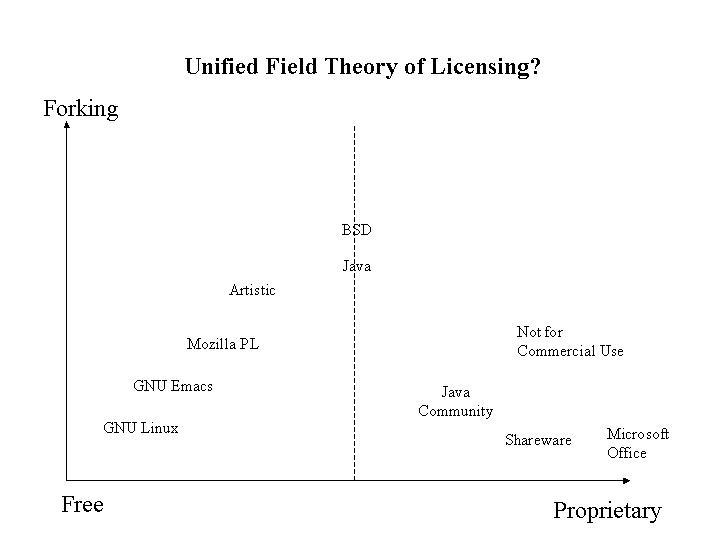
|
Source: Adapted from Donald K.
Rosenberg, 2000. Open Source: The Unauthorized White Papers, pp.110.
*It should be noted that the
diagram was originally conceived by Bob Young of Red Hat (See
Rosenberg 2000: xv)
Notes on the
diagram: Forking refers to.....However, in much of the
literature on free/open source, forking carries a negative connotation,
perhaps a reminder of the chaos that ensued when the BSD project was
forked, which effectively resulted in three different variants.
|
This clarification takes us to a whole new dimension of reasoning. By some definitions, The GNU GPL can be said to be the most open license. But by some other definitions too, the GNU GPL cannot be said to be the most open of licenses. Devilish coincidence? No. Ultimately, one can't measure objectively the degree of openness of a license. What makes the difference is the vantage point one assumes when thinking about openness, and especially about the value of openness. The vantage point that is so critical to the FSF, and which it seeks to foster, is that of social responsibility in an open society. What should be of interest then is that the GNU GPL is designed to foster a certain kind of behaviour toward technology, which the FSF has deemed socially responsible. If we want to be objective, we have to accept the fact that openness is a value we frequently associate with, and assign to social responsibility. To a certain extent, openness lies in the eye of the beholder.
So, despite the fact that the GPL is positioned as an ethical device, and Richard Stallman certainly designed it to be ethical, the GPL, given the circumstances we have to deal with today, falls short of pragmatism. Why? Simply, it is not equipped to deal with the technological terrain that unfolds before our own eyes. Reality has progressed more rapidly than the GPL has. When Richard Stallman created it, he did not, and could not have anticipated the characteristics typified by 21st century technologies. What we now see as a not very distant possibility, back then in 1984 it belonged in the sphere of science fiction [******]. For sure, we can't blaim Richard Stallman and the FSF for lack of a wilder imagination. Please don't take me wrong. This is not meant to be an assault toward the GPL; on the contrary, in the author's opinion, the GPL stands the best chances of surviving in the long run as the only true license (for the sphere of open code) along with the public domain. But in consideration of the rules of reality we are all bound by, the freedom that the GPL seeks to ensure, and it does ensure, is not necessarily ethical.
Say, for example, that I have developed a technology that could be used for a wide spectrum of purposes. One of these purposes is to enable normal folk caring to find out what's happenning behind closed doors to unveil carefully hidden and potentially illegal power relationships. Another purpose is to enable governments to track and monitor the activities of dissidents. Allow me to add some background information about myself and my goals. I am an open code developer because I see value in open code both in terms of promoting social responsibility and resulting in higher quality. I also realise that many good things can come from releasing my technology under a license that enables as many people as possible to use and build upon my technology. Since this wonderful technology is my brainchild, and from where I stand ethics and social responsibility matter, I choose to applaud and encourage other people to use my technology in ways that might help unveil those carefully hidden and illegal power relationships, and I also choose not to applaud and encougare other people to use my technology in ways that might help control societies and police states to tighten their grip on dissidents. There are many things that need to be stressed here. Obviously, if I license my technology under the GNU GPL, I allow (even though I may not agree with) people to pursue their highly divergent agendas. Here, openness is not very helpful in safeguarding social responsibility and upholding my principles. But is applause and encouragement the only weapons at my disposal? Are there any alternatives, or is my technology doomed to be used for purposes that offend me? For the most part, this is neither a philosophical nor a rhetorical question. This is real life. The technology described is also real - it is the technology behind a project tentatively called Mapping Contemporary Capitalism. And the above questions and agonies stem from real life too. They are the very questions and agonies that this project's developers are concerned with. In the words of one of them, this tension is epitomised in full swing: "We should acknowledge that making the map openly and widely available might have consequences opposite to those intended (for example IAA's maps of surveillance-free paths might draw attention to 'non-secure' areas and entail the installation of further CCTV cameras)". What did they do then? Did they choose to 'relinquish', killing their technology before it even got off the ground? Or do they get to interview all potential users to find out how they plan to use their technology? Nothing like that. Instead, like so many other open code developers, they chose to enforce ethics through law. But against the background of our analysis, the GNU GPL might not be the best of choices. They chose the Greater Good Public License (GGPL), which has been recently rebaptised Common Good Public License (CGPL). This an interesting twist and introduces a licensing model that claims to build upon and expand the GNU GPL in ways that are more adaptive to the problematic and threat represented by dynamic technology.
To this day, and to my knowledge, only two licenses tend to that direction. The Hacktivismo Enhanced - Source Software License Agreement (HESSLA)[14] forbids the use of software for purposes that infringe upon human rights. The Common Good Public License (CGPL) [15] goes much further. Not only does it cater for digital freedom, the way the GNU GPL does, and human rights (like HESSLA), but it is also concerned with preserving our natural co-habitat by limiting the environmentally-unfriendly uses a technology can be put into. But before we examine each of them in greater detail, let's make a small digression to discuss the taxonomy of ethical licensing.
What is ethical? toward a taxonomy of ethical licensing
For many people, being socially responsible is synonymous to being ethical. Of course, both social responsibility and ethics are largely ambiguous characterisations and thus wide open to subjective (mis)interpretation. Given my individual background, schooling, and upbringing in Greece, my understanding of what is ethical and what is not most definitely contradicts a Japanese person's view on many topics. And this is the rule rather than the exception. In Afganistan, it is unethical to consume alcohol, but it is perfectly acceptable to smoke marijuana. In other parts of the world, it is quite the opposite. Same goes with the relationship between the two sexes, the relationship among the members of a family, the relationship between people and religion, and so forth. For if we are to understand how we could bring about an ethical technosphere, we ought to have a common definition of ethics, a common ground or dialect if you prefer that will enable us all, despite our differences and divergent factual beliefs, to agree on what is ethical and what is not. Is that possible?
From the perspective of licensing, there are three ways to do this. Either one can assert which specific applications of technology are ethical and which are not, and work on producing a legal document that includes a list of ethical (or unethical) applications, and hope that the institutions charged with upholding the law and resolving any conflicts stemming from abuse of the licensed technology will punish any abusers, if and when their abuse surfaces. In a way, this is what the GNU GPL does, although what is described above goes one step beyond the scope of the GNU GPL. The GNU GPL implies that it's unethical to not share your work with others, to not allow others to use your work for any purpose, and so forth. You may wonder how and why the GNU GPL falls within this category as the first freedom it seeks to ensure is " the freedom to run the program, for any purpose", hence, at first glance, it may seem that it doesn't distinguish between ethical and unethical applications. This is true, but it is also true that it distinguishes between ethical and unethical when it implies that it's unethical to not allow others to run the program for any purpose. In a sense, one of the 'applications' (in the absence of more appropriate terms, we used the term application here) the GNU GPL deems unethical is the act of not allowing others to use the technology for any purpose. Despite some obvious differences, a prosthetic extention to this model could be conceptualised in a license that forbids certain applications in numeric form (1. use of this technology for non-medical purposes is forbidden by the terms and conditions of the license, 2. use of this technology for non-educational purposes is forbidden...., etc.). The point in concern is that according to this model one can assert which applications will be allowed and which will be not. The advantage of this approach lies in its consistency and robustness. One is either using the technology in an ethical manner or one is not. One is either allowing others to run the program for any purpose or one is not, and so forth.
The second option is to not assert which applications are ethical (or unethical), but let the license holders, that is, the developers to decide which applications they will tolerate. This may occassionally result in a state of weird vagueness as there are many unintended consequences of this alternative (ie. an unscrupulous or ill-disposed license holder changing his mind every now and then about a specific application in order to blackmail other parties or just cause frustration and discontent - this is the case when I say today that the way you use my technology is ethical and I thus allow you to continue doing so and tomorrow I say it isn't, effectively removing my previous permission and consent) but it is nonetheless a way to enforce ethics through licensing. The advantage of this approach is that it gives license holders the space to continually revisit and re-adjust their beliefs and stance toward ethics, and in so doing, they develop a timely and ephemeral attitude toward ethics in a largely discontinuous technological, social, economic, and political realm. In other words, this approach is more adaptive than the others. For much the same reasons, the disadvantage of this approach is inconsistency in standards to be adhered to, and to a large extent, difficulty in enforcement and conflict resolution by juridical institutions.
The third alternative is to appeal to a higher or 'wiser' instrument or authority, may that be the government, a civil society organism (ie. NGOs like Greenpeace, OXFAM, etc), or an international institution (like the United Nations or the World Trade Organisation) for guidance on which applications are ethical and then produce a binding legal document that instructs third parties interested in using, selling, and enhancing the technology to consult the principles promoted by the higher/wiser authority and act in a manner compatible with those principles. Failure to comply with the principles put forward by the higher authority results in removal of permission to use the technology. The benefit of this approach is that it manages to reduce ambiguity and inconsistency (when compared to the second alternative), while dwelling upon commonly shared principles and notions familiar to the juridical system. By building on previous ground, it reaches consensus more easily and it enables a wider understanding. The downside of it is that it depends largely upon the efficacy of the higher authority in assessing what is ethical, and thus the license cannot exist in isolation of a pre-existent and established ontological framework of rules, ethics, and social norms (that the higher authority is premised upon). In other words, if the whole of part of the supporting framerwork is rendered obsolete by socio-economic developments and technical forces, the validity and robustness of the license collapses with it.
Sure enough, there can be a swathe of hybrid models that combine properties of all three categories. We have now constructed a taxonomy of ethical licensing that will help us examine and analyse the effectiveness of the two licenses we mentioned before - the HESSLA and the CGPL. Let's start with the HESSLA.
HESSLA
The Hacktivismo Enhanced - Source Software License Agreement (HESSLA) is a license designed by a non-profit organisation active in the field of software development and licensing called Hacktivismo to promote the latter's political objectives. According to the Introductory Statement of the license document, "Hacktivismo itself exists to develop and deploy computer software technologies that promote fundamental human rights of end-users. Hacktivismo also seeks to enlist the active participation and involvement of people around the world, to help us improve these software tools, and to take other actions (including actions that involve using and distributing our software, and the advancement of similarly-minded software projects of others) that promote human rights and freedom worldwide".
Like the FSF, Hacktivismo recognises the political function of software, and is blunt about the purpose of the license: "the purpose of this License Agreement itself is political: Namely, to compliment the software's intended political function", and it goes on "Because of our non-commercial objective of promoting end-users' freedoms, Hacktivismo has some special, and admittedly ambitious, licensing needs. This License Agreement enhances the benefits of published source code by backing up our human rights projects with appropriate remedies enforceable in court". Hence, HESSLA's purpose consists of a legal function and a political function. The primary function is the political, that is, to promote human rights; and the secondary function is legal, that is, the license seeks to be legally enforceable.
The first question that emerges is how does
HESSLA, as a license, promote and
protect human rights, and how does HESSLA define human rights?
HESSLA is based upon a hybrid model of ethical licensing that borrows
elements from the first and third category analysed in the previous
section of the paper. To begin with, it appears to belong mainly to the
third category which can be roughly referred to as 'appealing to a
higher/wider authority or building on previous ground'. That is so
because the freedoms HESSLA promotes stem from the International Covenant on Civil and
Political Rights (United Nations), and the Universal Declaration of Human Rights
(United Nations again). Hence, the 'wiser/higher authority' that HESSLA
appeals to is the United Nations (an international institution) and the
'previous common ground' is constituted through the two pre-existing
documents. In addition, the freedoms that HESSLA promotes stem from the Hacktivismo Declaration too, but
this hardly moves the HESSLA onto a different space of the triangular
taxonomy because another United Nations document is made an integral
part of the Hactivismo Declaration. Most specifically, this is the Article 19 of the International Convention
on Civil and Political Rights (ICCPR), which according to the
author of the Hacktivismo Declaration, Oxblood Ruffin, says essentially
the same thing as the Article 19 of
the Universal Declaration of Human Rights, but the former is more
of a legally binding document than the latter. We will not engage into
such a cross-examination between the two documents here since for the
purpose of this paper both documents bear the same validity and fulfil
the same purpose (which is to appeal to a higher/wiser authority),
however, suffice to say that Ruffin and the Hacktivismo group in this
way sought to produce the basis of a license that would be legally
enforceable.
The Hacktismo Declaration was first issued on July 4th of 2001, and
the HESSLA (version 0.1) was published on November
25th of 2002. In short, HESSLA defines human rights the way the United
Nation does, and the following United Nations documents are cited in the
HESSLA as its underpinnings:
| How HESSLA defines Human Rights |
|
*Freedom of Expression: according to Article 19, Universal Declaration of
Human Rights |
Another interesting aspect that ought to be discussed is in what ways HESSLA is related to other free/open source software licenses. According to the license document, HESSLA "enthusiastically endorses and supports the goals and objectives of the Free Software movement and those of the open source community. In particular, we owe a special debt of gratitude to the Free Software Foundation, to the Open Source Initiative, and to many exceedingly talented people who have contributed to Free Software and open source projects and endeavors over the years" and "we have sought to combine most of the freedom-promoting benefits of "free" or "open-source" software (including mandatory disclosure of any changes or modifications Licensees make to the source code, whenever they release modified versions of HESSLA-licensed Programs or other Derivative Works), with additional enhanced license and contractual terms that are intended to promote the freedom of end-users. The Hacktivismo Enhanced-Source Software License Agreement promotes our objectives in an enhanced manner by including contractual terms that empower both Hacktivismo and qualified end-users with greater flexibility and leverage to maintain and recover human rights, through the mechanism of the contract itself including terms that are designed to enhance both our enforcement posture and that of qualified end-users in court".
Nevertheless, the FSF has rejected the HESSLA. It is worth quoting the full explanation in verbatim here.
| The HESSLA's
Problems |
The Hacktivismo Enhanced-Source Software License Agreement (HESSLA) is a software source license that tries to put restrictions of ethical conduct on use and modification of the software. Because it restricts what jobs people can use the software for, and restricts in substantive ways what jobs modified versions of the program can do, it is not a free software license. The ironic result is that the community of people most likely to feel sympathy for the goals of the HESSLA cannot contribute to HESSLA-covered software without violating its principles. The restrictions in the HESSLA prohibit specific activities that are inexcusable: violations of human rights, and introduction of features that spy on the user. People might ask why we do not declare an exception for these particular restrictions--why do we stick to the general policy of rejecting all restrictions on use and on the functionality of modified versions? If we were ever going to make an exception to our principles of free software, here would be the place to do it. But it would be a mistake to do so: it would weaken our general stand, and would achieve nothing. Trying to stop those particular activities with a software license is either unnecessary or ineffective. In regard to modified versions, the HESSLA's restrictions are unnecessary. The GNU GPL is sufficient protection against privacy-violating features, because it ensures that someone can get the source code, find the spyware feature, and publish an improved version of the software which does not have the feature. Users can then switch to that version if they don't want their personal information to be reported. As for restricting the use of the software by governments that violate human rights, this is likely to be ineffective. There are many other programs they can use. Also, at least under US law, a copyright-based source license can't restrict use of the program; such a restriction is not enforcible anyway. Meanwhile, they can simply decide they are exempt from the restrictions. |
CGPL
The FSF has not rejected the CGPL, but it is not likely it will ever approve it. This is not necessarily the case with the OSI, although the CGPL has not yet been submitted to the OSI for consideration as an OSI-certified license.
Licensing Limitations
Nowadays, it has become common to examine and analyse new technologies with respect to several characteristics they are likely to incorporate or/and manifest. Clayton Christensen, the foremost authority on issues related to the management of innovation and technology, advises to distinguish between disruptive and sustaining technologies, between market-pull and technology-push, and only then make strategic decisions based on the analysis's findings. Such thinking assumes that someone with experience in the proper use of the proper analytical frameworks and with sufficient understanding of the dynamics of the surrounding environment can tell with precision and certainty into which uses any given technology will be put into when in the hands of mainstream users. To the dismay of many industry executives, such a line of thinking is flawed. History is quick to point out a plethora of cases where inventors, technologists, and managers failed to grasp the actual uses a technology would be put into, and thus dismissed them as of little or no commercial significance (Rosenberg). This was the case with the laser, the telephone, and more recently, text-messaging (SMS) on mobile phones. Therefore, if one can't tell how a technology is likely to evolve, and this is all the more probable when confronting technologies having the potential to revolutionalise their field, or even to spawn an entirelly new field, then how one would be able to prescribe what uses and applications are to be allowed as ethical and which ones should be prevented as unethical? This is not a logical paradox. Even if one is certain of what constitutes ethical and unethical, one still can't police the ways technology will co-evolve with, and be shaped by individual end-users. So, if we take this argument to its logical extreme, what is the point of licenses such as the CGPL? Satisfaction of pure egoism and megalomania? Or demonstration of shocking ignorance and vulgar arrogance?
Marshall Mcluhan
copyright and patents are artifacts soon to collapse, says a first monday paper witten by alex kay.
pamela samuleson's paper: economics of licensing
Conclusions
All licenses have their shortcomings. I will leave it to the devices of the individual developer to decide which one has the less simply because this hinges greatly upon the circumstances, the technology in question, and one's stand with regard to what is ethical and what is not.
| digital
freedom |
human rights |
environmental
sustainability |
|
| GNU
GPL |
(?)yes |
- |
- |
| HESSLA |
?(yes) |
yes |
- |
| CGPL |
(?)yes |
yes |
yes |
By being ..... the GNU GPL manages to shut any windows for exploitation by those wishing to engage in games resembling the prisoner's dilemma. The increasing returns and the critical mass also push it forward and further strengthen its core proposition and endurance to time. However, it fails to address critical aspects of dynamic technology, which both HESSLA and CGPL take into account, and in fact, are better equipped to deal with.
Epilogue
The fix we should be aiming at need be social rather than technological or legal alone. In that regard, and insofar as the HESSLA and the CGPL manage to raise community awareness, stimulate dialogue, and rally support around the issues inherent in dynamic technologies, their raison d'etre has been fulfilled. I may even make the bold claim that Karl Popper, were he still in life today, would agree. As Ian Jarvie remarks, in his analysis of the meaning of Popper's legacy,
Acknowledgements
This paper doesn't invoke, and has not attained, any higher state of conscioussness. Nor do I claim full impartiality. This paper is inevitably biased since I am involved in one of the licenses discussed. What this paper seeks to provide is an opinionated, well-substantiated treatise of ethics in the digital sphere from the perspective of licensing mechanisms and in the context of an open society. Thus, I solely am responsble for any errors and omissions.
Had not been for the vigour and enthusiasm of the people involved in the Common Good Public License, the Organis Project, and the F/OSS community in large, the ideas laid out in this paper would have not come to fruition. I'm deeply grateful to all of them for shaping who I am. I'd like to take this opportunity to thank the person who's influenced me the most, the father of the CGPL and the Organis Project, Professor Carl Vilbrandt. No doubt, this paper is dedicated to his efforts and never-ending dedication toward incubating a sustainable future.
About the author
George can be contacted at georgedafermos at discover dot org
Notes
[1] Karl Popper, Open society and Its Enemies
and Karl Popper, The Poverty of Historicism
[2] The Open Society Institute
[3] George Soros, George Soros on Globalization
[*] For the sake of brevity, I have chosen not to elaborate on the different perspective, as regards to the value of openness, which is adopted by the two ideologically distinct camps of open code. On the one hand, the Free Software Foundation (FSF) stresses that openness is an aspect of (digital) freedom, and thus the FSF's rhetoric carries a more political flavour, emphasising the value that openness adds to society in large. On the other hand, the Open Source Initiative (OSI), while not explicitly dimsissing the social value of openness, maintains that the value of openness lies chielfy in producing higher quality software.
[**] Since I have chosen the GNU GPL as the reference point in my analysis, I also ought to note that the GNU GPL is endorsed by both the FSF and OSI.
[***] This is an oversimplification, if not to say a logical fault. Openness in decision making and political governance has long problematised thinkers of political philosophy, starting with the great ancient Greek philosophers. The merits of openness, it goes without saying, have been invoked and debated time and again throughout the centuries of evolution of western philosophy and political governance systems.
[****] for a list of the licenses endorsed by the FSF see # / for the list of licenses cerified by OSI see ##
[*****] but it doesn't reverse or alter the juridical process - the GNU GPL can be considered a form of copyright nonetheless.
[******] Version 1 of the GNU GPL was released in 1989, however, Richard Stallman started his GNU Project in 1984, and founded the FSF a year later in 1985.
[4] Thomas L. Friedman, The Lexus and the Olive Tree: Understanding Globalization
[5] The GNU General Public License
[6] Richard M. Stallman
[7]
[8] Bill Joy. 2000. Why the future doesn’t need us, Wired, Issue 8.04 – April. at
[9] U. Beck. Risk Society, London: Sage, translated by M.A. Ritter, 1992.
[10]
[11]
[12] Nicholas Wade. 2001. Grad Student becomes Gene Effort’s Unlikely Hero, The New York Times, February 13, 2001.
http://www.nytimes.com/2001/02/13/health/13HERO.html
[13] Charles Leadbeater. 2000. Living on Thin Air, Penguin: London, pp.169-170
[14] HESSLA
[15] CGPL
References
U. Beck. Risk Society, London: Sage, translated by M.A. Ritter, 1992.
Dan Brickley, Jo Walsh, Earle Martin and Simon Kent. 2002. The Semantic Web, Metamute, M25 :: 19.12.02, at
Thomas L. Friedman, The Lexus and the Olive Tree: Understanding Globalization
Ian C. Jarvie, Reflections on the Passing of Sir Karl Popper, at
Ian C. Jarvie, Popper's Republic of Science, talk given at the Japan Popper Society, at
Bill Joy. 2000. Why the future doesn’t need us, Wired, Issue 8.04 – April. at
Arthur Kantrowitz, 1989. The Weapon of Openness, Foresight Institute, at
Christopher M. Kelty. 2001. Free Software/Free Science, First Monday at http://www.firstmonday.dk/issues/issue6_12/kelty/
Charles Leadbeater. 2000. Living on Thin Air, Penguin: London.
Marshall McLuhan, Understanding Media and the Extentions of Man, at
Max More, 2000. Embrace, Not Relinquish, The Future, Extropy Journal of Transhumanist Solutions, May., at
Georges Politzer, Elementary Principles of Philosophy
Karl Popper, Open society and Its Enemies
Karl Popper, The Poverty of Historicism
Donald K. Rosenberg, 2000. Open Source: The Unauthorized White Papers
Nathan Rosenberg, Innovation's Uncertain Terrain, McKinsey Quarterly, at
George Soros, George Soros on Globalization
Carl Vilbrandt. 2003. CAD eXtended Dimensions, at
Nicholas Wade. 2001. Grad Student becomes Gene Effort’s Unlikely Hero, The New York Times, February 13, 2001.
http://www.nytimes.com/2001/02/13/health/13HERO.html
Links
Mapping Contemporary Capitalism
Hacktivismo Website http://hacktivismo.com/
Hacktivismo news syndication http://www.hacktivismo.com/news/backend.php
Background to the Hacktivismo Declaration by its main author Oxblood Ruffin, dated July, 4, 2002 http://hacktivismo.com/about/declarations/
Hacktivismo Declaration http://hacktivismo.com/about/declarations/en.php
Hacktivismo Enhanced - Source Software License Agreement (HESSLA)
International Covenant on Civil and Political Rights http://www.unhchr.ch/html/menu3/b/a_ccpr.htm
Universal Declaration of Human Rights http://www.un.org/Overview/rights.html
HESSLA's Problems http://www.gnu.org/licenses/hessla.html
Common Good Public License (CGPL)
Organis Project
Natural Step
Universal Declaration of Human Rights