Wednesday, April 14, 2004


Posted here Wednesday, April 14, 2004 at 10:22:40 PM    

US budget

http://www.reuters.com/financeNewsArticle.jhtml?type=bondsNews&;storyID=4830223

WASHINGTON, April 14 (Reuters) - The U.S. government's budget deficit came under fire on Wednesday from two global institutions saying a plan to halve the record gap by 2009 may not be enough to stop long-term damage to the world economy.


********

Posted here Wednesday, April 14, 2004 at 8:57:26 PM    

And Friedman in tomorrow's NYT can see some good where I haven't. But then it's complex and demanding to udnerstand.

http://www.nytimes.com/2004/04/15/opinion/15FRIE.html

Consider an intriguing article on Tuesday in the Israeli newspaper Haaretz pointing out that Yasir Arafat's Palestinian Authority and Hamas, longtime rivals, had "made a great deal of progress" toward setting up a new administration to run Gaza after Israel's unilateral withdrawal. The article quoted Hamas leaders as saying that they were willing to participate in the administration of Gaza now that it is being "liberated" — for which Hamas claims credit — and not being turned over in the context of the Oslo peace accords


********

Posted here Wednesday, April 14, 2004 at 8:28:23 PM    

George Ball in Foreign Affairs, 1979

http://www.foreignaffairs.org/19791201faessay8214/george-w-ball/the-coming-crisis-in-israeli-american-relations.html

A veteran of Middle East negotiations recently said to me: "Trying to help Israel find the way to peace is like pushing a bicycle out of the path of an approaching train while the boy riding it frantically back-pedals."

The metaphor reflects the dangers of the current situation but does not explain them. A major contributing cause is the excessively ingrown and convoluted relations between Israel and the United States. Over the last 30 years these relations have evolved to the point where Israel is more dependent on the United States than ever, and yet feels itself free to take hard-line positions at variance with American views without fear of anything worse than verbal admonition from Washington. The result is to encourage Israeli positions and actions that cannot be in the long-term interest of Israel itself, and to deprive the United States in practice of freedom of diplomatic action on issues that deeply affect its national interest.

The state of the relationship between the two countries has been uneasy for some years. It is now approaching a crisis state, and unless American-Israeli relations are radically redefined-either in a closer or looser direction-the search for an Arab-Israeli peace will be completely thwarted and the interests of both nations increasingly jeopardized.

How did we get into the present situation of "dependence without responsibility"? What can we learn from the past? And, above all, what is the American national interest in the present situation, and how can our support of Israel, and our relationship with Israel, be brought into line with that national interest?

II

To those familiar only with the period since 1967, it may come as a surprise that for nearly 20 years the relations between Israel and the United States were far from being as intricately intertwined as they have become since. Until 1956, America treated Israel not much differently from other friendly states. The rapid decision to recognize Israel in 1948, 11 minutes after Israel had proclaimed statehood, had been made by President Truman against the judgment of others in his government, and when, in Israel's first war, the Arabs promptly attacked the new state, the United States used United Nations machinery to bring about separate armistice agreements between Israel and the four belligerent Arab states, in 1949.

Four years later, Secretary of State Dulles directed the main thrust of his Middle East diplomacy at building a tier of defenses against the Soviet Union. To avoid prejudice to our larger Middle Eastern interests, he refused to provide arms to Israel. The guiding principle of our military assistance in the Middle East-expressed for a time in a tripartite agreement with Britain and France, signed in 1950-was to maintain an arms balance. We took no action to facilitate Israel's armament program until May 1956, when the State Department relinquished NATO priority over French military equipment to permit its diversion to Israel.

On October 29, 1956, Israel attacked Egypt in collaboration with the misbegotten Suez adventure of the French and British. Israeli forces swept across the Sinai Desert. Though ...


********

Posted here Wednesday, April 14, 2004 at 5:41:58 PM    

Interesting numbers

www.worldwatch.org/pubs/goodstuff/beverages/

In 2002, thirsty Americans consumed 189 billion sodas, juice drinks, and other beverages packaged in plastic or glass bottles and aluminum cans. Sadly, fewer than half of these bottles and cans were recycled.

If we assume 189 million adults, that's 1000 for each.


********

Posted here Wednesday, April 14, 2004 at 5:37:24 PM    

From this morning's hearing, presidential management style.

http://slate.msn.com/?id=2098861&;notification_id=20972984&message_id=0

In an otherwise dry day of hearings before the 9/11 commission, one brief bit of dialogue set off a sudden flash of clarity on the basic question of how our government let disaster happen.

The revelation came this morning, when CIA Director George Tenet was on the stand. Timothy Roemer, a former Democratic congressman, asked him when he first found out about the report from the FBI's Minnesota field office that Zacarias Moussaoui, an Islamic jihadist, had been taking lessons on how to fly a 747. Tenet replied that he was briefed about the case on Aug. 23 or 24, 2001.

Roemer then asked Tenet if he mentioned Moussaoui to President Bush at one of their frequent morning briefings. Tenet replied, "I was not in briefings at this time." Bush, he noted, "was on vacation." He added that he didn't see the president at all in August 2001. During the entire month, Bush was at his ranch in Texas. "You never talked with him?" Roemer asked. "No," Tenet replied. By the way, for much of August, Tenet too was, as he put it, "on leave."


********

Posted here Wednesday, April 14, 2004 at 4:40:33 PM    

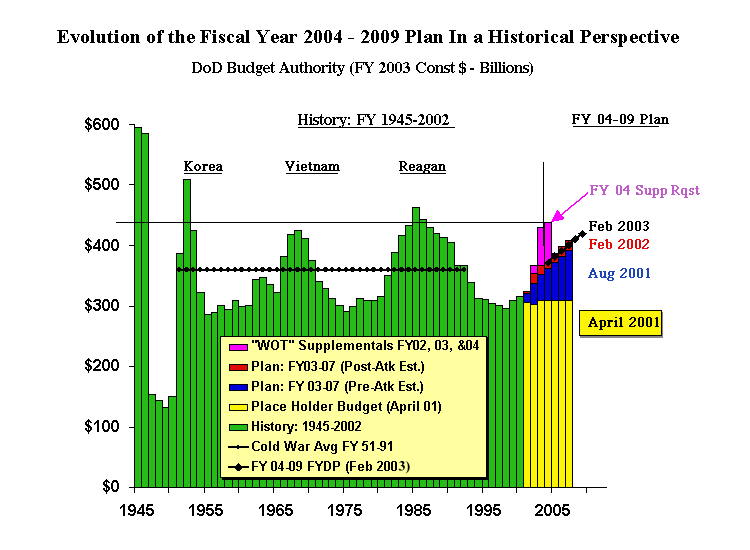
us military budget in constant dollars (note that the economy is much larger now, so as a percentage of gdp, the curve is misleading.)

from http://www.d-n-i.net/charts_data/evolution_of_the_fy_2004_supplemental.htm


********

Posted here Wednesday, April 14, 2004 at 4:08:53 PM    

On US/Israel/Palestine from the NYT

http://www.washingtonpost.com/wp-dyn/articles/A11483-2004Apr14.html

In response to a question, Bush said Sharon's policy, which also includes a unilateral departure from parts of the West Bank, means Sharon "is beginning to implement a vision that allows for contiguous territory so that a Palestinian state can emerge." That action, he said "accelerates the process" toward peace.

Asked about former president Jimmy Carter's recent charge that U.S. policy is tilted toward Israel, Bush replied that he is the first president to explicitly advocate a Palestinian state. "U.S.-Middle East policy is tilted toward peace, and the best way to achieve peace is to fight terror," he said. He said Sharon, with his new plan, "stepped up" to his responsibilities. "The Arab world has got responsibilities to help not only fight terror, but to provide hope for a peaceful Palestinian people," he said.

Bush argued that "the United States will not prejudice the outcome of final status negotiations," but explained why certain requirements must be imposed. "The realities on the ground and in the region have changed greatly over the last several decades, and any final settlement must take into account those realities and be agreeable to the parties," he said.

This can be seen as

1. A realistic approach to realities and the need for a solid peace, which requires that the Arab world find a way to play its part., or

2. An indication that the Bush presidency will take "terrorism" as its defining moment and take us down the path, with other pieces having to fall in place, such as Positioning the key Israel issue as "fighing terrorism", that support such a strategy. Such a strategy probably includes

a. the Fukuyama/ Freidman "end of history" view that the market democracy model wins.

b. this model, with a rhetoric of democracy and freedom, is very much an agenda of American/big business domination of the agenda.


********

Posted here Wednesday, April 14, 2004 at 3:55:54 PM    


Additions in red for changes since last posting  april 1(check archive calendar upper right)


The way the world looks this week. April 15 2004


The US and Iraq, given that the danger for the US perspective is that Iraq, Iran, Egypt, Saudi Arabia, Afghanistan, and Pakistan are too liable to become fundamentalists states, with a nuclear capacity. It no longer matters how we got into Iraq, the situation is deeply out of control. Note that with travel problems into Iraq, we are getting very little reporting.


And where totalitarian ME countries want an alliance with the US to keep their own people controlled, creating a very bad set of choices for the US between old style national elites or a kind of chaos that looks like it would go fundamentalist. The US supports old style nations, including Israel, or lets the situation go into very stressful conflict, of which the breakup of the old Yugoslavia is just a hint.


The US political situation. Where Iraq *does* matter, and the whole style of the admin, for its ideological approach, contrary to election rhetoric, was set in advance, on the economy and foreign affairs, to go rigid and concerned to bring America back to a rural past. The contest between Bush and Kerry, or even including Nader, may not be large enough to give any real options on the bigger questions, reducing the election to a blip on the forces unleased by WW2 US prosperity and its decline in the face of knowledge's capacity to spread world wide.


In a context where apology for wrong is probably needed - from the Indigenous Americas, Latin American interference, the penetration of Asia in Japan with Admiral Perry, and China with the opium wars (few I the US know what that name really means), and more recently for creating the ME boundaries, the reliance on oil, and the creation of the Taliban, and its blowback into the increased capacity for violence in the region.


The 9/11 hearings and the president's press conference set a style of no deep apaologies.


The economy, where long term balancing of the US wealth in relation to the rest of the world requires a declining dollar, and declining wages, and where elites will try to milk the situation to preserve wealth at the cost of everyone else, and have been very successful at doing this. The jobs report of an increase in 300,000 looks bogus. Pressures in the labor ndepartment, federal hiring of 150,000, and 80% as part time jobs suggest that Bush is wrong.


Technology, where the alignment of tech with money making is a major part of the concentration of economic wealth paradigm, with less and less profit in a monopoly rewarded economics of all against all. Moreover tech tends to imply a world view that wants to call itself secular, but it really is a religion in disguise, and this is a deep issue hardly conscious. The result has been that tech is not used for human betterment except in so far as the market can make choices - the SUV and technologies of control and surveillance. We need a new vision of a humane technics.


The rise of the mercenary "contract security" and others, a very large number in Iraq, point to a market governed mentality.


And the tech and economy dovetail back onto politics, aligning them together. Fascism is the increasingly polite word to describe this.


China along with Taiwan and Korea, with Cheney's visit.


And long term


Population, not just the total, but the makeup of the total, in age, and culture. It is not easy for anyone to call this a kind of warfare, but it is.


Environment, with degradations affecting much of the planet, making daily life harder for most people, and miserable for way too many, and with the possibilities of major collapse, in fish, water and plague.


Culture is increasingly trivialized towards market segments rather than humane values. The total market, product, life style images, the spirit of advertising and the image of life implied by the whole need to be compared, first to the past, and for example, that side of the catholic church that built cathedrals, talked about life, death marriage, childhood and motherhood (yes, I know the problems, I am talking about the positive cultural imagine), and embedded it in music, art, and meditation, colorful ceremonies in beautifully architected spaces. Then to compare the market world with what could be, taking things like the medieval church, the Japanese landscape, and community coherence seriously, in searching for a better future than our current options seem to allow for.


Knowing that in the past quality went with aristocracy (village cultures however were vital), and the modern goes with a tendency towards democratic individualism. A vital individualism with community aesthetic has to be the goal, for artists firstly, philosophers and educators second, and those involved with governance of course. The alternative is a drug based techno fascism that is not even attractive.


The repositioning of business and technology, now self serving sub maximizing activities, into a more humane vision of a sustainable and worthwhile humanity.


********

Posted here Wednesday, April 14, 2004 at 7:12:47 AM    

Juan cole at www.juancole.com has a simple analysis of Bush's speech. Seems like a good method.

Arguing with Bush

I saw President Bush's news conference Tuesday evening. He said many things that disturbed me, not in any partisan sort of way (and I continue to maintain that simple partisanship makes for bad analysis), but on grounds of ethics and clear thinking and democratic values. I got the transcript and began arguing back, but could see it could go on for hours. And probably others would do a better job. But, since bytes are cheap, I may as well post what I put down; this is a diary of sorts, after all.

On the analogy between Iraq and Vietnam:

' THE PRESIDENT: I think the analogy is false. I also happen to think that analogy sends the wrong message to our troops, and sends the wrong message to the enemy. '

If a historical analogy is offered as a cautionary tale or a form of analysis of a contemporary situation, it has to be judged on its own merits. Making such analogies is a form of democratic discourse, and it is the sort of thing that the Bill of Rights meant to protect when it said that the government shall make no law abridging the freedom of speech. To say that bringing it up "sends the wrong message to our troops" and to "the enemy" is to attempt to prevent democratic discourse on the grounds that it affects the morale of the democratic country's fighting forces and that it might give encouragement to those they with whom they are at war.

But the troops are either fighting for democratic values or they are not. If they are, then it is illogical to demand that the Republic forsake democratic discourse because they are fighting for it. It would be like saying that all Americans should turn in their firearms during the war, or that Americans should cease worshipping in the religion of their choice during the war. It is precisely the ability of American citizens to analyze the nature of the war freely that the troops are defending. Moreover, the "enemy" (though who exactly that is is unclear at the moment) is fighting for his own reasons, and can hardly take any real comfort from the existence of free and democratic discourse in the United States.

' A secure and free Iraq is an historic opportunity to change the world and make America more secure. A free Iraq in the midst of the Middle East will have incredible change . . . '

This premise is not necessarily true. Turkey has had relatively democratic elections since 1950, but this development had no resonances in the rest of the Middle East. Iran went theocratic in 1979, and Khomeini expected everyone in the Middle East to follow suit. No one did. Saudi Arabia is among the world's richest monarchies, but it has not spread monarchy in the mainly republican Middle East. Middle Eastern countries are often fairly insular with regard to politics, and every tub is on its own bottom. There is no guarantee that a "free" and democratic Iraq will have any real influence on the rest of the region.

At the moment, moreover, Iraq is a poster child for dictatorship. Any Egyptian who looked at what has transpired there in the past year might well decide that the soft dictatorship of Hosni Mubarak is altogether preferable to taking the risk of opening up the system and possibly causing a similar social breakdown!

' There's no question it's been a tough, tough series of weeks for the American people. It's been really tough for the families. I understand that. It's been tough on this administration. But we're doing the right thing. . .. '

I find the equation of the way in which the loss of nearly 80 US troops and the wounding of dozens has been "tough" on the American people, and the way in which these events have been "tough" for the Bush administration to be in bad taste.


Saddam Hussein was a threat.

It is difficult to see how a ruler whose army was so easy to defeat, and who was reduced to hiding in a spider hole, was a threat to the United States.

' He was a threat because he had used weapons of mass destruction on his own people. '

I should think this proves he was a threat to his own people.

' He was a threat because he coddled terrorists. '

I don't know what this means, to "coddle" terrorists. Either he sponsored terrorist actions aimed at harming the United States directly, or he did not. He probably did not, after 1993. The State Department did not even list Iraq as a terrorist threat in recent years.

' He was a threat because he funded suiciders. '

Saddam Hussein never gave any real support to the Palestinian cause, and he did not pay suicide bombers to blow themselves up. It is alleged that he funneled money to the orphans of such suicide bombers, but I have never seen any documentation for the claim. Supporting orphans is in any case not the same as funding terrorism.

' He was a threat to the region. He was a threat to the United States. '

I can't see how, given the state of his military in 2003.

' That's the assessment that I made from the intelligence, the assessment that Congress made from the intelligence; that's the exact same assessment that the United Nations Security Council made with the intelligence. '

Key figures of the Bush administration, including the President, Vice President Cheney, Secretary of Defense Rumsfeld and National Security Adviser Condi Rice consistently misled the Congress by intimating or stating over and over again that Iraq was close to having nuclear weapons, that it had weapons of mass destruction, and that it was responsible for September 11 and had strong ties to al-Qaeda.

All of these allegations were completely false. Having stampeded Congress into a hasty vote on the war in Iraq with this farrago of phantasies, to now use Congress's acquiescence as proof that Iraq was dangerous is frankly dishonest.

' I went to the U.N., as you might recall, and said, either you take care of him, or we will. Any time an American President says, if you don't, we will, we better be prepared to. And I was prepared to. I thought it was important for the United Nations Security Council that when it says something, it means something, for the sake of security in the world. '

So then would it not be equally important, if the Security Council said "no" to a war, for that decision to be upheld by the United States? When it says something, after all, it should mean something, for the sake of security in the world.

' See, the war on terror had changed the calculations. We needed to work with people. People needed to come together to work. And, therefore, empty words would embolden the actions of those who are willing to kill indiscriminately. '

I can't understand what this string of Bushisms could possibly mean. If Bush needed to work with people, why did he blow off the Security Council in March of 2003? If people needed to come together to work, wouldn't they need to come together about launching a major war that affected the entire world? Why then did Bush go to war virtually unilaterally (bilaterally at most)? That wouldn't represent much in the way of "people" "coming together." If empty words would embolden killers, wouldn't turning the entire United Nations Charter, which forbids unilateral wars of aggression without Security Council permission, into so much scrap paper be a way of "emboldening" such killers?

' He also confirmed that Saddam had a -- the ability to produce biological and chemical weapons. In other words, he was a danger. '

Saddam did not have any stockpiles of chemical or biological weapons at all, and had no nuclear weapons program. Iraq has the same ability to produce "chemical weapons" as all other industrializing societies do, no more and no less. But Iraq did not have such weapons, and it is hardly a casus belli that they had the potential to make them. So does Brazil, but we haven't invaded it lately.

' Finally, the attitude of the Iraqis toward the American people -- it's an interesting question. They're really pleased we got rid of Saddam Hussein. '

About half say the US presence in Iraq is a form of liberation. About half say it is a form of humiliation..

' And they were happy -- they're not happy they're occupied. I wouldn't be happy if I were occupied either. They do want us there to help with security, and that's why this transfer of sovereignty is an important signal to send, and it's why it's also important for them to hear we will stand with them until they become a free country. '

What? I thought they were happy. Now you say they aren't happy. Which is it?


********