Updated: 20.07.2005; 9:29:24 Uhr.
Update
think about this...
        

Dienstag, 23. November 2004

The Wrath of Bullmer.

Ballmer.jpgI'm not sure where Steve Ballmer's forebears hail from, but I wouldn't be surprised if in their ancestral tongue, "Ballmer" tranlslates as "killjoy wanker." The rotound Microsoft CEO just made waves at a Singapore conference, telling the attendees that Linux violated 228 different patents. He also warned--or, rather, threatened--that litigation may await companies that make Linux-based cellphones.

The dig may have been directed squarely at Panasonic and NEC, both of which have plans for 3G Linux handsets. Just a guess here, but something tells me they ain't backing off those plans just because The Round Mound of Redmond dropped some lawsuit hints. Though, as always, the lawyers are on speed dial. If only Lionel Hutz were alive to enjoy this.

Panasonic braves Linux-inspired wrath of Ballmer [The Register]

[Gizmodo]
1:47:52 PM    comment []

KaZaA Gets Cozy With Skype.

Kazaa.jpgSome smart cookie down at Sharman Networks sees the handwriting on telephony's wall. Or maybe he just wants the company's flagship P2P software, KaZaA, to be known for something other than spyware. Whatever the reason, the new KaZaA 3.0 will include Skype, so you can dial up your file-swapping pals in the Ukraine for nothing. They'll still try to screw you with adware, of course. But that's why the good Lord invented KaZaA Lite.

KaZaA

Update: JonPaul Checa reminds us to remind you that the founders of Skype also developed and kickstarted KaZaA, so there is some history here.

[Gizmodo]
1:46:27 PM    comment []

Robosapien Creator Tilden Interviewed.

tilden_+interview.jpg imageGadget Madness interviews Mark Tilden, the man whose RoboSapien will probably fill many large stockings this Xmas. Apparently, a Robosapien 2 is in the works and will be unveiled at the New York Toy Fair '05, which just happens to fall right on my birthday. A new cheap, hack-friendly robot would be a perfectly decent present, I think.

Interview with Robosapien Creator Mark W. Tilden [GadgetMadness]

[Gizmodo]
1:45:18 PM    comment []

Amazon Japan Cell Phone Fancypants Service.

amazon_barcode.jpg imageKeitai Watch reports that as part of a renewal of their site, Amazon Japan has introduced a flattering new feature called "Amazon Scan Search." After users download an application to their cell phone free of charge, they can scan barcodes of ordinary products, which in turn enables them to search the cell phone version of Amazon.co.jp for the respective product. Once they get a result on their search, they can then choose to purchase the item right from their phone. Obviously, there's quite a bit of overhead associated with this [~] like needing a phone with a camera, needing to use i-Mode, and needing to, you know, be in Japan [~] but I'm willing to ignore that for now.

Amazon Japan of course intends the service be used for on-the-spot price comparisons, as well as "finding out what sort of products are sold should you want something that your friend has." I'd say I await Amazon in America to introduce a similar service, but I will probably be waiting for all eternity.

Amazon Mobile [Amazon.co.jp via Keitai Watch]

[Gizmodo]
1:42:17 PM    comment []

Meet Mr Wu's wonderful robots.

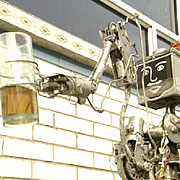
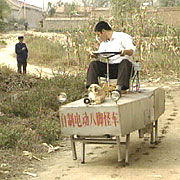
Wu Yulu, a Chinese farmer, left school at 14, has no formal technical training, but fathers amazing "labour-saving robots" out of welded-together metal, duct tape, second-hand batteries or any scrap he finds at rubbish dumps.

Number Five is a one-metre-tall humanoid robot that walks, changes light bulbs, lights cigarettes and pours tea. Number Six is a monkey-like robot with magnetized feet which enable it to crawl up metallic walls.

1256001.jpg 1256003.jpg

The inventor has also made a miniature frog-shaped robot that hops, and a giant, walking eight-legged trestle table capable of carrying two passengers. He's now working on Number Eight which would have a brain that could think, and arms and legs like a human.

Mr Wu hopes his creations may one day join the list of Chinese inventions that have changed history. So far, his talent wasn't met with luck. Five years ago, one of his creatures short-circuited, burning the family house to the ground. In 2000, a battery exploded, leaving Mr Wu with serious burns on his hands and torso.

Via Robot.net. < Sky and hilarious pics in China Pictorial.

[we make money not art]
1:41:51 PM    comment []

A step towards "self-cleaning" clothes.

Researchers at Clemson University are developing a water-repellant coating that can be used to produce clothes more resistant to dirt.

The coating - a polymer film mixed with silver nanoparticles - can be integrated into any fabric, including silk, polyester and cotton. In the long run, it can save time and money by reducing dry cleaning bills. It is also environmentally friendly.

omo_L.jpg

"The coating doesn[base ']t actually clean itself, but it does resist dirt much better than other fabric treatments," explains research team member Phil Brown. "You will still need some water to rinse away dirt and stains, but cleaning will be quicker and less frequent."

The researchers are also trying to engineer antimicrobial particles into the coating to repel strong odors such as sweat and even cigarette smoke.

Clothes made with the new coating could simply be sprayed clean or wiped with a damp cloth to remove the dirt. If desired, the fabric can still be cleaned by conventional means and put in the dry cleaner, without harming the coating.

Other possible applications include awning material for outdoor campers, fabrics for lawn furniture and convertible tops for cars. The coating could appear in consumer products within five years, the researcher estimates.

Via PhysOrg.

Chinese are working on self-cleaning garments too.

[we make money not art]
1:41:31 PM    comment []

What artists can do with a PowerPoint presentation.

Someone is dealing with my arch-enemy: the PowerPoint.

Pacific Film Archive video curator Steve Seid has decided to investigate how many people were using the software for other than corporate purposes. He issued a call for entries to 60 artists and forty-five of them have submitted their finest work.

Marisaz_Idol_PPT.jpg

The best will be shown at PFA on Wednesday, Dec. 1, at "PowerPoint to the People[dot accent]: An Evening of Automated Digital Presentations."

To befuddle the competitors, the first prize is $75, while second and third prizes get respectively $100 and $150.

"Because mastering this program is a questionable talent, you shouldn[base ']t be compensated for how well you know it," he explains. "With Power-Point[base ']s strange limitations, the less of a master you are, the more you bring to it."

Via del.icio.us / blackbeltjones.

[we make money not art]
1:40:51 PM    comment []

Mobile joint music listening.

Mattias Östergren from the Interactive Institute in Stockholm has developed SoundPryer, a wireless peer-to-peer software for mobile music "socials" in cars. Each driver becomes a mobile radio station, transmitting their digital music stream to other cars within Wi-Fi range. It enables music eavesdropping in traffic encounters, by streaming MP3 files via the Real Time Protocol.

soundpryer.gif

How it works: you attach a PDA, with built-in Wi-Fi card, to the dashboard and starts the Sound Pryer application and play Chopin on the car stereo. Suddenly, the icon of, for example, a red lorry appears on the screen and a tune from J-Lo fills your loudspeakers. Sound Pryer returns to playing your own music after you've passed the lorry.

More details in the PDF.
Via Networked_performance < the Feature who draws parallels between SoundPryer and the tUNA project of Media Lab Europe.

[we make money not art]
1:40:02 PM    comment []

Another non-evil label: Positron!.

Positron! Records follows the lead of the non-evil record label, Magnatune:


Positron! Records is pleased to announce that our artists now have the option of releasing their works under Creative Commons licenses.


Unlike those who suffer from what we like to call "major label retardation," we here at Positron! have never believed it was bad thing for our supporters to share our music with their friends. The Creative Commons licenses we use legally allow you to share songs from these records on peer-to-peer networks. In addition, you can sample portions of these songs for use in your own compositions, whether they are mash-ups for your friends, or a commercial release. It is our way of both thumbing our nose at the ridiculous state of copyright law in this country, and letting you, our customer and supporter, know that you are not a criminal, but a trusted ally in the war against corporate stupidity.


[via Lucas Gonze] [Creative Commons Blog - rss]
1:38:21 PM    comment []

Rediscover Culture with Firefox & CC Search.

Get Firefox!

Cool thing about Firefox 1.0 number 75387: access to the Creative Commons search engine is built in. If you're already using Firefox 1.0, just click on the search drop-down to the upper right of the browser window and select Creative Commons. If you're not using Firefox, get with the program!


The Creative Commons search engine crawls the web for content marked with Creative Commons license metadata and utilizes the same to help you find content to use and build upon, under terms you're willing to accept -- Semantic Web, anyone? We've had a prototype up since March and soft launched the current Nutch-based engine in September. Firefox integration is a major step forward.


Searching for "free culture" via Firefox 1.0 and the Creative Commons search engine.

[Creative Commons Blog - rss]
1:36:58 PM    comment []

The Velocity of Wikipedia.

Recent changes - Wikipedia, the free encyclopedia: Have you ever taken an opportunity to look at the "Recent Changes" page at Wikipedia.

At the time of this writing, the last 50 changes were within a 1 minute, 50 second span. I'm seeing three changes in the same second. The last 500 changes are in a 19 minute span.

[Gadgetopia]
1:36:35 PM    comment []

The Taipei Wi-Fi Project.

Taipei gets world's largest Wi-Fi grid: This makes that St. Louis plan look almost quaint by comparison.

It's the love of this kind of connectivity that is driving Taipei city planners to build what they say will be the world's biggest "Wi-Fi" network, making cheap, wireless Internet access available almost everywhere in the Taiwan capital.

My bet us that you won't get decent reception in the elevators.

[Gadgetopia]
1:36:17 PM    comment []

Spend fifty bucks to smash gadgets in Spain. sledgehammer

For 40 euros (around 52 bucks) you could just buy a bunch of old junk at the Salvation Army and destroy it in the comfort of your own home, but that[base ']s how much a junkyard in Spain is charging people for what they[base ']re billing as the ultimate stress-reducer: a chance to spend a couple of hours smashing away at discarded gadgets with a sledgehammer.


[Engadget]
1:35:38 PM    comment []

Branding Microcontent.

Well here I am blogging in my pyjamas. Not literally, but metaphorically. Chillin'. Taking stock. Thinking about goals for next year. I've also been thinking about my Design for Data theory and while I've been doing that, a few posts elsewhere have attracted my attention...

First a "in a nutshell" re-cap of what Design for Data means to me:

- Living Data; content is alive!
- Momentum: it's about movement of data/content (in time); not places where data/content resides
- it's about the user being in control of their webfeeds
- DYI websites for the users
- the application of weblike design to data
- Information Flow
- Rip, Mix n' Burn; Re-using content

That's not a complete picture, but I'm getting there.

Branding and Web Experiences

Digital Web Magazine published an article last week entitled The End of Usability Culture, Redux. It argues that web design is about creating effective "web experiences" and one way to do this is to focus on branding more so than usability guidelines (especially from the much-maligned Jakob Nielsen). The author, Dirk Knemeyer, cites Starbucks as "the perfect model" for what he's talking about:

"Starbucks leveraged all of the traditional approaches for international franchised brand success that old generation companies like McDonald’s mastered, then took it to the next level by replacing the idea of a commodity product with one of premium experience."

The role of the web designer then would be to create this compelling user experience. As Dirk puts it: "design is about creating for people."

While it's an excellent article, it seems to me that Web Designers are still fixated on the idea of website as 'container' for the content. Branding to a Web Designer is still largely a visual exercise. And I don't think there's anything wrong with that, because the Web as a 'place' won't be disappearing anytime soon. 

However I also think RSS flow is creating a need for the data itself to be 'designed', not into HTML containers but into chunks of branded microcontent that will probably be XML. What I mean is: the data may not end up as HTML, so we have to figure out how to "brand" our data.

Associated Press & Atomized Content

Another excellent article recently was a speech by Tom Curley, head honcho of AP (Associated Press). There were a lot of great insights in this speech and one of the main ones was this:

"...content will be more important than its container in this next phase [of the Web]."

He talks about unlocking content from those containers and "consumption on demand" will drive this - in other words, the user is in control. Words such as "disintermediate" and "reaggregate" are thrown into the mix. This is what he says about branding:

"The implications for content providers are enormous. You cannot control the "containers" anymore. You have to let the content flow where the users want it to go, and attach your brand -- and maybe advertising and e-commerce -- to those free-flowing "atoms."

The Associated Press, in this context, might end up "branding" facts such as sports polls or rankings, not just stories and photos; The LA Times and other newspapers will have to compete for eyeballs well beyond the boundaries of their published front pages and Web sites."

Curley doesn't actually say how we're supposed to brand what he calls "atomized content", but he does say that RSS and search are two of the main ingredients.

Gillmor Gang & eBay

I also listened to an interesting edition of The Gillmor Gang (a regular podcast from the likes of Steve Gillmor, Jon Udell and Doc Searls). They interviewed my namesake Jeffrey McManus, who is a technical evangelist at eBay. Steve Gillmor was giving Jeffrey a grilling about RSS and "disintermediation" and so forth, and in response Jeffrey noted this about the eBay website:

"...at the end of the day, that's why people come to eBay - is to have a great experience..."

In other words, the website is still the place where users go for the eBay "experience". 

Steve continued to press the matter, asking "what can't be done via api's [meaning off-site]". The object of the question being to find out if the eBay website was really necessary for users to do business with eBay. To which Jeffrey replied: sign-up, registration; bidding can't be done off-site [nb: I took rough notes only, so the quotes may be slightly off].

And Jeffrey later said: "It's our job to make eBay a compelling place to buy and sell stuff".

So what do I take from all that? Well it seems one of Web 2.0's leading companies still regards "place" (ie their website) as a critical part of their business model. That will please the web designers. Whether that will be the case in 5-10 years time is another matter...

Whither Design for Data?

I'll leave you with an Eric Rice post from today where he notes that his RSS traffic just passed his HTML views. My comment on that is: I don't think the RSS model is going to replace the HTML one. RSS and HTML do two different jobs. Currently it's true that branding via HTML is still the way to do business on the Web. Mainly because nobody has figured out how to effectively brand via RSS yet. And that's a business opportunity for Web 2.0. 

One company to watch in this space is FeedBurner. I think they're onto something important with their RSS feed services (such as splicing and stats).

For now, as one of Eric's commenters notes, branding is still largely visual:

[from Mike D]"I don't know that you can really brand yourself through RSS. Visual stimulation is oh-so important to generating and keeping interest."

OK, but mark my words: soon there will be ways to brand yourself in RSS. It's being invented right now by smart companies like Feedburner.

Postscript

Oh man, so much for blogging in my pyjamas! That was a bit full-on. If it's any consolation, it's now way past my bedtime :-) Almost time for me to get up in fact!

[Read/Write Web]
1:28:50 PM    comment []

© Copyright 2005 Joerg Rheinboldt.
 
November 2004
Sun Mon Tue Wed Thu Fri Sat
  1 2 3 4 5 6
7 8 9 10 11 12 13
14 15 16 17 18 19 20
21 22 23 24 25 26 27
28 29 30        
Oct   Dec


Click here to visit the Radio UserLand website.

Subscribe to "Update" in Radio UserLand.

Click to see the XML version of this web page.

Click here to send an email to the editor of this weblog.