|
 |
Sonntag, 28. November 2004 |
Pacman - Loose on the Streets New York has Pac-Mahattan, Singapore has Human Pacman.
The Mixed Reality Lab is also setting Pacman loose on the streets with an augmented reality game.
This one is using wifi, Bluetooth and GPS, head-mounted displays
and inertia sensors (to sense a body's position and head orientation);
the system allows players to turn into the yellow cookie-muncher or one
of the ghosts. Pacman's efforts to find cookies and avoid his enemies
can also be influenced by online helpers who can see a visualization of
the game on a computer screen and send messages to the player, or to
his pursuers.

"We're looking at next generation soldier platforms where they'll
have kind of a smart suit," said Dr. Adrian Cheok of the Mixed Reality
Lab. "As the soldier moves out into the battlefield he'll get live
information directly into his viewpoint using these specialized
head-mounted displays." The team is now working on a mobile-phone based
commercially-available version of Human Pacman.
"We're aiming to take Human Pacman to more mobile devices," he
explains. "Within two years we'll be able to see full commercial
Pacman-type games on the mobile phones." (Via Blueserker.)
The interaction between online and offline players reminded me of "Can you see me now?", a game by Blast Theory that I tested last month. In Summer- Fall,
2005, Blast Theory will install an interactive multi-player game in
Lower Manhattan. We'll keep you posted as soon as we get more details
so you'll have no excuse to miss it if you're around. It's a fantastic
experience, though I admit that you sort of look silly running in the
street trying to catch an invisible opponent.
- regine [Popgadget: Personal Tech for Women]
11:10:48 PM 
|
|
Wikipedia on Firefox. Mozilla Firefox - Wikipedia, the free encyclopedia:
The featured article at Wikipedia today is a huge, detailed piece on
Mozilla Firefox, thus bringing together two of my favorite things.
With Firefox, the Mozilla Foundation aims to develop a
small, fast, simple, and highly extensible web browser (separate from
the larger Mozilla Suite). Firefox has become the main focus of Mozilla
development along with the Mozilla Thunderbird email client and has
replaced the Mozilla Suite as the official browser release of the
Mozilla Foundation. [Gadgetopia]
10:56:40 PM
|
|
gmail-is-too-creepy.com. Gmail is too creepy: Will Google become the next Microsoft [~] great for the masses, but looked down upon by geeks?
Presumably you have a Gmail account, and do not object to
Google's policies. But many of us will not send mail to gmail.com
...Problem 1: Gmail is nearly immortal...
I touched on the some of the same issues here. I said:
Essentially GMail is a big bribe. Google is saying, "We
know this system is creepy, but we give you one gigabyte of storage."
They're counting on the fact that the downside of email scanning is
offset by the generous storage limits. I guess it's up to the consumer
to decide if this is true.
On another note, have you finally arrived when a "[your
name]-watch.com" site hits the Net? When gadgetopia-watch.com is
launched, I'm buying a Lexus. [Gadgetopia]
10:56:17 PM
|
|
From humanism to humanitarianism. So I've been wondering what happens to humanism in a post-human (c.f. Hayles) world. And, geek that I am, I immediately go to the dictionary to make sure I know what things mean.
human: of or characteristic of people as opposed to God or animals or machines. Origin ME humaine, from L. humanus, homo
humane: compassionate or benevolent; inflicting the minimum of pain. Origin ME, the 18th century form of human, humaine
humanize: make more humane; give a human character to.
humanoid: having an appearance or character resembling that of a human.
humanism:
a rationalistic outlook or system of thought attaching prime importance
to human rather than divine or supernatural matters; a Renaissance
cultural movement which turned away from medieval scholasticism and
revived interest in ancient Greek and Roman thought.
humanitarian: concerned with or seeking to promote human welfare.
First of all, I recognise that there are many kinds of humanism, and I'm specifically referring to one kind of posthumanism (and one that definitely shouldn't be confused with transhumanism). Now that gets dodgy, so I try to clarify.
When
I think of humanism, I think of the philosophies that hold that "reason
and science are the soundest means for investigating claims of truth;
that all ideas, values, myths, and social systems are based on human
experience; and that free thought thrives best in free, democratic
societies." These ways of thinking are historically bound to particular types of scholarship that are the foundations of both the Renaissance and a liberal arts education like my own.
Two
elements of humanism interest me the most: the focus on rationality and
the focus on individualism. From what I understand, the Greek
philosopher Epicurus taught, amongst other things, that pleasure makes
humans happy. While certainly suggesting that "people only act
according to what they find pleasurable and in their self-interest",
Epicureans were referring to the sort of pleasure that comes from
avoiding everyday passions and delights in favour of the more lasting
aspects of a virtuous life. But this focus on self-interest is what's
most interesting to me because it provided the foundation for Western
civilisation's belief in free will, individual rights, democracy and
capitalism. Futhermore, the scientific revolution was greatly
influenced by the combination - and exaltation - of the principles of
individualism and rationality.
Now I find myself stuck.
Personally, I do not hold individualism and rationality amongst the
most important aspects - let alone defining characteristics - of being
human. In fact, anthropological fieldwork in aboriginal communities
taught me that there are places and ways of living where these concepts
are almost entirely meaningless except in, for example, their ability
to explain why I was there studying those people instead of the other
way around. Because of these experiences I find it very easy to imagine
a posthuman world where our assumptions about individualism and
rationality are challenged.
Hayles
discusses why we may fear the posthuman - at best it suggests
redefining what it means to be human and, at worst, it suggests that
humans will be replaced by something else (intelligent machines, for
instance). Either way, it changes how we understand what it means to be
human. In the former case, Hayles suggests that our understandings of
humanity may have only ever been true for the privileged few who had
the power, wealth and leisure time to conceptualise themselves as
autonomous beings. Hayles continues to argue that we might be able to
mitigate the fear of becoming enslaved or obsolete by understanding
that there is a limit to how seamlessly humans can be articulated with
machines because our embodied experiences are fundamentally different.
The redefinition of the human does not scare or worry me. In fact, I might be inclined to extend Latour
and say we have never been human. Neither does losing the belief in the
supremacy of individualism or rationality bother me. Actually, I find
it somehow comforting. So why do I keep thinking about this?
Is it my fear that there are as many kinds of posthumanism
as there are humanism? Some of these ideas - and none more so than the
ones that proclaim to be humane - enrage and frighten me to the point
that I find myself wanting to defend a humanity I don't even believe
exists! In the end, I think what I really want to hold on to - whether
or not we are entering a posthuman world - is a sense of
humanitarianism. I am, first and last and always, concerned about the
welfare of people, all kinds of people.
And that leaves me with a new question: what happens to humanitarianism in a posthuman world?
[Eyebeam reBlog]
10:55:04 PM
|
|
Soda companies challenge health concerns.  With the federal government considering its first-ever warning that
soft drinks can cause unhealthy weight gain, soda companies - longtime
icons of the US food industry - are finding themselves increasingly on
the defensive, lobbying federal officials against the warning and
publicly arguing with the growing number of nutrition specialists who
say the fizzy, sugary beverages play a major role in America's obesity
problem.
With the federal government considering its first-ever warning that
soft drinks can cause unhealthy weight gain, soda companies - longtime
icons of the US food industry - are finding themselves increasingly on
the defensive, lobbying federal officials against the warning and
publicly arguing with the growing number of nutrition specialists who
say the fizzy, sugary beverages play a major role in America's obesity
problem. A draft of federal dietary guidelines, now under review
and expected in final form by February, says there is ''positive
association between the consumption of sugar-sweetened beverages and
weight gain." Scientists and nutrition specialists, citing
increasing obesity rates, also have begun pushing to reduce soda's high
profile in American youth culture, advocating a ban on soft-drink
advertising during children's television shows and eliminating the
beverages from schools, a child-focused approach reminiscent of efforts
successfully used against tobacco makers. In response,
soft-drink companies are lobbying against school bans and are urging
federal health officials to remove the proposed health warning from the
dietary guidelines. Already they have succeeded in fending off tougher
language against soda consumption that many scientists wanted included
in the guidelines. (BOSTON GLOBE)
[Eyebeam reBlog]
10:54:05 PM
|
|
Wheen teens design phones.  Teenagers are widely seen as the toughest sell for marketers. Anyone
who has ever been a teenager can probably guess one big reason: Adults
have no idea what teenagers want, and their attempts to crack the code
are often embarrassing.
Teenagers are widely seen as the toughest sell for marketers. Anyone
who has ever been a teenager can probably guess one big reason: Adults
have no idea what teenagers want, and their attempts to crack the code
are often embarrassing. But marketers are not going to leave
teenagers alone, because as a segment they are irresistible. Think, for
example, about cellphones and other wireless technologies. Even the
most clueless grown-up probably has some idea that cellphones are
integral to current youth culture. Yet it does not necessarily follow
that teenagers have the same wants and needs as other mobile-phone
users. At least that's the premise of Virgin Mobile, which has
explicitly designed its products and its brand to attract teenagers and
young adults and has so far signed up more than two million customers
in the United States. Along with the usual risks of chasing youth, the
cellphone business adds another: Many teenagers who have phones are
simply added on to one of the ''family plans'' offered by the biggest
wireless carriers, meaning they have whatever their parents have
decided they can have. The company has invited about 2,000 of
its young customers to serve as ''Virgin Insiders,'' who were asked for
their take during the development of the latest round of Virgin phones,
particularly the Flasher V7. (NEW YORK TIMES)
[Eyebeam reBlog]
10:53:42 PM
|
|
The death of the traditional child's toy.  Whatever happened to toys? Real toys, like dolls and model airplanes? A
recent Kaiser Family Foundation survey found that half of all 4- to
6-year-olds have played video games, a quarter of them regularly. Game
makers are aggressively marketing to children as young as 3, while
researchers report what parents already know: that children as young as
8 and 9 are asking for adult toys, like cell phones and iPods, rather
than stuffed animals or toy trucks.
Whatever happened to toys? Real toys, like dolls and model airplanes? A
recent Kaiser Family Foundation survey found that half of all 4- to
6-year-olds have played video games, a quarter of them regularly. Game
makers are aggressively marketing to children as young as 3, while
researchers report what parents already know: that children as young as
8 and 9 are asking for adult toys, like cell phones and iPods, rather
than stuffed animals or toy trucks. The trend has squeezed both
makers and sellers of traditional toys, from the electric train company
Lionel to retailers like Toys R Us and F.A.O. Schwarz. "I have seen
1-year-olds wanting to play with their parents' cell phones," said Irma
Zandl of the Zandl Group, a youth-marketing research company. And they
know the difference, she said, between a real one and a fake one.
Which raises a question: As toys change, has play itself fundamentally
changed? For that matter, does the early attachment to grown-up toys in
some way shorten in the imaginative world of childhood, with its
pretend tea parties and make-believe cops and robbers? (NEW YORK TIMES)
[Eyebeam reBlog]
10:52:55 PM
|
|
The Blogosphere By the Numbers.
According to David Sifry, Technorati 's chief executive, the current
number of blogs is now over 8 times bigger than the 500,000 blogs it
measured in June, 2003.
The company tracked
3 million blogs as of the first week of July, and has added over 1
million blogs to its stable since then. Meanwhile, Pew Internet &
American Life reports a new weblog is created every 5.8 seconds. That roughly translates into 15,000 new blogs every day.
Blog traffic - Weblog Posts / Day
go to ClickZ for a full report
[Eyebeam reBlog]
10:52:24 PM
|
|
Goodbye Reblog (from Beth).
It's been an intense two weeks of reblogging. I've got to say I really
have a new admiration and respect for the daily bloggers of the world.
You guys and gals really rock!! I want to say thanks to the following
blogsites which I felt were perfect for Eyebeam's Reblog..among them
Tom Moody, Tim Shey, Agenda, Engadget, NewScientist, NPR and many
others. If you noticed, over the past two weeks I tried not to blog
anything related to politics, Bush, reviews of new games or street
photos. I did this because I felt that our culture is saturated with
the above and also, I didn't want the Reblog to serve as free
advertising for major game corporations and their new releases. As I
reblogged daily I found myself constantly asking the question..Why is
this important? This is a tough question and ultimately I don't have
the answer just yet. However, I was excited to hear the tail-end of the
local news yesterday which featured a closing 5 second item about a
room made completely of chocolate and marzipan. At which time I
screamed out to my mate--I blogged that two days ago! AHH, the power of
being first, in the know, or just spending too much time online.
Goodbye Reblog..until we meet again. [Eyebeam reBlog]
10:51:43 PM
|
|
Is Video Conferencing Poised to Take Off?. The New York Times has an article
today that's a re-hash of the video-conferencing-is-finally-happening
genre. We're talking video over the broadband-enabled net, not mobile.
And over broadband the quality is pretty good actually.
Having said that, the evidence in the article seems to be entirely
anecdotal, backed up by a couple of press releases by companies trying
the flog conferencing kit. So much for hard news gathering.
Cheap video conferencing has been available for business usage for
some time now, and most systems simply gather dust in remote meeting
rooms. Video adds surprisingly little to most business conversations
and it can actually detract from the interaction as people tend to feel
self-conscious.
Having said that, the NYT does focus on two areas where video can
enhance social transactions (and mentions the real killer app - P2P
porn, in passing).
The first is grandparent/parent and child interactions. Where the
adult is away, it enables them to maintain a relationship with young
children far more effectively than just over a phone. And no one gets
self-conscious talking to a kid either, so that's one problem that
flies away.
The good news for the industry is that these kids are (obviously)
tomorrow's video conferencing users and that it will be as natural to
them as voice calls are to us. "Dad was it true that people could only
hear each other on the phone when you were a kid? And did they really
eat animals? Yeuh!!"
The other area is in social networking/dating, which is frequently a
euphemism for porn anyway. Despite their attempted family values and
squeaky clean image, AOL's early success was based largely on P2P chat
porn, which you could argue directly drove the uptake of the internet
too in the mid-90's. So, it's probably going to be driving video
conferencing - if it really does take off.
There is one interesting stat in the article, however. PalTalk, an
online video messaging service, has enjoyed 30 million downloads of its
free software to date. The basic service is free, which lets you see a
still image of the other person, with an upgrade of $40 a year giving
you video.
However, downloads are misleading. It's actual users that are the
real test and they claim that 3 million people use it at any one time.
Even if most of these users are, what a man quoted in the article calls, "people who show themselves", that's a lot of users.

[The Mobile Technology Weblog]
12:58:58 AM
|
|
Paparazzi Alert. 
We covered a few days ago a device that blurs your photo if people try to take a pic of you.
But, of course, some celebs want to be photographed at certain times. The Times Online
reports that Nokia is developing a new GPS based "celebrity mode
button" that allows you to alert the press to flock to your location. [The Mobile Technology Weblog]
12:36:28 AM
|
|
The Most Important Man in Advertising?. 
Hugh "cartoons drawn on the back of business cards" Macleod writes a fine blog over at Gaping Void - a kind of post-modern riff on marketing and what comes next now that advertising is dead (hadn't you heard?).
He just came up with this rather fascinating idea that I've been struggling to put coherently for a while:
Ask me to name what I think is the most brilliant piece of new advertising I've come across in the last 5 years.
My answer would not be some big, funky-dunky campaign from a company like Apple or Volkswagon.
My answer would not be something from some edgy, hipster, in-your-face creative hot-shop in downtown Manhattan or London.
My answer would be Robert Scoble, a regular guy with a regular job who blogs regularly about the company he works for. That company happens to be Microsoft.
I seriously believe Robert, on Microsoft's behalf, is making more
advertising history at this very moment than all the creative hot-shops
combined. He is changing the game beyond all recognition. The hot-shops
are not.
And he's probably doing it at less than 1% of the price the conventional agencies are used to charging.
He has a point you know. Scoble is probably responsible for more
people changing their minds about how they see Microsoft than all their
advertising this year. Or at least considering changing their minds :-)
His blog communicates that Microsoft isn't some faceless giant who
doesn't give a fuck about its customers. It's a company full of people
who are passionate about trying to make better products and cool
services for customers they respect.
They pay Scoble less than $100,000 a year (he's blogged about that)
and he does a day job too. If you had a $100,000 total marketing
budget, you couldn't even get an advertising agency to buy you lunch,
let alone work with you.
I know we've seen a lot of next BIG THINGS in the last few years.
But I really think that blogging is a genuinely big thing. Not just
because it empowers ordinary people to become journalists. But because
it's potentially a very powerful marketing tool, if used properly.
A final blogging thought from George Orwell - yes the Animal Farm/1984 chappie:
"For plugging the hole in history, the blog is the ideal
form...especially at a time when organised lyings exists on a scale
never before known."
Well actually, he wrote "pamphleting" but blogs are the new pamphlets and I'm sure that the great man would approve the change. [The Mobile Technology Weblog]
12:33:38 AM
|
|
Sustainable Restauranteuring. At mid-November's Eco-Metropolis Conference,
a local-to-NYC incarnation of the Bioneers annual gathering, I heard a
great panel on "The Greening of Cuisine: Sustainable Restauranteuring."
And we've had a flurry of suggestions for links to food-related
projects. The day after Thanksgiving -- America's most deeply felt
ritual feast -- seems like a good time to begin rounding these up.
Ranging from international trade to community kitchens, the common
thread woven through all these projects is the desire to feed people
well in all senses of the word, do business more justly, provide
opportunities for dignified employment (whether as a farmer, a food
artisan, or in restaurants), bring people together, and ultimate
transform food culture.
First: the Eco-Metropolis panel, which featured guests whose efforts
acutely reflect the economic and social contradictions--and
opportunities--of this city. It's exciting that so much worldchanging
is arising from one of New York's most unique, vital, creative and
economically essential arenas--restaurant culture.
Leslie McEachern of Angelica Kitchen
has been called "the godmother of vegan, organic cooking in New York
City." For over 25 years, Angelica has embodied McEachern's
philosophies of creating good food (that very intentionally avoids the
leaden, bean-sprouts-and-brown-rice pitfalls of "hippie cuisine"),
respect for the environment, engagement with and respect for farmers
and producers, and creating community. Angelica buys nearly all of its
food organic, from regional family operations. McEachern sees her
efforts as contributing to the gradual transformation of the restaurant
industry, such as the rise of the Slow Food movement worldwide.
The Community Food Resource Center,
meanwhile, is providing a remarkably cohesive--and inspiring--suite of
programs for low-income New Yorkers in Harlem. Director Hiram Bonner
described the foundation of CFRC's approach as "dignity and respect for
the consumer, the community and the environment." So in just a few
examples: the center's SOUL Community-Supported Agriculture (CSA)
program works with upstate New York farmers to bring fresh produce to
members in Harlem. The Vegetable of the Month Club offers cooking
classes. CFRC helps the members with their taxes so that they can
obtain credits they might otherwise lose, to invest in their CSA
memberships. The food pantry program moves beyond just providing a
handout, which can erode the self-respect of the recipient, to allowing
recipients to shop off a list of available products. The Community
Kitchen serves food with real plates and silverware, rather than paper
and plastic, and features a community culinary training program that
teaches food handling, preparation and nutrition skills to workers, who
can be certified by a nationally-recognized program and move on to
employment in the restaurant industry. "Meals on Heels" engages teens
from neighborhood high schools to deliver meals to homebound Harlem
seniors.
Restaurant Opportunities Center of New York
originally came together to help workers from the World Trade Center's
Windows on the World restaurant after the 9/11 attack, and has
blossomed into an advocacy center for the city's largely immigrant,
often undocumented and chronically underpaid restaurant workers. It is
doing research and analysis on the restaurant industry, advocating for
greater workplace safety and ending racism, helping workers open
cooperative restaurants, and continuing to assist the survivors of
Windows on the World and families of the victims.
More soon.
(Posted by Emily Gertz in The Second Superpower ? Cooperation, Politics and Activism at 08:39 AM)
[Eyebeam reBlog]
12:22:58 AM
|
|
Barbie goes through a midlife crisis.  After splitting up this year with her longtime boyfriend, Ken, she has
sought refuge in shopping, surfing and partying with a crew of trendy
pals on the beach in Jamaica. And at 45 years old, she even made a bid
for the White House.
After splitting up this year with her longtime boyfriend, Ken, she has
sought refuge in shopping, surfing and partying with a crew of trendy
pals on the beach in Jamaica. And at 45 years old, she even made a bid
for the White House. Then there was the makeover. She had a new
set of Paul Frank fashions, in addition to a new fragrance, a new
musical and a new man, Blaine, a spiked-hair California surfer.
But she's going through a crisis nonetheless, one that started at the
cash register. Though the Barbie brand generated $3.6 billion in global
retail sales this year, according to manufacturer Mattel Inc., Barbie
has seen sales slide over the last seven quarters. In the last few
years, rivals like the edgy Bratz dolls have upstaged her. To
re-energize its flagship brand, the world's largest toymaker set out to
cast Barbie and her pals in a series of books, magazines and animated
films, hoping the story lines would drive sales of the doll and her
accessories. For girls 6 to 9 years old, Mattel crafted
stories with preteen scenarios - dance parties, dating and shopping.
Barbie's look better reflects today's fashion trends. Mattel signed
preteen diva Hillary Duff to promote the brand. (ASSOCIATED PRESS)
[Eyebeam reBlog]
12:19:37 AM
|
|
Worlds Largest Lan Party underway. I remember the days when a friend lugging his PC round to my house was a huge deal. I once spent two straight days battling a friend in Descent over our
networked PC[base ']s. Happy times. once spent two straight days battling a friend in Descent over our
networked PC[base ']s. Happy times.
Of course, things have moved on significantly now. For those in Europe, Sweden to be specific, the worlds largest lan
party is underway. With over 6000 seats available, that[base ']s a pretty huge lan party. Over 6000 computers in one room[sigma]
Sure hope they all have good cooling!
[Eyebeam reBlog]
12:17:51 AM
|
|
How to deal with video games and your kids. 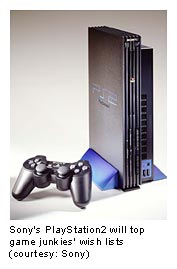
more popular than movies
Toy shopping is a a pleasure which I was denied for a few years.
But now that Black Friday is upon us, commenting on toys, well, it
seems like the right thing to do before I retake Rome and play
Warhammer 40K.
You can find dangerous toys at www.toysafety.net. But that's mostly for the toddler set.
However, with older kids, those over eight, too many parents let
vital decisions about appropriate entertainment be made by these same
kids. The same kids who can't decide whether to eat ham and cheese or
pb&j can bring in highly violent games to their homes because
parents buy blind or on their recommendation with no research.
There is a very simple thing you can do to find out if a video game is age and content appropriate:
Rent them.
Blockbuster has video games to rents as well as consoles to play
them on. So if you have a question about the appropriateness of a game,
play it yourself. Ratings, are, at best, a weak guide to what game is
acceptable. But you can play the game before you buy it. Don't take
someone's word for it, or a review. Now some games, like GTA: San
Andreas may be hard to get, but rentals are a great way to prevent
purchases of subjects you don't want in your home.
It also will shut the kids up. Because you know the games.
First, games are more complex morally and technically than anything
we played in our youth. Yet, many parents leave technical decisions in
the hands of kids. Not just with games, but in all aspects of
technology. Computers, mp3 players, kids buy them and parents
cluelessly permit this.
Too many parents remain shockingly uninvolved in their child's
tecbnological decisions. You only get busybodies trying to make their
decisions on what you can see when you don't do the work to control
your own home.
Some things are clearly not for kids, and it is your moral
responsibility to control what comes into your home, not Lou Shelton,
not the government and not Toys 'R Us. You.
Second, some games are just too complex for kids to play. Sure,
eight year olds want Tony Hawk 2, but can your kid use the controls?
Third, once you open a game and play it, most stores will NOT take
it back. They will exchange title for title, but you buy it, you own
it. So if you think GTA:AS is vile, well, you better hop on ebay to
sell it. That's why this is foreknowledge is so critical. You need to
know what comes in your home before it does, because it's not a coat, a
return is usually not possible.
It's simple, rent the games your kids want, send them away for the
weekend or go to a friend's house on a weekend, play the games for an
hour or so and then make your decisions. If you need to, rent the
console as well.
Why? Because I'm tired of ignorant parents running to everyone
screetching about how bad these games are. Play the fucking things
before you buy them and you won't have anyone to blame. Squeeze that
hour or so to make sure your kid is exposed to the values you want in
your home.
And gaming systems are different.
Nintendo Game Cube appeals best to the 5-12 set. You don't have to
worry about too many M rated games for Game Cube. My nephew had a PS 2,
and was saving to buy a Game Cube for a year. He was pretty close with
$60, too. Nintendo is geared towards kids with Pokemon, Dragonabll Z
and Beyblade games, as well as sports. The Pokemon games are exclusive
to their systems.
XBox, with it's concentration on sports and Halo 2 is mostly for
teenagers. Games come later to Xbox for some titles, like GTA.
Microsoft has a pretty cautious approach to some titles.
PS2, which I bought for Jen, is geared more for adults. The M
titles come out first for PS2 or PC. Now, there are many PS games for
kids, and if you have different ages at home, this is clearly the best
system.
Another thing, don't let your kid buy a game you haven't approved.
If you can't play it, get reviews of it. I know little kids have more
money than we could imagine. My nine year old nephew regularly gets
money for Christmas, enough to buy an additional game the day after
Christmas. But that is a piss poor excuse for letting something in your
home you do not want. You're the adult, you are responisble for what
your kids see, read and do. Don't blame the store for selling M rated
games. Blame youself for not being aware that's in your house.
Now, personally, I think most kids don't like realistic violence.
They like the fighting of Dragonball Z and Pokemon, they don't want to
play Manhunt or Shellshock Nam '67. Younger teens tend to like sports
games. My nephew likes racing games especially. There are literally
thousands of games around. Before people judge them, they need to play
them and understand what how they work.
Why so much commentary on console games? Because they are a major
part of our entertainment dollar and we spend far more time playing
them than watching movies or TV.
They have an up side and a down side. The positive side is that
they are goal focused, even educational entertainment which fosters
cooperation (in online play) and problem solving. The down side is that
kids stay in the house focused on a game and not being the game.
But what is completely unacceptable is the way parents let kids decide what values are in their home, only objecting afterwards.
[Eyebeam reBlog]
12:16:24 AM
|
|
© Copyright 2005 Joerg Rheinboldt.
|
|
 |
 |
 |
 |
| November 2004 |
| Sun |
Mon |
Tue |
Wed |
Thu |
Fri |
Sat |
| |
1 |
2 |
3 |
4 |
5 |
6 |
| 7 |
8 |
9 |
10 |
11 |
12 |
13 |
| 14 |
15 |
16 |
17 |
18 |
19 |
20 |
| 21 |
22 |
23 |
24 |
25 |
26 |
27 |
| 28 |
29 |
30 |
|
|
|
|
| Oct Dec |
|
 |
 |
 |
 |
|


