Updated: 20.07.2005; 9:31:09 Uhr.
Update
think about this...
        

Donnerstag, 6. Januar 2005

tis the season: II. So here's something cool that I'm happy to be able to announce. Five years ago, I published Code. It's time for an update. But rather than update in the old fashioned way, Basic Books has agreed to the following: Beginning in February, we'll be posting Version 1 of Code to a Wiki. "Chapter Captains" will then supervise updates and corrections. Depending upon the progress, sometime near June, I will take the product and edit and rewrite it to produce Code, v2. The Wiki will stay live forever (under a Creative Commons license). The edited book will be published in the fall. I have donated my advance for Code, v2 to Creative Commons. All royalties beyond the advance will be donated as well. At this point, we're collecting "Chapter Captain" (CCs, of course) volunteers. CCs should be expert in the subject of the chapter, and willing to work through the Wiki to produce an updated chapter. (Here's the table of contents.) My aim is not to write a new book; my aim is to correct and update the existing book. But I'm eager for advice and expert direction. If you're interested in volunteering, email me at this address. I am grateful to Basic Books to allow me to try this experiment. I worked very hard five years ago to learn enough to write Code. I'm extremely eager for the book to gain from the collective wisdom of at least part of the Net. No one can know whether this will work. But if if does, it could be very interesting. [Lessig Blog]
5:29:04 PM    comment []

Adopt a robot.

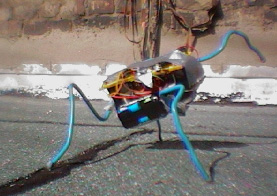
By adopting one of derstrudel 's robots, you accompany the creation of the robot and the projects it will be involved in.
Once their experiments are completed, the artists will send you the robot and it will be your own.

The services include a web site with information about your personal robot, and a robotergarten where you can watch your robot play with the other robots and chat with the other stepparents.

The price for an adoption is 50,- euro.

bugbot.jpg

Sebastian Noth and Christian Faubel from derstrudel will head one of Transmediale's workshops, on Februaray 4. They will teach people (including me!!! hopefully) how to create a robot out of electronic parts, wires and a soldering iron.

[we make money not art]
4:51:43 PM    comment []

Content and Containers.

One of my favourite articles of 2004 was a transcript of a speech by Tom Curley, CEO of the Associated Press. In it he said that "...content will be more important than its container in this next phase [of the Web]". Why? Because "killer apps, such as search, RSS and video-capture software such as Tivo -- to name just a few -- have begun to unlock content from any vessel we try to put it in."

Curley's speech was timely for me, because a couple of weeks earlier I'd launched a series of posts on a theory I called Design for Data - which was inspired by a Jason Kottke post and before that a Tim Berners-Lee article. Another inspiration was Joshua Porter's article for Digital Web Magazine entitled How Content Aggregators Change Navigation and Control of Content. All those things, plus my own ideas fermenting in my head! :-)

I wrote about Tom Curley's speech in a November 23 post on Read/Write Web entitled Branding Microcontent. I said then that "RSS flow is creating a need for the data itself to be 'designed', not into HTML containers but into chunks of branded microcontent that will probably be XML."

And that's where I left the theory, until recently when Joshua Porter and I began an email exchange to nut it out some more. At the same time I noticed, via a PressThink post entitled Top Ten Ideas of '04: "Content Will be More Important than its Container", that the journalist blog fraternity is still talking about Curley's speech and its implications.

PressThink is an influential media blog by NYU professor of Journalism, Jay Rosen. He summed up Curley's speech by saying that "we who make news content have to re-locate where we brand it, and think about adding our voice at every step."

Rosen and a number of other media bloggers are looking at Curley's speech from the point of view of news organizations - traditional Content Producers (in 20th century speak). I'm probably taking a more broader view - where a Content Producer is any person who publishes content on the Web (e.g. bloggers, corporate web publishers). I'm also applying Curley's insights to the Web 2.0 world of web services such as Flickr and Amazon. However despite our different points of view, we're all converging on the same thing - I believe.

Firstly, I liked this observation from Rosen:

"With RSS, readers get my post, the headline, the subhead-- but not the blog environment of PressThink. Therefore the content has to be good enough on its own, without the house. It has to "say" PressThink: no logo, as it were."

I find the "house"/place metaphor to be a fascinating one on the Web. I explored it (in a different context to this) in my Digital Web Magazine article The Evolution of Corporate Web Sites from April 2004. Corporate websites in the 90's were usually designed as 'places', but nowadays they're more likely to be a group of services. For a media website, this may mean a news subscription service where the news travels out to users - rather than users traveling to the website 'container' to view it.

Another media person to articulate this well is Tim Porter, in a recent Morph post:

"...the future of news media is the content, whether it be strong, in-depth journalism, witless pap or cogent analysis and conversation. The container, the vehicle that moves that content from producer to consumer (and remember, that distinction now is more and more a semantic one), is completely fungible."

The next piece of insight from Rosen's PressThink was this:

"Publishers and media owners hate spending money on people because deep down they don't believe their business runs on people. (They're wrong, by the way.) They believe they own the news franchise, and the franchise--or brand--is what's valuable."

I think he's making a few points here and one of them is that the value in content is increasingly the personality of the writer - the voice. And so the voice then becomes the design/brand. Of course that's what blogs are good at - and what traditional corporate websites are not so good at (think of all that horrid corporate-speak and bland design from a recent as a few years ago). At a deeper level, Rosen is saying that content is a truer representation of people - and their influence on business - than the franchise 'containers'.

Lastly, the following quote from Rosen is a nice way to tie-in with the techie crowd (which I belong to):

"'Content will be more important than its container' is thus a disruptive idea in journalism. In a way it is similar to that cross-platform battle-cry in the software biz: write once, run anywhere. (Originated by Sun Microsystems as a slogan for Java.)"

'Write once, run anywhere' is nowadays a basic underlying principle of Web 2.0 (i.e. the Web as Platform). Given that the Internet is the driver of most (if not all) of Tom Curley's insights in his November '04 speech, it's fitting that news media organizations are adopting the same philosophy as Web designers and developers.

[Read/Write Web]
4:50:05 PM    comment []

Waves of Hope Photostream.

tsunami2.jpgIn the wake of the tsunami disaster, an interesting online project has launched. Waves of Hope is a non profit free media news site run by volunteer reporters, writers and citizens from all over Sri Lanka. The cooperative has a stunning photostream at Flickr, as well, with shots of Sri Lanka from coast to coast in the immediate aftermath and in the days when rebuilding slowly begins.

[Wanda Lust]
4:37:55 PM    comment []

New Communications Forum 2005.
We are proud to announce that Creative Weblogging Ltd. will be a featured sponsor of the upcoming New Communications Forum 2005: Blog University [^] www.newcommforum.com.

We will be at the NewComm Forum to be held in the Silverado Resort in Napa, Calif. on January 26-27, 2005 .

Workshops and sessions will include:
  • Corporate Blogging: Getting Started
  • How to Pitch Bloggers
  • Forming Communities Online: Group and Conference Blogging and Wikis
  • Using Blogs to Enhance Employee Communications
  • The Blog's New Role in Crisis Communications
  • Blog Publicity & Measuring Success/Tracking
Learn:
  • The basics of blogging, including how to get started, tools, policies and guidelines
  • Benefits and potential pitfalls of corporate blogging
  • How to use blogs in a variety of arenas, including conferences and employee communications, as well as the role of blogs in a crisis
  • Strategies and tactics for increasing your blog[base ']s visibility and tools for measuring success
  • Methods for successfully pitching blogs
Visit www.newcommforum.com for more information, and to register. Be sure to use the special code NCF150CB when registering to save US$ 150.

Hope to see you there!

Your Creative Weblogging Team

[The Mobile Technology Weblog]
4:35:11 PM    comment []


Subscribe and this technology will ruin your life.

Subscribers to "This Mobile Will Change Your Life" will receive SMS orders they must carry out immediately.

mobilethree.gif

Orders vary from "kiss the nearest tall stranger" to "Walk into a police station, tell them you[base ']re finally giving yourself up, then remain totally silent" or "It[base ']s 2am: everybody meet in your nearest cemetery dressed as zombies, then march on the town centre".

If subscribers obey the 10 instructions a month, their life is guaranteed to change.

"Most people[base ']s lives are already dominated by their mobile phone. We[base ']re taking this one step further by making them literally slaves to their mobile," said Ben Carey, who, along with Henrik Delehag, imagined the "service".

"Most mobile applications restrict themselves to helping the user in some way. This is the first attempt to explore the darker side of mobile user psychology", explain the authors.

Via textually.

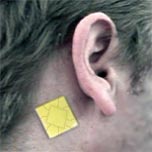
ear.jpg

This technology turned evil reminds me of Christophe Bruno 's WiFi-SM, a wireless patch to stick on your body to feel the global pain. It detects the information from approximately 4,500 news sources worldwide, looks for specific keywords such as death, kill, murder, torture, rape, war, virus etc. Each time it finds one of them, WiFi-SM device sends you an electric impulse.

[we make money not art]
11:32:25 AM    comment []

© Copyright 2005 Joerg Rheinboldt.
 
January 2005
Sun Mon Tue Wed Thu Fri Sat
            1
2 3 4 5 6 7 8
9 10 11 12 13 14 15
16 17 18 19 20 21 22
23 24 25 26 27 28 29
30 31          
Dec   Feb


Click here to visit the Radio UserLand website.

Subscribe to "Update" in Radio UserLand.

Click to see the XML version of this web page.

Click here to send an email to the editor of this weblog.