| June 2009 | ||||||
| Sun | Mon | Tue | Wed | Thu | Fri | Sat |
| 1 | 2 | 3 | 4 | 5 | 6 | |
| 7 | 8 | 9 | 10 | 11 | 12 | 13 |
| 14 | 15 | 16 | 17 | 18 | 19 | 20 |
| 21 | 22 | 23 | 24 | 25 | 26 | 27 |
| 28 | 29 | 30 | ||||
| May Jul | ||||||
 Tuesday, 9 June 2009
David Brooks reports on some surprisingly large impacts from a randomised trial of New York [base ']ÄúHarlem Children[base ']Äôs Zone[base ']Äù schools. The effects are so big that I find it hard to imagine they[base ']Äôre readily replicable, but it[base ']Äôs tantalizing stuff.
The fight against poverty produces great programs but disappointing results. You go visit an inner-city school, job-training program or community youth center and you meet incredible people doing wonderful things. Then you look at the results from the serious evaluations and you find that these inspiring places are only producing incremental gains.
That[base ']Äôs why I was startled when I received an e-mail message from Roland Fryer, a meticulous Harvard economist. It included this sentence: [base ']ÄúThe attached study has changed my life as a scientist.[base ']Äù
Fryer and his colleague Will Dobbie have just finished a rigorous assessment of the charter schools operated by the Harlem Children[base ']Äôs Zone. They compared students in these schools to students in New York City as a whole and to comparable students who entered the lottery to get into the Harlem Children[base ']Äôs Zone schools, but weren[base ']Äôt selected.
They found that the Harlem Children[base ']Äôs Zone schools produced [base ']Äúenormous[base ']Äù gains. The typical student entered the charter middle school, Promise Academy, in sixth grade and scored in the 39th percentile among New York City students in math. By the eighth grade, the typical student in the school was in the 74th percentile. The typical student entered the school scoring in the 39th percentile in English Language Arts (verbal ability). By eighth grade, the typical student was in the 53rd percentile.
Forgive some academic jargon, but the most common education reform ideas [base ']Äî reducing class size, raising teacher pay, enrolling kids in Head Start [base ']Äî produce gains of about 0.1 or 0.2 or 0.3 standard deviations. If you study policy, those are the sorts of improvements you live with every day. Promise Academy produced gains of 1.3 and 1.4 standard deviations. That[base ']Äôs off the charts. In math, Promise Academy eliminated the achievement gap between its black students and the city average for white students.
Let me repeat that. It eliminated the black-white achievement gap. [base ']ÄúThe results changed my life as a researcher because I am no longer interested in marginal changes,[base ']Äù Fryer wrote in a subsequent e-mail. What Geoffrey Canada, Harlem Children[base ']Äôs Zone[base ']Äôs founder and president, has done is [base ']Äúthe equivalent of curing cancer for these kids. [base ']Ķ
These results are powerful evidence in a long-running debate. Some experts, mostly surrounding the education establishment, argue that schools alone can[base ']Äôt produce big changes. The problems are in society, and you have to work on broader issues like economic inequality. Reformers, on the other hand, have argued that school-based approaches can produce big results. The Harlem Children[base ']Äôs Zone results suggest the reformers are right. The Promise Academy does provide health and psychological services, but it helps kids who aren[base ']Äôt even involved in the other programs the organization offers.
[base ']Ķ Basically, the no excuses schools pay meticulous attention to behavior and attitudes. They teach students how to look at the person who is talking, how to shake hands. These schools are academically rigorous and college-focused. Promise Academy students who are performing below grade level spent twice as much time in school as other students in New York City. Students who are performing at grade level spend 50 percent more time in school.
For more wonkish readers, the abstract of the paper is over the fold.
[Andrew Leigh]Are High-Quality Schools Enough to Close the Achievement Gap? Evidence from a Bold Social Experiment in Harlem
Will Dobbie and Roland G. Fryer, Jr.
Harlem Children[base ']Äôs Zone¬Æ (HCZ) is arguably the most ambitious social experiment to alleviate poverty of our time. We provide the first empirical test of the causal impact of HCZ on educational outcomes, with an eye toward informing the long-standing debate whether schools alone can eliminate the achievement gap or whether the issues that poor children bring to school are too much for educators to overcome. We implement two identification strategies. First, we exploit the fact that HCZ charter schools are required to select students by lottery when the demand for slots exceeds supply. Second, we use the interaction between a student[base ']Äôs home address and cohort year as an instrumental variable. Both approaches lead us to the same story: Harlem Children[base ']Äôs Zone is enormously effective at increasing the achievement of the poorest minority children. Taken at face value, the effects in middle school are enough to reverse the black-white achievement gap in mathematics and reduce it in English Language Arts. The effects in elementary school close the racial achievement gap in both subjects. Harlem Gems and The Baby College¬Æ, the only two community programs in HCZ that keep detailed administrative data, show mixed success. We conclude by presenting three pieces of evidence that high-quality schools or high-quality schools coupled with community investments generate the achievement gains. Community investments alone cannot explain the results.
2:42:02 AM

The Black-White Test Score Gap Downunder.
(xposted @ Core)
Discussing NT schools, the CIS[base ']Äôs Helen Hughes writes:
This week all Australian children in school years 3, 5, 7 and 9 sat numeracy and literacy tests for the second time. The tests are to give Australians an annual snapshot of basic educational progress. The first national [base ']ÄòNAPLAN[base ']Äô tests, held in May 2008, showed that 90% of children passed. Western Australia has made the tests available for government schools on the Internet, and Education Minister Julia Gillard has promised that all the 2009 test results will be posted by school.
An overview of the 2008 tests showed that there was no [base ']Äògap[base ']Äô between Indigenous and non-Indigenous students. Indigenous students in mainstream schools in Victoria, Tasmania and the ACT had the same results as non-Indigenous students.
I find this claim difficult to reconcile with the facts. Looking at the NAPLAN report (15mb), here[base ']Äôs year 7 numeracy:

To put this into more concrete terms, the average score by year 7 Indigenous students is about the level of year 5 non-Indigenous students. (This is true even if you restrict the comparison to metropolitan schools.)
It is certainly true that the black/white test score gap in the NT is bigger than in other states, and Hughes is right to discuss why it might be.* But let[base ']Äôs not pretend away a 2-year performance gap in other states at the same time.
* It[base ']Äôs possible that schools are the cause, but also notable that the NT black/white test score gap is very large in the grade 3 tests too [base ']Äì suggesting that there may also be differences before children arrive at school. Looking at grades 3, 5, 7 and 9, it doesn[base ']Äôt appear to me as though the racial test score gap widens faster in the NT than in other states, which is what a [base ']Äòlower school quality[base ']Äô argument would predict.
Update, 19/5 - Helen and Mark Hughes respond:
[Andrew Leigh]Thank you very much for your perceptive comment on Indigenous performance in the NAPLAN results. Yours is the first meaningful comment based on analysis of the data that we have received in two years work on remote Indigenous education.
Our concern has been with the egregious difference between Indigenous performance in remote schools that have sub-standard curriculums, facilities and administration, compared with mainstream schools.
We concur that according to NAPLAN Indigenous metropolitan students on average do not score as well as the non-Indigenous cohort, and that Indigenous students lag non-Indigenous by varying amounts [base ']Äì up to two years in the states/territories without remote / very remote schools.
Differences in average scores between Indigenous and non-Indigenous are not the same as differences in failure rates, although we acknowledge that Indigenous failure rates are also somewhat higher in metro areas. ¬[sgl dagger]We concentrated on failure rates as they tend to highlight the percentage of students not getting an education, while the average score tells more about the average quality of education most students receive.
Comparison of Indigenous scores in metro areas with scores for non-Indigenous from matched socio-economic groups would be necessary to give an indication if any difference can be attributed to [base ']Äòindigenousness[base ']Äô. For example, in Year 7 Numeracy in¬[sgl dagger]Victoria, there were 682 Indigenous students and over 60,000 non-Indigenous students [base ']Äì a meaningful comparison would be with like socio-economic non-Indigenous students within the latter cohort.
We thus do not think that your comments detract from our basic thesis that non-performing separate schools rather than [base ']Äòindigenousness[base ']Äô account for the principal failure of Indigenous education.
2:40:43 AM
Increasing Diversity.

The diversity of the universe has been increasing since the beginning of time. In its very first seconds the universe contained only quarks, which began to assemble into a variety of sub-atomic particles within minutes. By the end of the first hour, the universe contained dozens of types of particles but only two elements, hydrogen and helium. Over the next 300 million years drifting hydrogen and helium atoms found each other and their micro-gravities bound them together into masses of growing nebula that eventually collapsed into fiery stars. Star fusion built up the hydrogen and helium with additional particles until they emerged as dozens of new heavier elements, and so the diversity of the chemical universe increased. Eventually some "metallic" stars exploded into supernova spewing their heavy elements into space, to be swept up again over millions of years into new stars. In a kind of pumping action, these second and third round star-furnaces added yet more neutrons to metallic elements to create more varieties of heavy metals until all 100 or so varieties of stable elements were created. The increasing diversity of elements and particles also created an increasing variety of star species, galaxies types, and varieties of orbiting planets. On planets with active tectonic crusts new kinds of minerals increased in time, as geologic forces reworked and rearranged the elements into new crystals and rocks. The diversity of crystallized minerals on Earth, for instance, increased even further with advent of life.
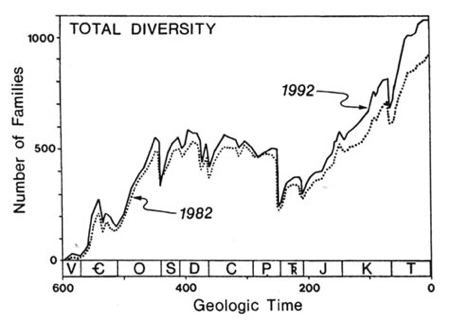
Two different studies (1982 and 1992) reveal increasing diversity in evolution of life on Earth
The invention of life greatly accelerated the diversity in the universe many fold. From a very few species 3.8 billion years ago, the number and variety of living species on Earth has increased dramatically over geological time to the 30 to 100 million now present. This rise has been uneven in several ways. At certain times in Earth's history large-scale cosmological disruptions (such as asteroid hits) have wiped out gains in diversity. And in specific branches of life diversity sometimes did not advance very much, or even retreated. But overall, in life as a whole over geologic time, diversity has widened. In fact life's diversity has doubled since the dinosaurian era, only 200 million years ago. The growth of biological differences, as a whole, is expanding exponentially, as this rocketing increase can be seen in vertebrates, plants and insects.
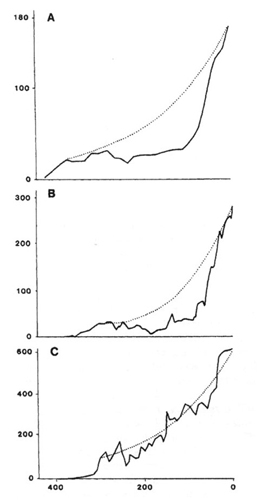
Exponential increase in diversity in (A) terrestrial plants (B) vertebrates, and (C) insects.
The trend toward diversity is further accelerated by the technium. The number of species of technology invented every year is increasing at an increasing rate. It's difficult to precisely count the varieties of technological invention since innovations don't have the defined borders of breeding that most living organisms do. We might count ideas, which underlie each invention. Each scientific article represents at least one new idea. The number of journal articles has exploded in the last 50 years. Each patent is also a species of idea. At last count there were 7 million patents issued in the US alone, and their total has been increasing exponentially as well. Considering that humans have named and identified only 1.6 million living species, as far as we know, the "made" now outnumber the "born" four to one.
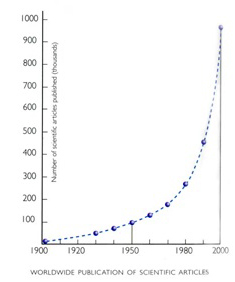
Exponential increase of scientific articles
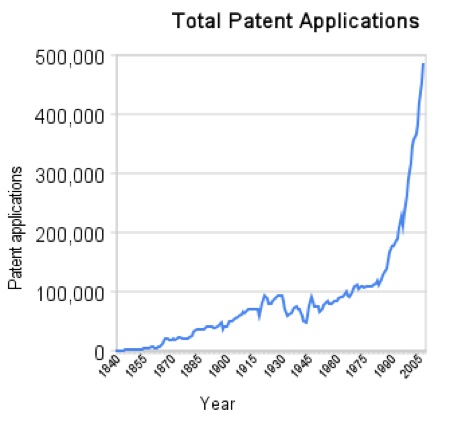
Exponential growth in US patents
We see increased diversity everywhere in the technium. Manufactured species of underwater organisms such as 70-foot submarine parallel living organisms like a blue whale. Airplanes ape birds, so to speak. Our houses are but better nests. But the technium explores niches that the born never ventured into. We know of no organisms using radio waves, yet the technium has produced hundreds of varieties of radio communicating species. While moles have been digging up earth for millions of years, two-story tunnel digging contraptions are so much larger, faster, and less daunted by solid rock than anything born that we can truly say they occupy a new niche on Earth. X-ray machines have a type of sight unknown among the living. And there is simply no biological analog to an Etch-a-Sketch, a digital watch, or a Space Shuttle, to name a few examples. Increasingly the diversity of the technium has no counterpart in biological evolution, and so the technium has truly increased diversity.
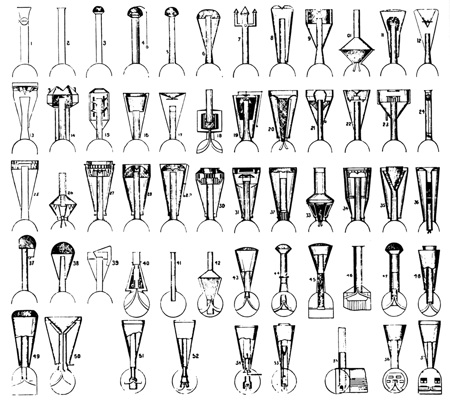
Diversity of spark catchers for train locomotive smokestacks, from The Evolution of Technology
The diversity of the technium has already surpassed our skills of recognition. There are so many varieties of things that one individual can't name them. Cognitive researchers have discovered there are about 3,000 easily recognizable noun categories in modern life. This total includes manufactured objects and living organisms such as: elephant, airplane, palm, telephone, chair - things that are readily discernable in a flash without thinking. Researchers came up with the estimate of 3,000 based on the number of nouns listed in dictionaries, how many objects are found in the vocabulary of an average 6-year-old child, and the number of objects that a primitive expert system (20q) can recognize. They estimated there are, on average, ten named varieties for each noun category. Ten kinds of chairs, ten kinds of fish, ten kinds of phones, ten kinds of beds that ordinary people might be describe. That gives a rough estimate of 30,000 objects in most peoples lives, or at least 30,000 that they would recognize. Even when we name a form, most of the variety of life and the technium goes by us without a specific name. We may recognize a bird, but not which species of bird. We know a grass, but not which grass. We know it is a cell phone, but not what model. When pressed we can discern a chef's knife from a Swiss Army knife from a spear point, but we may or may not be able to discern a fuel pump from a water pump.
Of course there are many more than 30,000 varieties of manufactured things in the technium, but it is fair to ask whether some of their variety is important. In biological terms the 30,000 varieties of common nouns represents a type of meta diversity called disparity. Disparity indicates a difference in basic design forms, or a basic body plan, or form type, such as "elephant" or "palm" or "chair." The actual variety of chair, or elephant can vary in details, and this local variation is what we call diversity. Disparity increases much more slowly than diversity, and is a more significant kind of variation. One is always more impressed with a brand new kind of invention (it's a light bulb!) rather than a variation of known invention (another spark catcher!). In biological evolution disparity can decrease (fewer new ways to make an animal) while diversity increases (more new kinds of already-invented elephants and horses).
There are branches of the technium where the diversity of technological species is dwindling; today there are fewer innovations in spark catchers, buggy whips, hand looms, and ox carts. I doubt anyone has invented a new manual butter churner in the last 50 years. (Although many people are still inventing "better" mousetraps.) Handlooms will always be around for art. Ox carts are not extinct and will probably never go extinct globally as long as oxen are born. But because oxcarts encounter no new demands, like all artifacts hovering near obsolescence, they are remarkably stable inventions, continuing over time unchanged, like horseshoe crabs. But technological backwaters like these are overwhelmed by the mind-numbing avalanche of innovation, ideas, and artifacts throughout the rest of the expanding technium.
One hardware wholesaler, McMaster-Carr, lists "over 480,000 products" in its catalog. There you can find 2,432 varieties of wood screws alone. Amazon carries 85,000 different cell phones and cell phone products. So far humans have created 500,000 different movies and about one million TV episodes. At least 10 million different songs have been recorded. The largest database of bar codes lists 2.7 million different products for sale in Europe and the US, which EAN, the issuing agency, says is "only a small fraction" of the product codes that have been issued. Multiplying that small fraction up gives a grand total of about 100 million different products in circulation.
All these quantities are rising as diversity of the technium increases over time. The number of new technological "species" in many branches of the technium - food products, media creations, consumer gadgets, tools, and material types -- seem to be growing by 10% annually. That means that in 50 years, when the next generation is in middle age, there will be 12 billion different produced products for sale, including 10 million different types of cell phone-like thingies, and 1.1 billion (!) different songs to listen to. There will still be a top 40 hit song list, but the existence of 1 billion alternative songs will bend our culture.
The problem with this cornucopia of diversity and abundance is not the problem of how we can individually absorb it; even if you listened to a song only once, (or watched a movie, tried a tool) in a non-stop marathon during your waking hours for your entire life, you could not make a dent in the totality. The real problem with ultra-diversity is in not being able to grasp the whole of it, not being able to search through it, to track your navigation in this space of billions, and to (re)find the best when you summon it.
A billion songs by 2060 (how many a century later?), 12 billion products for sale in 50 years (how many in two centuries?) seem outrageously large, perhaps unlikely. Surely, compound growth doesn't keep going. It is true that growth of all species, both made and born, follow an "s" curve as they slowly rise in numbers, then increase rapidly, and eventually taper off in a plateau, to be replaced by another species. So cell phones are unlikely to ever reach 10 million varieties simply because long before 50 years hence they will be replaced by a different device. And perhaps the format of songs, too, might peak in popularity to be replaced by some unit of music unknown to us now, just as the 90-minute movie was unknown a century ago. Nonetheless, the total diversity of these new replacements plus the peak diversity of the old yields absolutely increasing numbers of new things in the technium.
Some researchers question the economic assumptions of technological ultra diversity. How many different phone designs can a market support, even a global market? Or shoes? (Zappos carries 90,000 different shoes today. In 50 years, at current rates of diversity growth, there should be 10 million choices in shoes. Talk about a long tail!) Who would design, finance and market this diversity? One answer: prosumers drive ultra diversity. The buyers are the makers of diversity. Right now major book publishers are fighting to remain economically viable. A big-time New York book publisher may produce 200 titles per year. But Lulu, a prosumer company that enables authors to publish their own paper books is releasing 5,000 titles per week. A slew of other companies are pioneering the expansion of diversity by enabling mass customization, in which items can be personalized and customized by manufacturing means (instead of customized by hand). A small industry of long-tail mass-customization exists at the margins of the economy. Blurb makes photo books; Café Press, hats and mugs; Threadless, t-shirts; Infectious, decals; CD Baby, music CDs. Within the next 50 years personal fabricators in local shops will begin to permit individuals to create personally diversity tangible artifacts, manufactured in units of one. The world of 1 billion species of tools, 100 billion unique varieties of products is plausible.

A few iconoclasts believe this ultra-diversity is toxic to humans. In the "The Paradox of Choice", sociologist Barry Schwartz argues that the 285 varieties of cookies, 171 kinds of salad dressing and 85 brands of crackers for sale in the typical supermarket today is paralyzing consumers. They enter the store looking for crackers, see a bewildering wall of cracker choices, become overwhelmed with trying to make an informed decision and finally walk out not purchasing any crackers at all. "Whether people are choosing jam in a grocery store or essay topics in a college class, the more options people have, the less likely they are to make a choice," says Schwartz. Similarly, in trying to choose a plan of medical benefits plan with hundreds of options, many consumers give up because of the complexity of choice is paralyzing and instead resign from the program, whereas programs that included a default choice of options (no decision necessary) had much higher enrollments. Schwartz concludes: "As the number of choices grows further, the negatives escalate until we become overloaded. At this point, choice no longer liberates, but debilitates. It might even be said to tyrannize."
It is true that too many choices may induce regret, but "no choice" is a far worst option. Civilization itself is a steady move away from "no choice." As ever, the solution to the problems that technology brings, such overwhelming diversity and choices is better technologies. The solution to ultra-diversity will be choice-assist technologies. These better tools will augment humans in making choices among bewildering options. Diversity, in fact, will produce tools to handle diversity. (Diversity-taming tools will be among the wildly diverse-making 821 million patents that current rates predict will be filed by 2060.). We are already discovering how to use computers to augment our choices with information and webpages (it's called Google), but it will take additional learning and technologies to do this with tangible tools, and idiosyncratic media. At the dawn of the web some very smart computer scientists declared that it would be impossible to select from a billion web pages using key word search, but we routinely do just that on 100 billion web pages today. No one is asking for fewer web pages.
Difference powers the world. It is the absolute difference in temperature between cold space and hot stars that powers not only life on earth, but syntropy anywhere. No delta, no life, no stars, no galaxy, no nothing. Maintaining a difference is what living systems and minds do. When a difference can be maintained over time, it can begin to multiply and increase differences elsewhere. If it a diverse ecosystem is in good health it will, over time, increase its own diversity. Evolution increases differences. Culture is about accentuating differences. The technium runs on differences.
That may sound strange to many, because the stereotypical image of increasing technology is one of standard products, world-wide sameness, and unwavering uniformity. Yet, paradoxically, diversity can be unleashed by uniformity. The uniformity of a standard writing system (like an alphabet or script) unleashes the unexpected diversity of literature. Without uniform rules, every word has to be made-up, so communication is localized and inefficient. But with a uniform language sufficient communication transpires in large circles so that a novel word, phrase or idea can be appreciated, caught, and disseminated. The rigidity of an alphabet has done more to enable creativity than any brain-storming exercise ever invented.
The standard 26 letters in English have produced 28 million different books in English. Words and language will keep evolving of course, but their evolution rides on basic fundamentals that are conserved and shared; unvarying (over the short term) letters, spelling, grammar rules enable creativity in ideas. Increasingly the technium will converge upon a few universal standards - perhaps English, and western musical notation, mathematical symbols, but also widely adopted technical protocols, from the metric system to ASCII and Unicode. The modern infrastructure of the world today is built upon a shared system woven from these kinds of standards. That is why you can order machine parts in China to be used in factories in South Africa, or have research done in India for drugs released in Brazil. This convergence of fundamental protocols is also why the youth of today can speak to each other directly in a way not possible even a decade ago. They use cell phones and netbooks running common operating systems, but they also employ standard abbreviations and increasingly share common cultural touchstones by watching the same movies, listening to the same music, studying the same subjects in school, and pocketing the same technology. In a curious way the homogenization of shared universals allows it to transmit the diversity of cultures.
In a world of converging global standards, a recurring fear among minority cultures is that their niche differences will be lost. They need not be. In fact, the increasingly common carrier of global communication can heighten the value of their differences. The distinctive foods, medicinal knowledge, and child rearing practices, say of the Yanomamo tribe in the Amazon, or the San Bushman in Africa, were only esoteric, local knowledge before. Their diversity commanded a difference that did not make a difference outside the tribe because their knowledge was not connected to the rest of cultures. But once connected to standard roads, electricity, communications, their differences can potentially make a difference to others. Even if their knowledge could only be applied in their local environment, wider knowledge of their knowledge made a difference. Where do wealthy people travel to? Places that retain differences. What eateries attract customers? The ones with distinctive differences. What products sell in a global market? The ones that think different. If such local diversity can remain distinctively different while it is connected (and this is a very big IF) then that difference becomes steadily more valuable in a global matrix. Maintaining that balance of connected-but-different is a challenge of course, because much of this cultural difference and diversity originated via isolation, and in the new mix it no longer will be isolated. Cultural differences that thrive without isolation (even if they were born out of it) will compound in value as the world becomes standardized. Of this stance I am reminded of Bali, Indonesia. The rich, distinguished Balinese culture seems to deepen even as it becomes interconnected to the modern world. Like other inhabitants of old and new, the Balinese may wield English as their universal second language while speaking their own tongue at home. They make their ritualistic offerings from flowers in the morning and study science at school in the afternoon. They do gamelan and google.
In this way the technium can both become more homogenized and more diverse at the same time. Take languages, mentioned earlier, as an example. In 100 years it is very likely there will be at least one common language spoken by at least half the people on the planet. But the same people will also retain their regional tongue as well, perhaps even more widely than is spoken today, since some fading languages such as Gaelic have revived. Yet we are currently loosing dozens of tribal languages every year, reducing diversity. On the other hand, millions of earthlings have learned newly created computer languages. These are entirely new types of languages. I would argue that the global diversity of languages has decrease but its global disparity has increased.
Costume is another. The most widely dispersed manufactured technology in the world today is not a steel blade nor a cell phone (although these are extremely prolific) but manufactured cotton cloth. In the most remote regions of the world, in the swamps of Papua New Guinea, or the desert plateau of Tibet, you'll find very few imported iron knives or metal pots, but you'll find people wearing generic machine-made t-shirts or pants. This is one technology that has penetrated every tribe on Earth. A lot of this is cast-off clothing from developed countries, but a lot is new clothing made in nearby capital cities. Machined cotton fabric is so cheap to make per piece, so easy to transport, and so much superior to labor intensive rough home-spun, that traditional clothing is often reserved for occasional celebrations in both poor and wealthy places. However, the very same qualities that make manufactured cloth so ubiquitous also makes it easy to modify or customize. Bolts of machine cloth are printed in local patterns, dyed in local colors, cut in local designs, and sewn into distinctive style. In the cities of the planet new kinds and types of machine-made clothing is increasing the disparity of cloth. Fancy fashion shops, sports catalogs and outdoor stores sell inventive new kinds of fabric and wholly new concepts in clothes. The degree of diversity that is lost by traditional hand-weaving is gained by new styles, even though particular designs may disappear - though they rarely do. On the whole, the variety of traditional clothing may have decreased in local regions but overall the disparity of clothing design has increased around the globe.
We can go down the list: cuisine, ceremonies, art, and music. In every case there may be a loss of diversity in some local regions over time (as there has always been) but a gain of globally disparity. Local losses hurt, but we are increasingly a global species. We seek maximum diversity because it is the source of innovation, evolution, and ultimately progress. And it is also the product of all those, too.
Diversity is the currency of progress. The things that we desire - freedom of choice, options and difference - are types of diversity, and in a loop of upcreation, more diversity produces more of the things that we desire.
Beginning from the white dawn of creation, diversity in the universe has been increasing. Its rate of increase has been ramped up by life, and is now being further accelerated by the technium. What technology wants is greater diversity.
2:33:04 AM
National Quality Council agrees on priorities. The National Quality Council has identified five Action Groups to work on achieving 5 priorities for 2009. They are: Vet Products for the 21st Century, Quality of Assessment Action Group, Skills for Sustainability Action Group, International VET Action Group, and National Consistency Action Group. [Vocational Education & Training Headlines]
2:08:19 AM
New international documents available on VOCED. A collection of vocational education and training (VET) related research and policy documents from various regions of the world are now available online on VOCED, including many of the older print-based copies. VOCED is the international research database with over 35,000 documents available. [Vocational Education & Training Headlines]
2:04:05 AM
This Page was last update: 11/7/09; 9:41:31 PM
Copyright 2009 Bill Coppinger
Theme Design by Bryan Bell


