| |
 |
Thursday, September 14, 2006 |
Jeff Cohen | Washington Post Hires Top Bush Speechwriter. "Few media marching bands have beat the Iraq war drums more frantically and with more influence than the editorial pages of the Washington Post. On Monday, the Post announced the hiring of another drummer boy, one who played a key propaganda role inside the Bush White House," writes Jeff Cohen - referring to Michael Gerson, Bush's top speechwriter. [t r u t h o u t] [t r u t h o u t]
7:21:36 PM 
|
|
Bob Geiger: "War on Terror" Numbers To Silence Republican Candidates. When George W. Bush made a prime-time television appearance Monday night to give a political speech -- under the guise of commemorating the five-year anniversary of September 11 -- he started right off by telling both a lie and the truth in one short sentence.
"Today, we are safer, but we are not yet safe," said Bush, which means he was batting .500 with the truth in just one short statement. Not bad for him. It is undeniably true that we are not yet safe, but to imply that we are safer than we were before Bush turned the world against us is demonstrably false.
And Senator Dick Durbin (D-IL) sketched out the only numbers needed to confirm that Bush's "war on terror" is not only going very badly, but has gotten much, much worse on his watch.
"Osama bin Laden is still on the loose. Al-Qaeda's membership, estimated at 20,000 on 9/11, is now estimated by our intelligence agencies at 50,000. Instead of shrinking and disappearing, they are growing geometrically," said Durbin on the Senate floor Tuesday, in describing how unsafe Republicans have made America.
Now there's a number we want to talk a lot about between now and the midterm elections, as Republicans beat their chests and say how safe they've kept Americans.
And Durbin's numbers check out. According to the 9/11 Commission Report, "U.S. intelligence estimates put the total number of fighters who underwent instruction at bin Laden-supported camps in Afghanistan from 1996 through 9/11 at 10,000 to 20,000."
And recent research by the nonprofit, nonpartisan Memorial Institute for the Prevention of Terrorism, funded by the Department of Homeland Security and other government grants, says that the number of Al-Qaeda has jumped from the 20,000 reported by the 9/11 Commission a few years ago to 50,000 today.
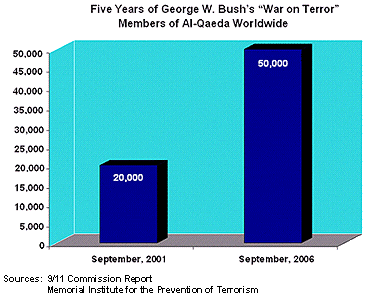
This is an astonishing and disturbing number given that these are the people our own government said attacked us on September 11 -- and there's a hell of a lot more of them now.
Durbin also responded to charges by Rick Santorum (R-PA) that floor-statements made by Senate Minority Leader Harry Reid (D-NV) about Iraq were damaging and purely political in nature, by citing a report released Monday from the U.S. Government Accountability Office (GAO) entitled "Stabilizing Iraq: An Assessment of the Security Situation."
"The GAO published a graph yesterday. The number of attacks rose from around 100 in May of 2003 to roughly 4,500 in July of 2006," said Durbin. "Is it political or partisan to note the obvious, the GAO report to which Senator Reid made reference? That is not political partisanship; that is a reality, and we should face that reality because Iraq does continue to slip into civil war despite the billions that we have spent and the thousands of American lives which have been lost in that battle."
And here is the chart from the GAO report:
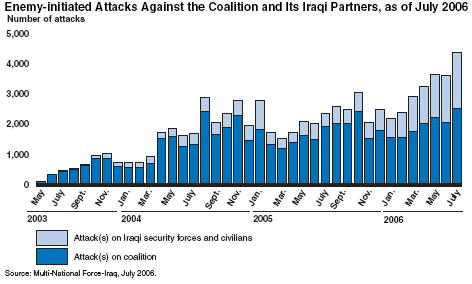
"Since June 2003, the overall security conditions in Iraq have deteriorated and grown more complex, as evidenced by increasing numbers of attacks and Sunni/Shi'a sectarian strife," said the GAO report.
The report continues:
"Enemy-initiated attacks against the coalition and its Iraqi partners have continued to increase through July 2006. Since 2003, enemy-initiated attacks have increased around major religious or political events, including Ramadan and elections...
"Overall, attacks increased by 23 percent from 2004 to 2005. After declining in the fall of 2005, the number of attacks rose to the highest level ever in July 2006. Total attacks reported from January 2006 through July 2006 were about 57 percent higher than the total reported during the same period in 2005. These data show significant increases in attacks against coalition forces, who remain the primary targets, as well as civilians and Iraqi security forces." The GAO ended the report with some damning questions for the Republican-controlled Congress -- questions that will undoubtedly be met with deafening silence until the scheduled October 6 adjournment, including:
- "What are the key political, economic, and security conditions that must be achieved before U.S. forces can draw down and ultimately withdraw from Iraq? What target dates, if any, has the administration established for drawing down U.S. forces?"
- "Why have security conditions continued to deteriorate in Iraq even as the country has met political milestones, increased the number of trained and equipped security forces, and increasingly assumed the lead for security?"
- "If existing U.S. political, economic, and security measures are not reducing violence in Iraq, what additional measures, if any, will the administration propose for stemming the violence?"
I guess, using Republican parlance, the General Accountability Office must hate America too.
Durbin, the second-ranking Democrat in the Senate, wrapped up by pointing out that, after a brief period of focus and success in Afghanistan following the start of that war in October 2001, things have been going downhill ever since and the Taliban is once again making a major bid to control the country.
"There is another reality," said Durbin. "The Taliban is gaining ground again in Afghanistan. They have set up shop in Pakistan where that Government has agreed to have a safe haven for some of these terrorist forces. That is unfortunate, and it is disastrous when you think of our long-term war on terrorism."
Bush seems to disagree with that assessment, saying on March 16, 2006, "We have joined with the Afghan people to bring down the Taliban regime -- the protectors of the Al-Qaeda network -- and aided a new, democratic government to rise in its place."
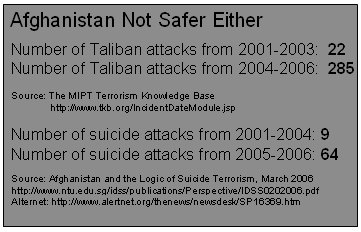
I suppose there may be a way to squeeze some truth out of that statement, but the Administration will never acknowledge that, on their contrived, tough-on-terror watch, things have quietly been going to hell in a hand basket in Afghanistan, with Taliban attacks and suicide bombings way up in the last two years.
And, even if we accept the White House's ongoing claim that Iraq, and not Afghanistan, is "the central front in the war on terror," the daily Iraqi death toll, our own dead and wounded and the recent revelation that U.S. forces may have lost control of Anbar province to the insurgents, tells just how badly Bush is doing there as well. Not to mention that as far back as mid-2005, even Bush's fellow Republicans were convinced that the Administration's rosy outlook was a load of BS.
"Things aren't getting better; they're getting worse," said Nebraska's Republican Senator, Chuck Hagel, a Vietnam Veteran, in June 2005. "The White House is completely disconnected from reality... The reality is that we are losing in Iraq."
Throw all of that together with threats from Iran and North Korea -- that the White House seems to have no ability or willingness to engage -- and an overextended, worn-out military, and you get quite a bowl of weak mush served up by the guys continuing to brag about how safe they'll keep us.
So, to recap, every Congressional candidate needs to say this over and over again in the next eight weeks:
- A 150 percent increase in the number of Al-Qaeda members in the world while we're focused on a civil war in Iraq
- Attacks on U.S. troops, Iraqi forces and civilians are skyrocketing, despite assurances from the White House that things are going just fine in Iraq
- Our neglected troops in Afghanistan are facing a 1,200 percent increase in Taliban attacks and a 600 percent jump in suicide bombings.
And then repeat again and again and again until November 7.
Oh, and one more thing: Where the hell is Osama bin Laden?
You can read more from Bob at BobGeiger.com.

 [The Huffington Post | Full Blog Feed] [The Huffington Post | Full Blog Feed]
7:19:43 PM
|
|
Larry C. Johnson: Armitage Into the Trick Box. Joe and Val Wilson filed an amended complaint today that adds Richard Armitage to their law suit. The media spin is that Armitage is the guilty party and everyone else in the Bush Administration are off the hook. How so many media mavens can exhibit such profound stupidity on a collective level escapes me? They must have reading disabilities. The complaint filed by the Wilson's repeats the facts laid out originally by Patrick Fitzgerald when he indicted Scooter Libby for perjury and obstruction of justice.
The silly spin that because Fitzgerald did not indict under the Intelligence Identities Protection Act (IIPA) ignores the behavior of Libby. Libby's lies and obstruction prevented Fitzgerald from being able to determine whether or not he had an IIPA case.
The wishful thinking of the Washington Press Corps that this case go away is ignorant and self-serving. The facts of the case and, most importantly, the timeline demonstrate that Armitage, while a player in the drama, is not a lone actor nor a bumbling fool. A conspiracy rooted in the office of the Vice President was unleashed against American citizens who dared to point out the naked ignorance and prevarication of the President.
This much we know. The White House, specifically Vice President Cheney and Scooter Libby, were investigating Joe Wilson and his wife in late May 2003. The White House had Valerie's name before Richard Armitage got it. Armitage was not the only one talking to reporters about Valerie Plame. Here are the facts from the complaint:
Events Leading up to July 2003
a. On or about January 28, 2003, President George W. Bush delivered his State of the Union address which included sixteen words asserting that"[t]he British government has learned that Saddam Hussein recently sought significant quantities of uranium from Africa."
b. On May 6, 2003, the New York Times published a column by Nicholas Kristof which disputed the accuracy of the "sixteen words" in the State of the Union address. The column reported that, following a request from the Vice President's office for an investigation of allegations that Iraq sought to buy uranium from Niger, an unnamed former ambassador [now known to be Plaintiff Joseph C. Wilson IV] was sent on a trip to Niger in 2002 to investigate the allegations. According to the column, the ambassador reported back to the CIA and State Department in early 2002 that the allegations were unequivocally wrong and based on forged documents.
c. On or about May 29, 2003, in the White House, Libby asked an Under Secretary of State ("Under Secretary") for information concerning the unnamed ambassador's travel to Niger to investigate claims about Iraqi efforts to acquire uranium yellowcake. The Under Secretary thereafter directed the State Department's Bureau of Intelligence and Research to prepare a report concerning the ambassador and his trip. The Under Secretary provided Libby with interim oral reports in late May and early June 2003, and advised Libby that Wilson was the former ambassador who took the trip.
d. On or about June 9, 2003, a number of classified documents from the CIA were faxed to the Office of the Vice President to the personal attention of Libby and another person in the Office of the Vice President. The faxed documents, which were marked as classified, discussed, among other things, Wilson and his trip to Niger, but did not mention Wilson by name. After receiving these documents, Libby and one or more other persons in the Office of the Vice President handwrote the names "Wilson" and "Joe Wilson" on the documents.
e. On or about June 11 or 12, 2003, the Under Secretary of State orally advised Libby that, in sum and substance, Wilson's wife worked at the CIA and that State Department personnel were saying that Wilson's wife was involved in the planning of his trip.
f. On or about June 11, 2003, Libby spoke with a senior officer of the CIA to ask about the origin and circumstances of Wilson's trip and was advised by the CIA officer that Wilson's wife worked at the CIA and was believed [erroneously] to be responsible for sending Wilson on the trip.
g. Prior to June 12, 2003, Washington Post reporter Walter Pincus contacted the Office of the Vice President in connection with a story he was writing about Wilson's trip. Libby participated in discussions in the Office of the Vice President concerning how to respond to Pincus.
h. On or about June 12, 2003, Libby was advised by the Vice President of the United States that Wilson's wife worked at the Central Intelligence Agency in the Counterproliferation Division. Libby understood that the Vice President had learned this information from the CIA.
i. On June 12, 2003, the Washington Post published an article by reporter Walter Pincus about Wilson's trip to Niger, which described Wilson as a retired ambassador but not by name, and reported that the CIA had sent him to Niger after an aide to the Vice President raised questions about purported Iraqi efforts to acquire uranium. Pincus' article questioned the accuracy of the "sixteen words," and stated that the retired ambassador had reported to the CIA that the uranium purchase story was false.
j. On or about June 14, 2003, Libby met with a CIA briefer. During their conversation, Libby expressed displeasure that CIA officials were making comments to reporters critical of the Vice President's office, and discussed with the briefer, among other things, "Joe Wilson" and his wife "Valerie Wilson," in the context of Wilson's trip to Niger.
k. On or about June 19, 2003, an article highly critical of Vice President Cheney appeared in The New Republic magazine online entitled "The First Casualty: The Selling of the Iraq War." Among other things, the article questioned the "sixteen words" and stated that following a request for information from the Vice President, the CIA had asked an unnamed ambassador to travel to Niger to investigate allegations that Iraq had sought uranium from Niger. The article included a quotation attributed to the unnamed ambassador alleging that the administration officials "knew the Niger story was a flat-out lie." The article also was critical of how the administration, including the Office of the Vice President, portrayed intelligence concerning Iraqi capabilities with regard to weapons of mass destruction, and accused the administration of suppressing dissent from the intelligence agencies on this topic.
l. Shortly after publication of The New Republic article, Libby spoke by telephone with his then-Principal Deputy and discussed the article. The Principal Deputy asked Libby whether information about Wilson's trip could be shared with the press to rebut the allegations that the Vice President had sent Wilson. Libby responded that there would be complications at the CIA in disclosing that information publicly, and that he could not discuss the matter on a non-secure line.
m. On or about June 23, 2003, Libby met with New York Times reporter Judith Miller. During this meeting, Libby was critical of the CIA, and disparaged what he termed "selective leaking" by the CIA concerning intelligence matters. In discussing the CIA's handling of Wilson's trip to Niger, Libby informed Miller that Wilson's wife might work at a bureau of the CIA.
The July 6 "Op-Ed" by Mr. Wilson
n. On July 6, 2003, the New York Times published an Op-Ed article by Wilson entitled "What I Didn't Find in Africa." On that same day, the Washington Post published an article about Wilson's 2002 trip to Niger, which article was based in part upon an interview of Wilson. Wilson appeared as a guest on the July 6 television interview show "Meet the Press." In his Op-Ed article and interviews in print and on television, Wilson asserted, among other things, that he had taken a trip to Niger at the request of the CIA in February 2002 to investigate allegations that Iraq had sought or obtained uranium yellowcake from Niger, and that he doubted Iraq had obtained uranium from Niger recently, for a number of reasons. Wilson stated that he believed, based on his understanding of government procedures, that the Office of the Vice President had been advised of the results of his trip.
o. In a May 12, 2006 court filing in United States v. Libby, the government proffered a copy of the July 6 Op-Ed annotated shortly after its publication in the handwriting of the Vice President of the United States. The government believes those notes of the Vice President "support the proposition that publication of the Wilson Op-Ed acutely focused the attention of the Vice President and [Libby] - his chief of staff - on Mr. Wilson, on the assertions made in his article, and on responding to those assertions."
Libby's Actions Following Wilson's July 6 "Op-Ed" Column
p. On or about July 7, 2003, Libby had lunch with the then-White House Press Secretary and advised the Press Secretary that Wilson's wife worked at the CIA and noted that such information was not widely known.
q. On or before July 8, 2003, Vice President Cheney advised Libby that the President of the United States specifically had authorized Libby to disclose to New York Times reporter Judith Miller certain information from an October 2002 National Intelligence Estimate concerning Iraq and weapons of mass destruction in order to rebut Mr. Wilson. Just three days later, on July 11, 2003, Director of Central Intelligence George Tenet conceded that claims about Iraqi attempts to buy uranium from Africa in the January 2003 State of the Union address were a mistake and that the "16 words should never have been included in the text written for the President," an acknowledgment that the substance of Mr. Wilson's criticism was legitimate and correct.
r. Rather than admit the validity of Wilson's criticisms, on or about the morning of July 8, 2003, Libby met with Judith Miller. When the conversation turned to the subject of Joseph Wilson, Libby asked that the information Libby provided on the topic of Wilson be attributed to a "former Hill staffer" rather than to a "senior administration official," as had been the understanding with respect to other information that Libby provided to Miller during this meeting. Libby thereafter discussed with Miller Wilson's trip and criticized the CIA reporting concerning Wilson's trip. During this discussion, Libby advised Miller of his belief that Wilson's wife worked at the CIA.
s. Also on or about July 8, 2003, Libby met with the Counsel to the Vice President in an anteroom outside the Vice President's Office. During their brief conversation, Libby asked the Counsel to the Vice President, in sum and substance, what paperwork there would be at the CIA if an employee's spouse undertook an overseas trip.
t. Not earlier than June 2003, but on or before July 8, 2003, the Assistant to the Vice President for Public Affairs learned from another government official that Wilson's wife worked at the CIA and advised Libby of this information.
u. On or about July 10 or July 11, 2003, Libby spoke to a senior official in the White House [believed to be Karl Rove or one or more of John Does No. 1- 10] who advised Libby of a conversation [Rove or the Does] had earlier that week with columnist Robert Novak in which Wilson's wife was discussed as a CIA employee involved in Wilson's trip. Libby was advised by [Rove or the Does] that Novak would be writing a story about Wilson's wife.
v. On or about July 12, 2003, Libby flew with the Vice President and others to and from Norfolk, Virginia, on Air Force Two. On his return trip, Libby discussed with other officials aboard the plane what Libby should say in response to certain pending media inquiries, including questions from Time reporter Matthew Cooper.
w. On or about July 12, 2003, in the afternoon, Libby spoke by telephone to Cooper, who asked whether Libby had heard that Wilson's wife was involved in sending Wilson on the trip to Niger. Libby confirmed to Cooper, without elaboration or qualification, that he had heard this information too.
x. On or about July 12, 2003, in the later afternoon, Libby spoke by telephone with Judith Miller of the New York Times and discussed Wilson's wife, and that she worked at the CIA.
--No Quarter

 [The Huffington Post | Full Blog Feed] [The Huffington Post | Full Blog Feed]
8:30:46 AM
|
|
Marty Kaplan: How to Hack a Diebold (Ivy League Edition). Watch this video.
Princeton computer scientists have figured out how to hack into a Diebold AccuVote [sic] TouchScreen voting machine. The subversion of democracy takes a coupla minutes, a screwdriver or paperclip, plus a floppy with the malware they've written.
This is no comedy video; it's a bone-chilling, blood-pressure-raising, citizen-outraging rebuttal to all the calming unctuous bromides you've heard about the safety of our voting technology. The authors of this paper may be geeks, but they don't wear tinfoil hats. The P doesn't stand for Paranoia; it stands for Princeton.
I'd upload the Princeton video so you could watch it right here, but the Creative Commons non-commercial license it's copyrighted under precludes wrapping it in an ad. As long as you attribute it and don't profit from it, you can post the video on any site you'd like. If the hotlink to the video doesn't work for you, here's the URL: http://itpolicy.princeton.edu/voting/videos.html
The complete paper can be found here: http://itpolicy.princeton.edu/voting/
Had enough?

 [The Huffington Post | Full Blog Feed] [The Huffington Post | Full Blog Feed]
8:27:28 AM
|
|
© Copyright 2006 Patricia Thurston.

|
|
|
|
|


