|

|
Thursday, March 13, 2003
|
|
| |
US to Invade The Netherlands (David Weinberger)
According to Human Rights Watch, in order to protect US soldiers from being brought to justice for any war crimes they may commit, Bush has signed a new law that
... authorizes the use of military force to liberate any American or citizen of a U.S.-allied country being held by the [International Criminal] court, which is located in The Hague.
Since the Hague (or "den Haag" as those beastly Dutch refer to it) is in the Netherlands, this has stirred up some consternation. Dutch blogger and future enemy soldier, Niek Hockx, has blogged about this amusingly.
In protest of Holland's outrageous aiding and abetting of The Hague, I pledge that from now on, when my girlfriend and I each pay our own way, I will refer to it as "going freedom." Also, I'll refer to the tree blight as "Freedom Elm Disease." Take that, Wooden Shoe Legal Pot boy! (Joho the blog)
I thought this was a joke actually. But follow the link! We - no, strike that - our glorious leader really did sign into law the American Servicemembers Protection Act of 2002. We are living in surreal times.
8:34:11 PM 
|
|
The Dubya War Glossary (Geov Parrish)
The Dubya War Glossary (Geov Parrish)
democracy n. The ideal form of a political system - now used interchangeably with the economic system called "capitalism" - in which a handful of wealthy people with occasional minor policy differences take turns enriching their patrons and being elected by a citizenry that is allowed no other choices. E.g.: "We intend to turn Iraq into a democracy, just like the United States."
preemptive attack n. Replaces blitzkrieg. Unprovoked invasion of a country that poses no threat, esp. if that country is defenseless and has extensive reserves of oil.
Saddam Hussein n. The nation of Iraq, pop. 24,002,000 (2002 est.); area 172,476 sq. mi. (slightly larger than California), centered on the Tigris and Euphrates Rivers in Southwest Asia, previously known as Persia and Mesopotamia; one of the oldest continuously civilized regions in the world. "Iraq" and "Saddam Hussein" are generally used interchangeably, e.g.: "We're going to bomb the hell out of Saddam Hussein." (alternet)
8:05:21 PM
|
|
Occult Chemistry
Occult Chemistry
Direct observation of atoms through clairvoyance. This occurred in 1895. (metafilter)
"Close examination of the work of the Occult Chemists sheds light on one corner of the intellectual scene a century ago. In some ways the story is amusing, but amid the hoopla of the millennium, it can also provide science students at all levels an important lesson on the nature of scientific proof and the place of authority in science. It might help their teachers consider what lessons are most important to convey through a science curriculum."
I'm sorry, I had to include this. When I first set out on the path to true wisdom, I was attracted to theosophy, basically to any form of theology that had cool charts and diagrams of the mechanics of how the universe and god really got the job done, metaphysically speaking. There's lots of cool diagrams here of what atoms look like to the naked (clairvoyant) eye.
7:56:01 PM
|
|
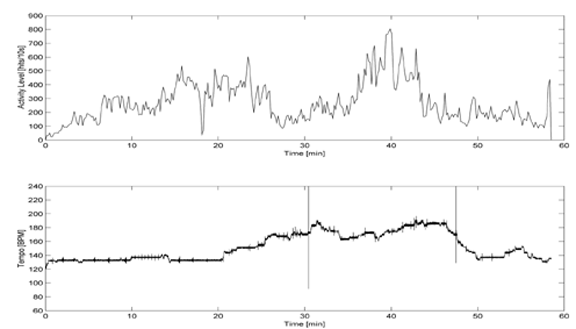
COOLNESS QUOTIENT APPROACHING INFINITY: Smart Mob Sensors for Ravers!
"Recent Master's degree recipient and sometime-DJ Mark Feldmeier's cool new Media Lab project uses inexpensive, wireless motion sensors to give dancers collaborative control of a music environment in real time." (Smart Mobs Weblog)
From the project website: "We have run this system at several MIT dance events. The received data is seen to strongly reflects the activity and state of the participants. For example, this figure shows FFT results for people dancing to nonrhythmic and rhythmic music; although there is no peak in the former, it shows up clearly in the latter, indicating that the dancers are synchronizing to a definite tempo that corresponds to the BPM (beats-per-minute) of the music being played. If one observes the activity and tempo plots across an hour of dance (with about 20 participants), structure is clearly seen as dancers go through cycles of increased/decreased activity and push the tempo higher when the generated tempo is set to be above the measured tempo."
The website contains, photos, diagrams, quicktime movies of the action, and links to relevant papers and reports.
7:32:42 PM
|
|
How Hydrogen can Save America (Peter Schwartz and Doug Randall)
How Hydrogen can Save America (Peter Schwartz and Doug Randall)
The cost of oil dependence has never been so clear. What had long been largely an environmental issue has suddenly become a deadly serious strategic concern. Oil is an indulgence we can no longer afford, not just because it will run out or turn the planet into a sauna, but because it inexorably leads to global conflict. Enough. What we need is a massive, Apollo-scale effort to unlock the potential of hydrogen, a virtually unlimited source of power. The technology is at a tipping point. Terrorism provides political urgency. Consumers are ready for an alternative. From Detroit to Dallas, even the oil establishment is primed for change. We put a man on the moon in a decade; we can achieve energy independence just as fast. Here's how. (WIRED MAGAZINE)
Both authors are afilliated with the Global Business Network, an organization engaged since 1987 in a "collaborative exploration of the future, discovering the frontiers of knowledge and creating innovative tools for strategic action."
Wired Magazine: Happy Anniversary!
While we're on the subject of Wired, their 10th anniversary issue is out, and looks to be a good read. It has of course, the inevitable timeline article, and so is great way to see where we came from, and (by inference) see where we might be headed. Of course we will inevitably be wrong, but it sure has been one hell of ride, eh sports fans?
7:13:42 PM
|
|
New Federal Budget Proposal (Ben Dover)
New Federal Budget Proposal (Ben Dover)
The budget that House Budget Committee Chairman Jim Nussle unveiled and the Committee approved on March 12 contains deep and widespread cuts in basic domestic programs such as Medicare, Medicaid, veterans programs, student loans, school lunches, child care, food stamps, cash assistance for the elderly and disabled poor, and many other programs. The budget would require Congressional committees to cut "mandatory" programs by $470 billion over the next ten years.
* * *
While requiring deep cuts in domestic programs, the budget makes room for most of the President's large tax-cut package, including $1.4 trillion in tax cuts through 2013. The tax cuts in the President's "growth" package alone, all of which are included in the Nussle budget, would cost $725 billion over ten years and would, according to the Tax Policy Center, result in tax reductions averaging $90,000 each in 2003 for those Americans who have incomes of more than $1 million.
* * *
"Class warfare turns out to be alive," [Center on Budget and Policy Priorities] Center director Robert Greenstein commented. "It is a centerpiece of the Nussle budget, with deep budget cuts that could harshly affect the poor, the vulnerable, and many middle-class Americans, alongside lavish tax cuts for the nation's richest individuals. With this budget, we would be marching down the path toward a new Gilded Age."
"The Nussle budget serves one very useful purpose." Greenstein added. "It shows that these large tax cuts aren't free, and that at bottom, the issue is one of national priorities. This ought to trigger a national debate. Are tax cuts averaging $90,000 a year for millionaires so high a priority that we should cut health care programs, increase the ranks of the uninsured, reduce the cost or limit the availability of student loans, and increase hardship among the disabled, poor children, and others to free up room for massive tax cuts?"
There is more information on the here on the Center on Budget and Policy Priorities website.
6:43:22 PM
|
|
ART ALERT: The Future We Were Promised
ART ALERT: The Future We Were Promised
This is an online exhibition of the work of A. C. Rudebaugh, a commercial illustrator working in the 50's. The drawings evoke the big-finned future so that was part of the cultural mindscape back then: underwater cities, cars (and buidings!) with enormous fins, all very Ayn Rand. Cool stuff, worth a gander. (via memepool)
6:29:21 PM
|
|
Social Mapping Software (Steven Berlin Johnson)
Whuffie Watch: Social Mapping Software (Steven Berlin Johnson)
In his classic novel Cat's Cradle, Kurt Vonnegut explains how the world is divided into two types of social organizations: the karass and the granfalloon. A karass is a spontaneously forming group, joined by unpredictable links, that actually gets stuff done- as Vonnegut describes it, "a team that do[es] God's Will without ever discovering what they are doing." A granfalloon, on the other hand, is a "false karass," a bureaucratic structure that looks like a team but is "meaningless in terms of the ways God gets things done."
* * *
For most of the past 50 years, computers have been on the side of the granfalloons, good at maintaining bureaucratic structures and blind to more nuanced social interactions. But a new kind of software called social-network mapping promises to change all that. Instead of polishing up the org chart, the new social maps are designed to locate karasses wherever they emerge. Mapping social networks turns out to be one of those computational problems- like factoring pi out to a hundred decimal points or rendering complex light patterns on a 3-D shape- that computers can do effortlessly if you give them the right data. (SOURCE: "Who Loves Ya Baby?", Discover)
And if'n you don't know about whuffie, pardner, git on over to Ole Cory Doctorow's website and read his novel Down and Out in the Magic Kingdom, also available at your bookstore or library. It's a rootin tootin good read and just might leave an idea or two in yer brainpan. Or read this little article, which lays out the concept pretty succinctly. It's a concept with legs, as they might say on Broadway. Memetically speaking it's a winner. Look here, it's even got it's own weblog!
5:48:53 PM
|
|
Lilek's Vintage Ads
Lilek's Vintage Ads
Lileks has started a gallery of vintage ads printed off the microfilm morgue at his newspaper and scanned in. Lovely stuff. ( boing boing)
5:02:42 PM
|
|
How a War Became a Crusade (Jackson Lears)
How a War Became a Crusade (Jackson Lears)
President Bush's war plans are risky, but Mr. Bush is no gambler. In fact he denies the very existence of chance. "Events aren't moved by blind change and chance" he has said, but by "the hand of a just and faithful God." From the outset he has been convinced that his presidency is part of a divine plan, even telling a friend while he was governor of Texas, "I believe God wants me to run for president."
This conviction that he is doing God's will has surfaced more openly since 9/11. In his State of the Union addresses and other public forums, he has presented himself as the leader of a global war against evil. As for a war in Iraq, "we do not claim to know all the ways of Providence, yet we can trust in them." God is at work in world affairs, he says, calling for the United States to lead a liberating crusade in the Middle East, and "this call of history has come to the right country."
Mr. Bush's speeches are not the only place one finds this providentialist spirit - everyone from Christian fundamentalists to interventionist liberals is serving up missionary formulas: bogus analogies to the war against Hitler; contrasts between American virtue and European vice; denials that sordid material interests could have anything to do with the exalted project of exporting American democracy.
To those who worry about the frequent use of religious language, Mr. Bush's supporters insist that the rhetoric of Providence is as American as cherry pie. This is true, but it is crucial to understand that Providence can acquire various meanings depending on the circumstances. The belief that one is carrying out divine purpose can serve legitimate needs and sustain opposition to injustice, but it can also promote dangerous simplifications - especially if the believer has virtually unlimited power, as Mr. Bush does. The slide into self-righteousness is a constant threat.
The great rhetoricians of Providence have resisted the temptation of self-righteousness. When the Rev. Dr. Martin Luther King Jr. wrote from a Birmingham jail that "we will win our freedom because the sacred heritage of our nation and the eternal will of God are embodied in our echoing demands," he was seeking common ground with white Southerners, not predicting perdition for satanic segregationists.
Likewise, when Abraham Lincoln invoked Providence in his second inaugural address, his message to the victorious North and the defeated South was one of reconciliation. By characterizing the Civil War as a national expiation for the sin of slavery, he wanted "to bind up the nation's wounds" and make some moral sense of the appalling losses on both sides. At its best, providentialist thinking can offer a powerful antidote to self-righteousness.
Too often, though, American politicians and moralists have reduced faith in Providence to a religious sanction for raw power. In the 1840's, with the emergence of the idea that the United States had a manifest destiny to expand to the Pacific, the hand of God was no longer mysterious (as in traditional Christian doctrine) but "manifest" in American expansion. As for the natives who unproductively occupied the Great Plains, Horace Greeley, the journalist, said in 1859: "`These people must die out - there is no help for them. God has given this earth to those who will subdue and cultivate it, and it is vain to struggle against his righteous decree."
By the end of the century, Senator Albert Beveridge and other imperialists had made Manifest Destiny a global project, insisting that God had "marked" the American people to lead in "the redemption of the world."
In the wake of World War I, Woodrow Wilson showed that it was possible to use redemptive rhetoric for aims that went beyond nationalism, and yet to still fall victim to hubris. By intervening in the war and ensuring a just peace, said Wilson, "America had the infinite privilege of fulfilling her destiny and saving the world."
The failure of Wilson's postwar dream helped make most Americans skeptical of world-saving fantasies during World War II. Thus our most necessary war was also the most resistant to providentialist interpretation. It was a dirty job, and somebody had to do it: that was the dominant view, among policymakers and the public. Only in retrospect has World War II acquired an aura of sanctity.
To be sure, the cold war fitfully revived the nationalist uses of Providence, at least among true believers like Secretary of State John Foster Dulles - not to mention Ronald Reagan, whose rhetoric arrayed the "city on a hill" against the Soviet "evil empire." But for most Americans, the failed crusade in Vietnam eviscerated the delusion that we had a sacred duty to export American ways - by force if necessary - to a recalcitrant world.
Until now. The proposed war against and rebuilding of Iraq has brought the sentimental, self-satisfied sense of Providence back into fashion. One might have supposed that an attack on our country would have rendered utopian agendas unnecessary - as it did for most Americans during World War II. But while a war on terrorism may not need Providence to justify it, a war to transform the Middle East requires a rhetoric as grandiose as its aims. The providentialist outlook fills the bill: it promotes tunnel vision, discourages debate and reduces diplomacy to arm-twisting.
Worst of all, it sanitizes the messy actualities of war and its aftermath. Like the strategists' faith in smart bombs, faith in Providence frees one from having to consider the role of chance in armed conflict, the least predictable of human affairs. Between divine will and American know-how, we have everything under control. So the White House and its backers can safely predict that the unpleasantness will be over in a few weeks, with low casualties on both sides.
Combat veterans, from Gen. Norman Schwarzkopf down, reject these scenarios. We can be sure that the soldiers in the Persian Gulf region do, too. This should come as no surprise: there has always been a chasm between the war planners and the soldiers on the ground. The planners are convinced that they can control outcomes; the soldiers know the arbitrary cruelties of fate at first hand - maiming this one, leaving that one alone. They know the power of luck.
There may be no atheists in foxholes, but there are not many believers in Providence in them either. Combat soldiers have always been less confident than politicians that God is on the premises. They have paid homage to an older deity, Fortuna. From the Civil War through the Persian Gulf war, American soldiers have festooned themselves with amulets and lucky charms - everything from St. Christopher medals and smooth stones to their girlfriends' locks of hair. And why not? Ritual efforts to conjure luck speak directly to their own experience.
But the power of providentialist thinking persists, drawing strength from the fervent beliefs of Christian, Islamic and Jewish fundamentalists. The more humane interpreters of those traditions are increasingly ignored, and the ideologues take command, convinced that they are doing God's will.
Certainly those of us who doubt the divinity (not to mention the efficacy) of the president's plan must continue to challenge it. But as we watch Mr. Bush prepare for righteous battle, ignoring the protests of "old Europe" and many in his own country, even the most rational among us might be pardoned for fingering a rabbit's foot from time to time. (SOURCE: New York Times)
4:42:45 PM
|
|
|

|
© Copyright
2003
Jay Machado.
Last update:
5/7/2003; 11:30:45 PM.
This theme is based on the SoundWaves
(blue) Manila theme. |
|
Food for Thought: My news aggregator subscription list
|